Author Archive

a random encounter chart that reminds you of the 5e hex crawl, wandering monsters, weather, navigation, and surprise rules

Thursday, February 12th, 2015

Running a by-the-book 5e hex crawl takes practice. There are a lot of fiddly rules on different pages: you have to skip back and forth between the sections on weather, wandering monsters, getting lost, and random hex contents.

I’ve been running hex crawls lately and I’ve boiled down the relevant rules (for me) into a single random encounter chart. Based on the current location/terrain type, the DM fills specific encounters into the chart, Mad Libs-style. The chart does the heavy lifting for determining weather events, chances to get lost, monsters both in their lair and out, surprise, and landscape features.

This chart also reminds me to run a good mix of encounter types: some monsters are friendly! sometimes you run into an inexplicable mystery of the ancient world! Many “encounters” don’t lead to combat! (Of the 12 slots on this table, you only need about 5 potential combats.) With a relatively small and varied number of possible encounters, you can design a bunch that you really want to run, instead of lots of “2d6 goblins” filler. The DM, at least, should be excited to roll on the random encounter table. Here’s my encounter chart template as a PDF.

Checking for encounters: Roll d6 four times a day: morning travel, afternoon travel, first night watch, second night watch. Any roll of 6 means that you roll on the encounter chart. (Or use the official 5e rule: roll 20, encounter on 18-20. Pretty much the same odds, but I like the traditional d6.)

Rolling on the encounter chart: Roll d12 on this chart while traveling, or d6 while stationary (for instance, while resting). The chart is organized so that stationary encounters can’t sneak up on you while you’re not moving.

1: Plot advancing creature: This means different things in different campaigns. If you’re running a campaign about the rise of Tiamat, you might populate this slot with dragons or Tiamat cultists. In my open-ended game where the characters are pursuing their own goals, I fill this slot with people or groups related to characters, like the drow assassin that’s chasing the noble. If you’re running a totally plotless hex crawl, fill this slot with a high-level monster (it potentially advances the story by killing the party!)

2: Intelligent creature: Any locale-appropriate group or creature with tool-using intelligence or higher. At night, if the characters hide their camp and don’t light a fire, treat this roll as no encounter (unless your intelligent monsters has darkvision or a sharp sense of smell). That’s the advantage the PCs get for not lighting a fire.

3: Unintelligent creature: Beasts or unintelligent monsters. Most beasts shy away from fire. If the characters are resting and have a campfire lit, treat this roll as no encounter (unless they’re fearless or fire-based beasts). That’s the advantage the PCs get for lighting a fire.

4: Ambush creature: Use stealthy creatures or creatures with special movement modes (flying, burrowing, climbing, swimming, incorporeal). All of these creatures can typically take the party by surprise, so check for surprise against the party’s Perception (rules for perception while traveling: PHB 182). If the PCs are currently using a special movement mode, populate this slot entirely with matching creatures (flying PCs may ignore almost all other encounters, but a 4 is always another flying creature.)

5: Beneficial creature: There are actually a few good monsters in D&D, along with friendly adventurers, kobold bands looking for a new king, and suspicious traders with valuable information to sell. You could roll d4 on this chart to find out what kind of beneficial encounter this is.

6: Weather: If you make the standard 4 random encounter checks per day, you have about an 8% to 12% daily chance to hit bad weather. (The DMG weather chart gives a 15% daily chance of heavy precipitation. Of course, this is probably lower in practice because few DMs roll on the weather chart every day.) Feel free to use any place- and season-appropriate weather that challenges or inconveniences the characters in some way, or use the official weather rules in the DMG p. 109. Possible weather inconveniences: while exposed to the weather, you can’t benefit from a long rest; low visibility forces a Survival check to avoid becoming lost; fords and valleys are flooded.

7. Lair: Locale-appropriate bad guys (or beasts) live here. Usually lairs are where creatures keep their treasure. This could also be a dungeon entrance. No matter the level of the PCs, I make 1 in 6 lairs contain monsters with more than 10 HD/level/CR. Alert PCs shouldn’t run into a cave without scouting first.

8. Survival Check or Hazard: The rules for getting lost (DMG 105) are vague: a Survival check is made “when you decide it’s appropriate.” Consider this encounter slot a reminder. Characters might get lost because of detours, low visibility, or hazards. Hazards include rockslides, quicksand, etc, all detailed in the DMG p. 110.

9. Path Choice: Take a forest shortcut? Ford the river or caulk the wagon? The tradeoff might be apparent (safe path vs. quick path), or a Survival check, or good reasoning, might be needed to reveal which choice is best.

10. Beneficial location: Typically, this means a friendly settlement or homestead (1 in 6 chance of being bigger than a village). Random settlement rules are on DMG 112. In the uncharted wilds, this might instead mean a treasure or natural resource, or a magic resource like a stand of healing herbs or a teleportation circle, or (valuable late in the day) a defensible place to camp.

11. Ruin: One cool thing about the 5e assumptions is that ruins seem to be about as common as civilized spots. A ruin might be a lair or the entrance to a dungeon, but it might just be an abandoned village or castle, an ancient monument (DMG 108), or a weird locale (DMG 109) that hints at lost history beyond the scope of the adventure.

12. Tracks: It’s cool when the PCs gather information that lets them make informed decisions about their surroundings. Roll d12 on this table; there are tracks, noises, glimpses, or other signs that lead to (or let the PCs avoid) that encounter or location.

OK, so much for the chart explanation. Now here’s an example chart that I’ve made for my campaign, and some blank ones in case you want to print them up and use them.

ENCOUNTER CHART FOR THE WILD HILLS:
1: Plot advancing creature: Depends on the group. Let’s say a monk who’s challenging the monk PC to duel for an available position in the heirarchy: someone murdered the Grand Master of Flowers.
2: Intelligent creature: A paladin from a well-known paladin order. He tells the PCs that he has fought through Hell and returned with a book of devil truenames, and he is fleeing from a pack of vengeful devils. He will accept any help: fight his pursuers (encounter 5); escort him to his destination, which is a holy priory; take his book from him for safekeeping; etc. He is actually a blackguard and he is on his way to sell the book to a devil in a ruined priory.
3: Unintelligent creature: Ghosts of an extinct dwarf clan. They snipe at the party with their ghostly flintlock rifles; from their ancient dwarven curses, it appears that they think the PCs are goblins. They are nearly mindless and cannot be reasoned with. When down to 1/2 HP, each starts retreating to a jumble of bones and treasure in a valley about a mile away. If the bones are blessed, the ghosts will rest.
4: Ambush creature: Hungry wyvern family; will try to fly off with the first PC casualty. Target horses preferentially.
5: Beneficial creature: A troop of paladins searching for the blackguard who stole their book of devil truenames. They will bless and heal friendly PCs and will offer a reward for the book’s return.
6: Weather: Unseasonal snowstorm which follows and surrounds a pack of 7 ravenous winter wolves. Under moonlight, the wolves turn into 7 cursed and miserably cold brothers.
7. Lair: A small tribe of sheep-raising ogres, unusually well-supplied with wool kilts, led by Queen Morag, a relatively industrious and intelligent ogre. If the party seems too powerful to kill, she’ll offer to hire out her warriors as mercenaries (100 GP a day or best offer).
8. Survival Check or Hazard: A miles-wide area of canyons and plateaus. It’s easy to get lost or hit a dead end in the canyons, while staying on the plateaus requires crossing the occasional abyss.
9. Path Choice: Entrance to a long tunnel which leads in the general direction of the PCs’ travel, but descends. Various side passages lead back to the surface while the main tunnel goes to the underdark.
10. Beneficial location: An empty tower with ominous gargoyles up top. They’re actually non-animate stone gargoyles. However all the wood floors are rotten and will collapse under more than #500 weight (characters get saves to avoid falling). The top floor (unless it’s damaged) has a weather-stained permanent summoning circle which can be activated to summon an imp who will answer one question per day: the imp can cast Scry to try to answer the question. Before answering each question, the imp will demand the answer to a personal question about the asker’s life.
11. Ruin: A sloping round tower, three hundred feet tall, completely solid (no inside space). An outside spiral staircase leads to a thirty-foot-wide platform on top, protected by battlements. On the platform are the signs of many old campfires. This is a safe place to camp (except in lightning storms). The bottom of the tower has a gnawed appearance because local peasants have removed stones for their building projects.
12. Tracks: An unseasonal path of quickly-melting snow which leads to encounter 6.

Here’s a blank encounter chart PDF for you to fill out.

the always and never rule

Wednesday, January 28th, 2015

If I were writing the D&D rulebook I’d make a Rule Negative One, right before Rule Zero (“The DM always has the authority to change the rules”).

The always and never rule:

In this book, the words “always” and “never” have a special meaning. Whenever you see these words, mentally add “with at least one interesting exception, to be determined by the players and DM.”

This rule always applies.

Then I’d make sure to use the words “always” and “never” a lot. I’d throw in tons of restrictions. Demons, drow, and orcs are always evil. Paladins are always lawful good. Dwarves are never wizards. Skeletons are always mindless. Under a Zone of Truth spell, you can never lie. Halflings can never resist a pie.

cursed items turn into regular items

Monday, January 12th, 2015

OK, you know all those brutal old-school cursed items? Bowl of watery death, rug of smothering, etc? i always hated them, but I think I came up with a twist that allows me to use them in good conscience.

Every cursed item, when its curse is thwarted, becomes a useful magic item for the user who mastered it.

For me, this suddenly transforms “evil DM” items into “interesting treasure” items. Cursed items are kind of like intelligent items: if you prove stronger, they can be useful tools. But instead of making a contested ego check, you conquer the item by succeeding at some task that’s specific to the curse.

I’ll use examples from 3e for cut and paste convenience, but every edition has pretty much the same list of gotcha items.

Broom of Animated Attack: This item is indistinguishable in appearance from a normal broom. It is identical to a broom of flying by all tests short of attempted use.

If a command is spoken, the broom does a loop-the-loop with its hopeful rider, dumping him on his head from 1d4+5 feet off the ground (no falling damage, since the fall is less than 10 feet). The broom then attacks the victim, swatting the face with the straw or twig end and beating him with the handle end.

What I’d add to this: the rider can make difficult Ride checks to stay aboard the broom. Several successes will “break” the broom. From then on, it will be an exceptionally loyal Broom of Flying for this user, but will act as a Broom of Animated Attack for all other riders.

I’d further posit that one of the items needed to create a Broom of Flying is “the soul of a steed.” Brooms of Animated Attack are imbued with the souls of unbroken steeds, or of nightmares.

Bag of Devouring
This bag appears to be an ordinary sack. Detection for magical properties makes it seem as if it were a bag of holding. The sack is, however, a lure used by an extradimensional creature—in fact, one of its feeding orifices.

Any substance of animal or vegetable nature is subject to “swallowing” if thrust within the bag. The bag of devouring is 90% likely to ignore any initial intrusion, but any time thereafter that it senses living flesh within (such as if someone reaches into the bag to pull something out), it is 60% likely to close around the offending member and attempt to draw the whole victim in. The bag has a +8 bonus on grapple checks made to pull someone in. […] Creatures drawn within are consumed in 1 round.

OK, this bag is really good at grappling, and it devours people in 1 round? What if the proposed victim is a better grappler? Instead of automatically devouring an engulfed victim, it must beat the victim in a wrestling match. Otherwise, the extradimensional creature is tamed, and the “victim” climbs out of a brand new bag of holding.

Cloak of Poisonousness
This cloak is usually made of a woolen material, although it can be made of leather. A detect poison spell can reveal the presence of poison impregnated in the cloak’s fabric. The garment can be handled without harm, but as soon as it is actually donned the wearer is killed instantly unless she succeeds on a DC 28 Fortitude save.

A wearer who succeeds on the Fortitude check now has an immunity to this particular poison and gets a nice Cloak of Resistance – and a potential assassination tool. (“You look cold. Take my cloak.”)

-2 Sword, Cursed
This longsword performs well against targets in practice, but when used against an opponent in combat, it causes its wielder to take a -2 penalty on attack rolls.

All damage dealt is also reduced by 2 points, but never below a minimum of 1 point of damage on any successful hit. After one week in a character’s possession, the sword always forces that character to employ it rather than another weapon. The sword’s owner automatically draws it and fights with it even when she meant to draw or ready some other weapon. The sword can be gotten rid of only by means of limited wish, wish, or miracle.

-1 and -2 items are tough because they don’t force a single moment of conflict; they just make you worse at stuff over a long period. Therefore, you should have to spend a significant amount of time winning the item over. Here are a couple of possibilities.

  • Why is the -2 sword trying to fight you? Maybe it has a quest it wants accomplished. Instead of declaring an attack, let it choose the target; given its choice of target, it might turn out to be +2 against the enemies of its creator. Ask it to point towards a place where you can do it a service.
  • Embrace the challenge of using the sword as your primary weapon, serving out a period of trial to prove your worthiness. Score three critical hits with the cursed sword, or strike the killing blow on a dragon, and it might suddenly become a +2 sword.
  • Here’s a simple one: have someone cast Remove Curse on the sword, and then pick it up again. It’s now +2.

    Armor of Arrow Attraction
    Magical analysis indicates that this armor is a normal suit of +3 full plate. However, the armor is cursed. It works normally with regard to melee attacks but actually serves to attract ranged weapons. The wearer takes a -15 penalty to AC against any attack by a ranged weapon. The true nature of the armor does not reveal itself until the character is fired upon in earnest.

    I actually think you need to be killed by missile fire in full Borimir fashion, or at least be dropped to the brink of death, to tame this armor. Once you’re resurrected or healed, the armor will become normal +3 armor for you. However, if you ever clean your bloodstains from the armor, the curse re-exerts itself.

  • 5e DMG: Every D&D city should be a metropolis

    Monday, January 5th, 2015

    The 5e DMG has no size category for cities larger than 25,000 people: because cities require so much surplus food, such cities are “very rare”. Similarly the 3e DMg says that a 100k metropolis should be the exception, not the rule. This is bad advice. Every game world should be dotted with metropolises of mind boggling scale. Screw medieval demographics.

    DNS basically has three adventure settings: dungeon, wilderness, and urban. D&D dungeons are not pokey prisons beneath a castle. They are unmapped mega-labyrinths and Mythic Underworlds. Who cares why the dungeon was built or where monsters’ food comes from? D&D wilderness is not a cozy Sherwood Forest where every encounter is with a jolly bandit in Lincoln green. It’s more like that Oregon trail game where you always die of cholera but instead of cholera it’s dragons. It’s the Mythic Wilderness. Similarly D&D urban adventuring shouldn’t be restricted to plausible little 25k cities – the same population as modern Port Chester, NY. The players don’t play D&D to explore fantasy Port Chester. The great D&D cities are Greyhawk, Waterdeep, Lanhkmar – all aspects of the Mythic City – filthy, vast, unmappable.

    In practice I’ve found that the metropolis is the standard urban adventuring setting. When you settle down to an extended urban story arc, you do so in a city big enough to stretch your arms in. D&D is not a research paper or a movie. It doesn’t require historical plausibility and it doesn’t cost you anything to build sets. D&d should embrace that. Instead of advising prudent and conservative little settlements, it should recommend vast old sprawling cities containing stinking treasure-laden rivers, ancient forgotten palaces jutting between slum roofs, armies of beaurocrats in competing courts, entire neighborhoods which only appear under certain moons, and strange monstrous denizens who remember ancient days.

    5e DMG talks a good game about ancient dragons

    Tuesday, December 16th, 2014

    The 5e DMG describes the tiers of the game from levels 1-4, where you fight rats in a basement, to level 17-20, where you fight “wyrms of tremendous power, whose sleep troubles kingdoms and whose waking threatens existence itself.”

    Wow, that’s some high flown rhetoric about dragons! Let’s take it seriously and see where it takes us.

    First of all, sleep and waking are traditionally very important to dragons. In old school d&d, dragons are, I think, the only monsters with a chance to be asleep when discovered in their lairs. This is clearly an emulation of Smaug, who is asleep when Bilbo finds him and who has been holed up in his lair, apparently, for about sixty years. So dragons hibernate. Like cicadas, they have an active period when they desolate the countryside and a sleeping period of 30+ years when they leave their nests little if at all. I propose that the older the dragon, the longer the sleeping period. The d&d world just can’t support lots of existence-troubling dragons all awake at once.

    Their sleep troubles kingdoms. What does that even mean? The simplest and most boring explanation is that everyone is worried about when the dragon will wake up. Possible, but not mythic enough. Another possibility: those world-altering 5e “lair effects” persist during the dragon’s hibernation. Undoubtedly true, but the area around a dragon’s lair is probably wilderness anyway. I don’t see lair effects troubling kingdoms. The best explanation I have is that hibernating dragons aren’t 100% asleep. They can wake or semi-wake for brief periods, maybe even lash out a casual claw to wipe out a foolish lair intruder. And they can have conversations. They can get reports from their spies, bandy words with bold explorers, and send kobolds to negotiate alliances with other evil monsters. The diplomacy and threats of an ancient dragon could trouble nations, and perhaps truly powerful dragons can use other powers from far away. Green to twist the minds of mortals. Black to bring eclipses and darkness. Red to spark rage-fueled wars and wildfires. Et cetera.

    Of course, if anyone seriously angers a hibernating dragon by wounding it or by stealing its treasure, it will fully wake and start its ravages early. So the countryside will try to persuade the adventurers: “Let sleeping dragons lie.”

    Waking threatens existence. That seems like that’s gotta be hyperbole, right? They’re just dragons. Sure, dragons have good stats, and an ancient dragon could probably torch a palace and decapitate a kingdom or two, unless the kingdom has some epic level heroes handy. But existence? Like, the whole material plane and the other planes as well?

    Ok here is my theory. There are only a literal handful of dragons who can actually raise this sort of existential threat: one of each chromatic color, in fact. Here I am taking a cue from Rory’s game world. He has an important NPC black dragon who is an oracle to those brave enough to visit its lair (if it conforms with my house rules proposed above, it is in its hibernation period and is probably using its oracular power for some sinister future purpose). As far as Rory has revealed, this is the most powerful black dragon in the world, but it doesn’t necessarily attack its visitors. But imagine the devastation that this infallible black dragon will wreak when it wakes up. Let’s say that, likewise, the master of green dragons has a charmed coterie of spies in every palace and its claw on the domino which could topple civilization. The white dragon master is not cunning like its peers: it is simply cold personified. Packs of winter wolves coalesce from its icy snores. When it wakes, it wreaks ice-age blizzards in which glaciers roll towards the heart of the world. Blue and red dragons: I can’t think of the powers of the two strongest dragons right now. Perhaps you can. If so, leave a comment. The point is, each dragon has the individual power to threaten kingdoms or the world, though not existence itself. But here is the thing. These five master dragons are on sleep cycles from, say, 28 years for white to, say, 60 for red. If they are ever all awake at once, they, Voltron-like, form an unchained Tiamat. And then existence really is threatened.

    treasure acquisition rates in the 5e DMG (and the missing 1 GP=1XP rules)

    Tuesday, December 9th, 2014

    You might be curious: if you use the treasure tables in the 5e DMG, how rich will the characters be? This becomes important if you want to do things like give characters XP for GP found.

    Here’s the breakdown: for each tier (a band of 4-6 levels) I’ve written a script which presents the average monetary treasure and provides a sample roll on the treasure table. (I’m using ~ as shorthand for “on average” here.)

    What we see here is that, for each tier, average hoard value is multiplied by 10. At first glance, this seems like a problem. This is not granular at all, and treasure values don’t change for 6 levels at a time?? A closer look reveals that it might work quite well. The treasure quantity is tied to the monster’s level, not the PC’s level. If PCs take on monsters of varying but surmountable difficulties, they will naturally fight steadily increasing numbers of higher-tier monsters as they level up. For instance, if you imagine a group who fights monsters of their level +1d6-2, these big steps turn naturally into a nice curve. Not only it is a smooth average, it’s one with extremely varied rewards. That means that there’s lots of the “wow! I’m rich!” moments that make slot machines so popular.

    Knowing how much money characters are “expected” to earn helps us gauge a lot of things about the economy. For me, the most important questions are a) when can characters afford domains? and b) can I give out 1 XP per 1 GP and ignore monster XP?

    When will the players be afford to buy castles? Because of 1e tradition, I want people to be able to afford domains at around level 10, so I might price them at a few tens of thousands of GP. At that price, a tenth-level party, which will probably have picked up a few third-tier hoards, will be able to start affording them.

    What about 1 GP = 1 XP? There’s no rules for that in the DMG, and you want to have some way to match GP to XP to figure out how long it will take to level. At straight GP to XP, are we looking at a full campaign taking, like, a few weeks or a few decades?

    Well, according to the “standard” expectations of treasure hordes found per career, a 20th-level party will have discovered about 3 million GP, at a rate of about 3 treasure hordes per character level. It takes 255,000 XP to get to level 20, so that hoard is enough for about 8 characters to get to level 20. That means that, at level 20, GP=XP is in the right ballpark, but a little high.

    How does 1 GP=1 XP fare at lower levels? It takes 300 XP to get to level 2, which means that the party has to find 1 tier-1 treasure hoard per character. That will take a while, considering that level 1 is supposed to be a training level. Tier-one treasures will generally net about 100 XP for each character in a four-person party, which makes advancement pretty slow. Tier-two treasures (monster level 5+) provide 1000 XP each, and become necessary for advancement at around character level 3. Tier-three treasures (monster level 11+) provide 10k XP each, and characters of level 6+ really need one or more tier-three treasure in order to advance in level. High-level characters need four or five such finds, which means that high levels take a lot more time to accrue. No one needs a tier-4 treasure (level 17+): its 100k XP would take a party of 17th-level characters to level 20 in one shot (assuming you could gain more than 1 level per treasure).

    In short, the treasure expectations almost-but-not-quite work for 1XP=1GP. For that trick, the treasure finds really do need to be a little more regular. Here’s the fix I propose:

    Whenever a monster is in the top half of a tier (levels 3-4, 8-10, 14-16) double the monetary treasure. This eases the speed bumps that slow down character advancement at certain points.

    Ignore tier-four treasures. A steady diet of doubled tier-three treasures will allow high-level characters to advance after every two hoards (or once after a dragon hoard). A tier-four treasure of 300,000 GP might be fun but it is not necessary for character advancement.

    blank province, kingdom, and continent hex maps for 5e

    Friday, December 5th, 2014

    provincemapI just talked about the DMG map scales for 5e D&D: province (1 mile hex), kingdom (6 mile hex), and continent (60 mile hex).

    Maybe you want to try drawing up a new continent for your brand new 5e game. I’ve made print-resolution blank hex map PDFs for the three map scales. As suggested in the DMG, it’s 5 hexes to the inch.

    Province map has kingdom hexes overlaid on it so you can easily place it on your kingdom map.

    Kingdom map has a continent hex overlay.

    Continent map is just a plain hex grid.

    Here’s a zip of all three.

    the world population of D&D: notes from the 5e DMG

    Tuesday, December 2nd, 2014

    OK, first of all: as was the case with the Monster Manual, Rory and my names are in the Dungeon Masters Guide! We’re credited as “Additional feedback provied by”. It’s notable that I didn’t review the acknowledgements section, or that particular spelling error would have never gotten through. In fact, since I saw early drafts of DMG sections, a third or more of the book is completely new to me.

    Of the core books, the DMG benefits the most from close readings: things that were explained fully in previous DMGs are often presented in complete but compressed form. I’ll probably find things to unpack in this DMG for a few weeks.

    Today I’ll be talking about page 14 of the DMG. In the 3e DMG we got, like, a chapter on worldbuilding, demographics, and settlement generation. In 5e we get page 14. This contains the outdoor campaign mapping rules, into which is encoded a lot of world demographics information. From this page, what can we learn about the D&D world? Is it more like a medieval dark age, or the early Renaissance, or is it totally ahistorical?

    Page 14 recommends getting hex paper with five hexes to the inch (so about 2000 hexes per sheet, more or less.) Following in the footsteps of BECMI, the DMG recommends maps at three different scales. This time it’s Province (1 mile hex), Kingdom (6 mile hex) and Continent scale (60 mile hex).

    First of all, there’s a major error in the section about combining scales: it says that at continent scale, “1 hex represents the same area as 10 kingdom scale hexes.” Wrong. 1 continent hex is 100x times the area. Similarly, a kingdom hex is the area of 30 province hexes, not 6 as claimed. It looks like this was simply an error of saying “area” when they meant “length”, and, with that substitution, the rest of the math on the page works out fine. Still, that will confuse some poor saps when they get around to making new campaign maps.

    OK, on to those sweet demographics!

    On a province-scale 8 1/2 x 11 map, which takes about two days of travel to traverse, the DMG says that you’d expect to find one town (population generally around 4000, based on settlement size ranges) and 10 villages (population around 500 each), which works out to about 5 people per square mile in settled lands, about the same population density as the Western Sahara. Wow! Fantasy medieval Europe is empty!

    The kingdom scale of 6 miles per hex is just about standard for D&D outdoor hex scales (5 to 8 miles per hex, depending on edition). A kingdom map of a settled area will have 10 notable cities or towns; villages are not shown at this scale. Considering that a kingdom map contains 30 province maps, each of which is likely to contain a town, it’s probable that small towns aren’t shown on the map either.

    Continent scale is huge. At 60 miles to the hex, you could fit Europe on one sheet of hex paper, plus about a third of Russia. If your continent fills the map, it has the same area as 3000 province maps, and it takes three months to traverse at 25 miles per day. That’d give you a population of 30 million people if the entire continent were settled, but probably it’s half wild. Apparently this matches the demographics of Europe in 650, right after the Plague of Justinian wiped out 50% of the world population.

    OK, so D&D demographics match a) 650 AD, one of the worst post-apocalyptic times in world history and b) Western Sahara, a current nearly-uninhabited strip of desert.

    We don’t have to do anything with this information. We can run a jolly D&D campaign with dragons, kings, and quest givers without wondering about the number of peasants in a square mile. But we can also find inspiration in the game’s parallels with Earth demographics. Here’s what the numbers suggest to me.

    a) There was a recent event, probably within the last 100 years (because population recovers over a few hundred years), that killed a lot of people. Everybody still remembers it and it terrified of its return. What was it?

    b) There are a lot of deserted villages. Furthermore, in every village, town, and city, there are a lot of empty houses. Land is cheap.

    d) The king is happy to give you a parcel of land and a border fort when you hit name level. Why not? That border fort is sitting empty right now.

    e) A lot of abandoned dungeon locations were probably thriving civilized structures within the last 100 or 200 years. For instance, that border fort the king just gave you.

    These speculations are borne out by other parts of the DMG.

    -Standard city size caps at about 25,000: larger metropolises, like Waterdeep and Greyhawk (or Toulouse!) are rare. These city populations are fairly low for medieval city population, but make sense in the wake of a plague that wiped out half the population.

    -In the Wilderness section, a wilderness province contains “ruined villages and towns that are either abandoned or serve as lairs for marauding bandits and monsters.” Wilderness doesn’t have to mean old-growth forest or untamed mountains: it might also mean farms and villages given over to chaos.

    use this 17th century city map for your home base

    Friday, November 21st, 2014

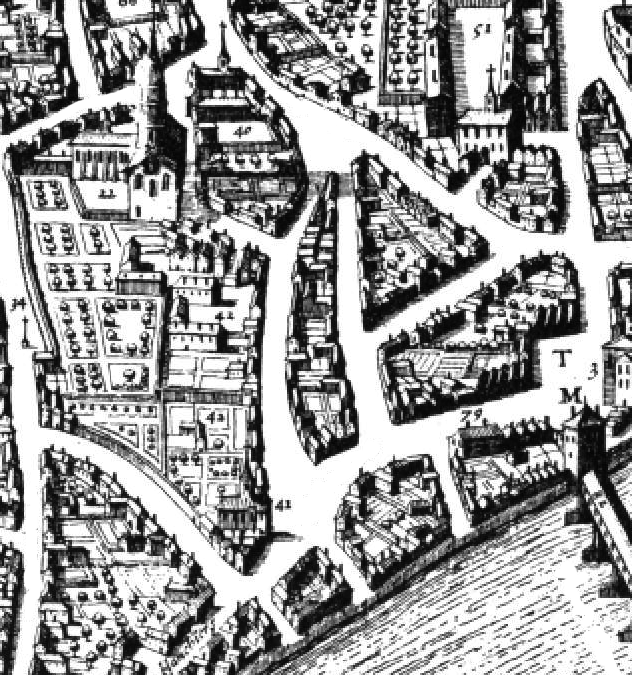
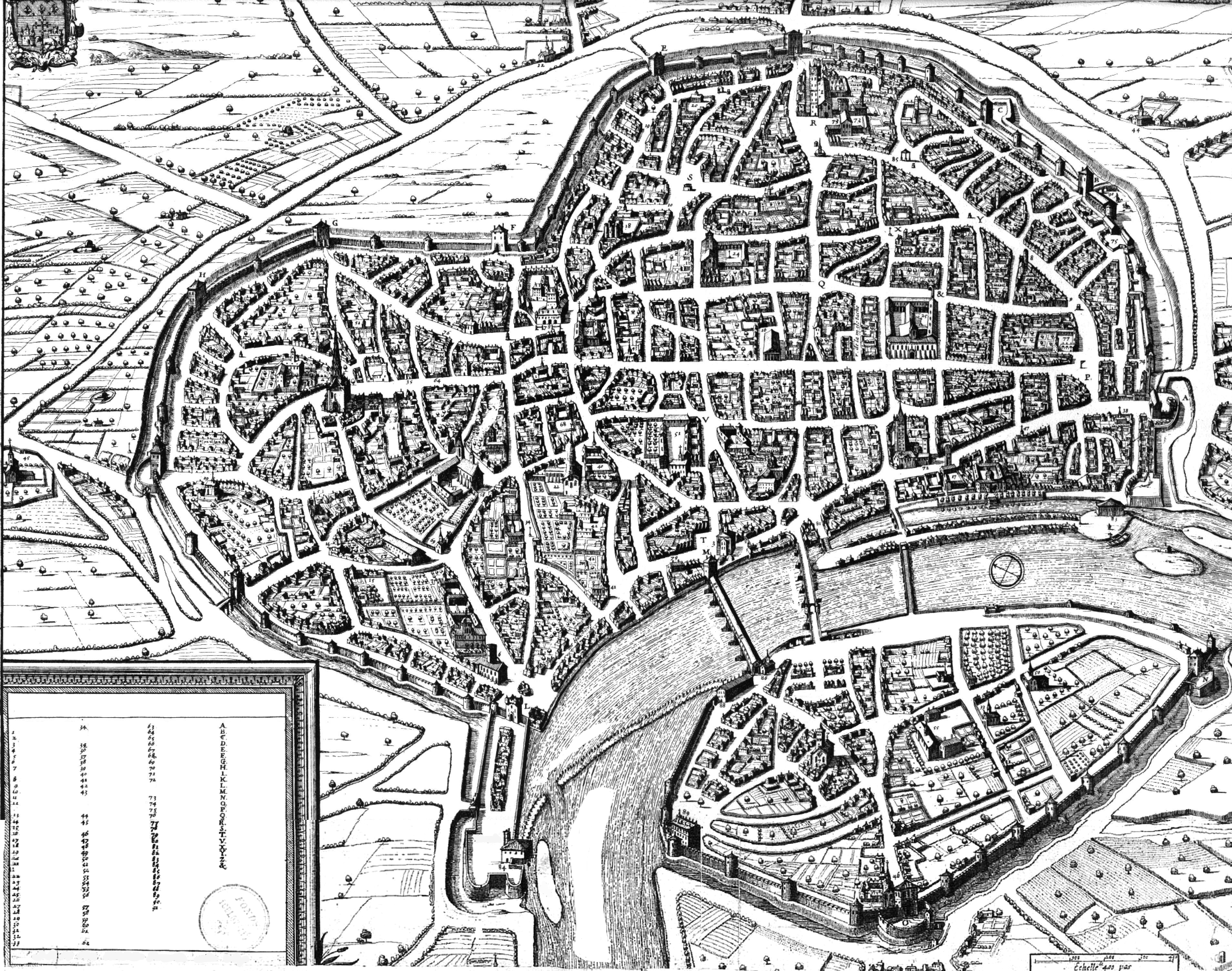
    My dad has this map of the city of Toulouse in 1631. I don’t know where he got it. Maybe he picked it up in Toulouse in 1631.

    toulouse

    click to enlarge

    It’s a super D&D-style map. It’s one of those Greyhawk-like maps which shows every building in the city. Furthermore, it’s numerically keyed. The original map labels 100 or so locations in the city – in French of course. I’ve deleted all the key text and street/river names so you can write your own.

    Here’s a representative neighborhood:

    toulousesmall

    The numbers are scattered haphazardly around the map, so it’s pretty hard to look up the location of, say, 36. Give them a break. In 1631, D&D was in its infancy. The numbers are also tiny: the best-resolution map I could find is just good enough to read the numbers, but could be better.

    So you want to drop this map into your campaign world. What kind of city does it represent?

    According to Wikipedia, Toulouse in the 1690s had 40,000 inhabitants. In 1631 that was probably a little lower. I estimate that this map shows about 5 or 6 thousand houses. You could plausibly fit that population into that number of buildings, so this map could actually show every house in what the 3e DMG would classify as a Large City or even a Metropolis. This could be your big home base city, and you can key every church, palace, inn, and NPC’s home, if you so desire.

    What’s the scale of the city? I left the charming medieval French scale bar. Distance is measured in “pais”, or paces. A pace was 30 inches, which is a great D&D number because two paces is exactly 5 feet. Toulouse is about two miles across in its widest dimension.

    Also interesting to note: city blocks in 17th century Toulouse were a big ring of buildings surrounding some outside space: orchards, gardens, or common pasture. If this map is to be believed, everyone had a backyard. That observation matches with similar medieval city maps: check out Brussels. Sure, these cities feature filth in the streets, cramped alleys, and overhanging second floors, but there are lots of public squares and semi-private green places.

    Another thing: Toulouse’s shape. It looks like a heart, broken by the river running through it. City of the broken heart?

    Here’s a one-page PDF of the map. It might be better served by a two-page spread with larger, less randomly placed numbers. I leave that as an exercise to the DM.

    what’s this about a shakespearian D&D storyline?

    Tuesday, November 11th, 2014

    At Gamehole Con this weekend, Chris Perkins dropped some D&D future product spoilers. For instance, you might have heard him say that there will be a 5e Open Game License. But you might have missed this tidbit: a future D&D storyline will be “a giants based story influenced by a Shakespearean play.” That sounds nuts!

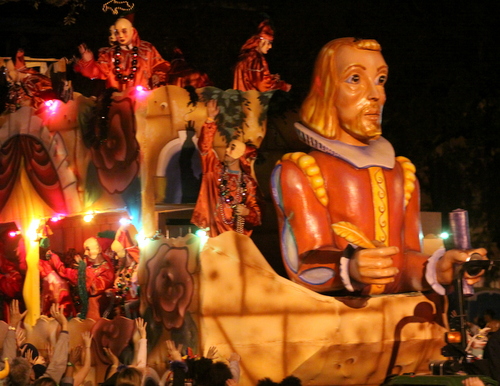
    sparta-romeo-and-julietSo my question is: what Shakespeare play?

    The Tempest: Elminster is washed up on a desert island with his daughter? who exists apparently? Elminster enslaves some spirits giants. Years later, the PCs wash up ashore. In classic Forgotten Realms fashion, Elminster messes with the PCs for a while and then fixes everything.

    A Midsummer Night’s Dream: Titania and Oberon, rulers of the fairie court, are already D&D canon. Throw some enemy giants or fomorians in there. Half of the players must wear donkey heads and the other half must wear fairy wings and glitter.

    Henry V: How about Henry V mashed up with Against the Giants? Choose from exciting 8th level pregens like
    -King Henry, a rogue 5/paladin 3, who gives inspiring speeches like “Once more unto the breach glacial rift of the frost giant jarl, dear friends, once more!”
    -Scrope, a fighter 8, a friend of the King. The DM secretly informs him that he’s actually a traitor working for the giants.
    -Falstaff, a rogue 8, who has a really cool character concept but isn’t allowed to attend any sessions and dies offscreen in an NPC speech.

    Romeo and Juliet: A forbidden love between rival factions. Is Romeo a giant, or is Juliet? Both possibilities are creepy. Or is Romeo a fire giant and Juliet a frost giant? The PCs all play the part of Mercutio and are all killed before the end of the adventure.

    As You Like It: A pastoral comedy set in the Forest of Arden. The “all the world’s a stage” speech is changed to “all the world’s a D&D game” and is read aloud by the most morose player. There are no giants in this adventure, but for the sake of the adventure, Shakespeare is considered to be a giant.

    Tamburlaine by Christopher Marlowe: Perkins did say a Shakespearean play, not a Shakespeare play, which lets in the other Elizabethan playwrights. Tamburlaine is a mass-combat campaign suitable for epic characters (armies are numbered in the hundreds of thousands). It’s easy to find inspiration from its blood-and-thunder speeches like

    What means this devilish shepherd, to aspire
    With such a giantly presumption,
    To cast up hills against the face of heaven,
    And dare the force of angry Jupiter?
    But, as he thrust them underneath the hills,
    And press’d out fire from their burning jaws,
    So will I send this monstrous slave to hell,
    Where flames shall ever feed upon his soul.

    Right there we have devil shepherds (and, by inference, devil sheep?), giants, burning jaws, and a monstrous slave who is sent to hell, all of which could be statted up.