Author Archive

Essentials starter: ambushed by goblins!

Saturday, August 28th, 2010

The choose-your-own-adventure used for character creation/rules walkthrough is quite well-executed. You’re on a wagon with a dwarf merchant. Your embryonic, any-color hero is ambushed by goblins. Based on how you react, the game recommends a character class to you. You make choices first, and then learn mechanics.

Your four potential character classes all lead through the same goblin battle. If you’re like me, you’ll try all the classes; and furthermore, you’ll read all the text blocks to see the options you didn’t choose. Luckily, the options are sequenced by character class, so reading the book in order doesn’t give you a confusing mess; it gives you, in order, the slightly-branching but easy-to-follow stories of a fighter, wizard, rogue, and cleric each fighting goblins.

The adventures for the different classes each have to provide much of the same game information, so there is a lot of repeated text; but there are a few surprising differences for each class.

Before we get to the classes, though, the game asks us some role-playing questions. “Think for a moment about what your character hopes to achieve. […] Are you setting out on a life of adventure on purpose – or about to stumble into one by accident? Are you heading to the town to see someone you know, or perhaps to pay your last respects to a relative who has died?”

I think my character hopes to achieve fame and fortune as a merchant prince. He needs trade goods, so he’s hoping his merchant companion will have a tragic accident on the road. He doesn’t have the guts to murder the merchant in cold blood, but maybe if there’s a fight… weapons can slip…
More Red Box thoughts…

wait, I can be ANY color?

Saturday, August 28th, 2010

The Essentials Players Book, like the 1983 Mentzer Player’s Book, starts with a solo adventure that teaches the basic D&D concepts. One difference is that in Mentzer, you play a male human fighter – a lovable, goofy, dumb fighter. In Essentials you can build any of the 4 main D&D classes: fighter, wizard, cleric, and rogue. But that choice comes later. First you choose your gender, race, and appearance.

“Your hero can be a human, an elf, a dwarf, or a halfling […]. Your character can be male or female, and can have whatever color skin, hair, and eyes you can imagine.”

Wow, I feel like I’m drinking from the firehose of narrative power! My character will forever define my unique spirit! I think I’ll be an elf with ebony skin and violet eyes!

More Red Box thoughts…

who gets to be the DM?

Saturday, August 28th, 2010

The 1983 Mentzer Red Box and the Essentials Red Box introduce the DM role in similar terms:

Mentzer: “One person must also learn how to be a Dungeon Master (or DM) – the person who plays the role of the Monsters. The other booklet in this set is the DUNGEON MASTERS RULEBOOK, and explains everything the DM needs to know.”

Essentials: “One player gets to be the Dungeon Master (DM) – the person who plays the roles of the monsters and guides the other players on their adventures. All the other players create heroic characters using this book, but the DM gets to read the other book in the box – the Dungeon Master’s Book.”

In Mentzer, someone MUST be the DM, and in Essentials, someone GETS to be the DM. Instead of “whoever draws the short straw jumps on the DM hand grenade” we have “I’m Tom Sawyer and whitewashing the fence is fun!”

OK, that’s a little bit of hyperbole. We all know that whoever draws the short straw has to play the CLERIC.

More Red Box thoughts…

Back of the Red Boxes

Saturday, August 28th, 2010

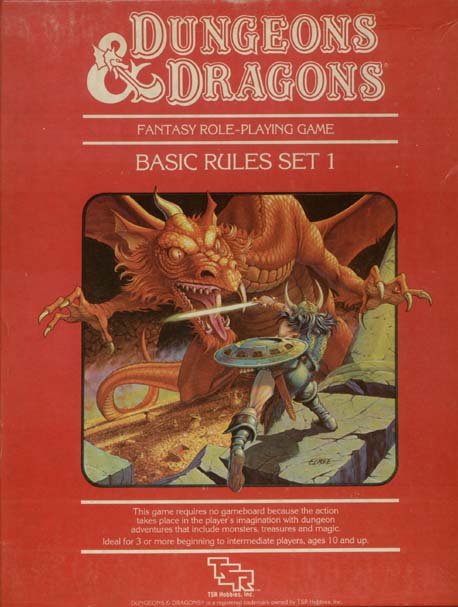
The back of the 1983 Red Box contains INFINITELY more ALL-CAP WORDS used for EMPHASIS! Most of them are the word “FUN”! A dragon “swoops TOWARDS you with a ROAR!” It’s “more FUN than any other game!” “Start having “FUN”! “Programmed adventures for easy learning and HOURS of FUN”! “expand your FUN”! “More treasures, more monsters – and MORE FUN!” There’s also one example of Capitalizing the First Letter for Emphasis: “This New Popular Edition has been completely revised!”

The new set, by comparison, seems as dignified and sober as an actuary, or pallbearer, or pallbearer who is pregnant with twins who are both actuaries. Compared to 13 all-cap phrases and 10 exclamation points in Mentzer, the Essentials set has 0 all-cap phrases and a parsimonious 2 exclamation points. Sure, it lets us know that “in this game, anything is possible – the only limit is your imagination!” and “you can play an adventurous hero”. But riddle me this: will those activities be FUN?

More Red Box thoughts…

Red Box differences

Saturday, August 28th, 2010

Mentzer box

There are a few differences between the Red Boxes besides the depth and the publisher name. Below the picture, the 1983 box says, “This game requires no gameboard because the action takes place in the player’s imagination with dungeon adventures that include monsters, treasures and magic. Ideal for 3 or more beginning to intermediate players, ages 10 and up.”

Essentials red box

Essentials red box

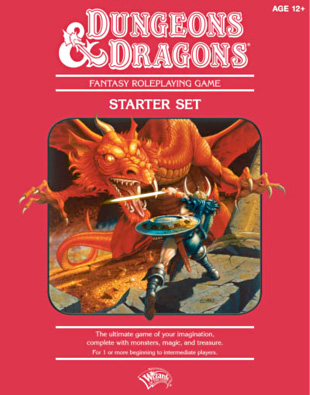
The Essentials red box says, “The ultimate game of your imagination, complete with monsters, magic, and treasure. For 1 or more beginning to intermediate players.” Definitely a trimmed-down version of the text: gone is the disclaimer about the lack of a game board (Essentials does contain a poster map, which sort of is a game board) and gone is the reference to “dungeon adventures”. Also, “treasure” and “magic” have swapped places. Just for alliteration? Or is magic more important now than it was in 1983?

Also, the 1983 set is for 3+ players, 10 and up. The new set is for 1 or more players. In the top right corner it now says “Age 12+”. But you know what? I bet 11 year olds would still like it.

More Red Box thoughts…

Elmore today

Saturday, August 28th, 2010

Essentials red box

Essentials red box

Seeing the classic Elmore art on another D&D Red Box made me think about the continuity of the hobby. It’s good to know that another generation will grow up knowing that red dragons have knees. Also, is it possible that the treasure trove has even more ewers than I had previously counted?

More Red Box thoughts…

liveblogging D&D Essentials Starter

Saturday, August 28th, 2010

Essentials red box

Essentials red box

I just picked up the D&D Essentials box, and I’ll blog my thoughts as I read through it.

The new Essentials Red Box is bigger than the 1983 Mentzer Red Box. The box is the same height and width, but about 50% deeper. Mentzer D&D just required the two booklets, dice, marker crayon, and MY IMAGINATION. The new box packs two booklets, dice, power cards, tokens, maps, and also, presumably, MY IMAGINATION. There’s also a large triangular cardboard insert propping up all the components, which has the effect of making the box look fuller than it is. Without it, everything would fit in a Mentzer-sized box. I guess the cardboard insert is to protect MY IMAGINATION from getting crushed during shipping.

More Red Box thoughts…

yams, 1cp each

Friday, August 27th, 2010

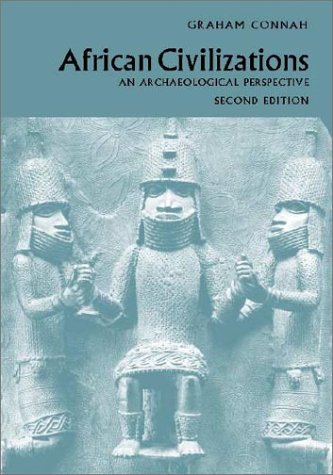
African Civilizations by Graham Connah

African Civilizations by Graham Connah

Apparently, among the important staples of ancient and medieval West African diet were palm oil and yams. These are foods I never eat. Nevertheless, in the book, there is, for instance, a big map of Africa with a dotted line showing the “yam zone”. This got me thinking about food exoticism in D&D and fiction generally.

Re-inventing common objects and foods is a worldbuilding rookie mistake. In a novel, it’s annoying if the main character drinks k’jinn instead of milk. It exoticises the main character and distances the reader. In RPGs, it’s even worse. If you say, “In my campaign world, milk is called k’jinn”, players will not start saying “Legolas takes a drink of k’jinn.” You’ll be lucky if you get “Legolas takes a drink of ka-spoon, or whatever milk is called.”

There is, however, a place for exotic foods and names. If a drink has a made-up name, that should mark it as exotic to the characters. If the PCs travel to a new continent, and everyone who meets them offers them a glass of k’jinn, this might make them feel like they’ve actually traveled somewhere.

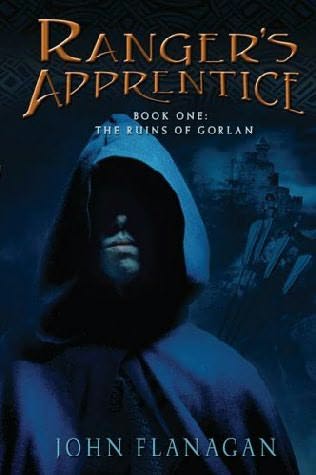
Ranger’s Apprentice

Thursday, August 26th, 2010

I’ve mentioned that recent young-adult fantasy book/movie series are beginning to look like teen origin stories in a D&D party. Harry Potter is the teen wizard, Percy Jackson is the teen fighter, the Sorcerer’s Apprentice, whatever’s his name, is the teen sorcerer.

The newest member of the party is Will Treaty from “Ranger’s Apprentice”. This series already consists of nine books, and there is a movie in the works.

Not a bad party – still light on leaders and heavy on ranged strikers, but all in all, we have a lot of ugly ducklings whose latent heroic gifts make them very special swans – swans with explicit D&D classes.

As far as I know, D&D isn’t really big among young-adult fantasy readers – I think it’s bigger among guys who were young-adult fantasy readers about 30 years ago. But I’m pretty sure that the kids who read and watch these books and movies would like playing D&D – if they knew what it was.

I don’t know if WOTC will be able to capitalize on this market. I don’t think they have the money to put commercials for the Essentials starter set in front of the “Ranger’s Apprentice” movie; get back-page ads in young-adult fantasy novels; get tie-in games with the Artemis Fowl, Inkheart, and Septimus Heap franchises. Too bad, because it would be cool to see what another generation would make of D&D.

earn your magic perks

Tuesday, August 24th, 2010

The more I think about it, the more I think the Essentials magic item rarity system is a huge game fix.

Common Items: no more socks for Christmas

Let’s take a 16th-level party. +3 weapons, armor and amulets are necessities. But all other magic item abilities are perks. D&D is a game about earning perks. In a game about earning perks, we don’t give out unearned perks.

Right now, characters have access to every item, and because players can spend a lot of time poring over the Character Builder, they always end up starting with, or buying, their capstone item. Once someone has the +2 Sword of Meshing Perfectly With Their Other Broken Abilities, no other +2 sword is going to interest them. In fact, they might prefer it to any +3 sword (except the +3 Sword of Meshing Perfectly With Their Other Broken Abilities). A DM has no way to please players but by staying on-wishlist, which is boring. Wishlists limit the number of D&D items in the universe from about a million to about 20.

As a DM, when I’m placing treasure, I’m thinking about what perks to give my players. If every character starts with a +2 weapon or implement with no abilities, I know that a +2 weapon, with any ability, will be valued. As it is, though, I often place cool items all over the dungeon; players find them; they decide their current gear is better; and everyone gets a “socks-for-Christmas” letdown.

Now, with players will be able to buy only generic, +x items, they no longer have the ability to ruin Christmas for themselves.

Rare items: cutting the Gordian cake and eating it too

From the article:

The rules assume that the DM hands out one rare item per character per tier. Rare items are meant to be character-defining, powerful objects that help forge the character’s identity in the world. If you find a flame-tongue weapon, you’ve uncovered an important, powerful blade.

People have been long complaining that they want fewer, more meaningful magic items. That’s always been a problem, though, because frequent magic-items drops are one of the big D&D rewards. If Rare items are really character-defining and once-per-tier, then we can have our cake and eat it too: we have a nifty way of giving the epic Excalibur items while still being able to dole out the routine magical junk that gets people back into the dungeons.

Conclusion
So far, the 4e magic system has been very efficient and sturdy without being very exciting, like a German-engineered school bus. I feel like it’s getting an upgrade: