Archive for the ‘RPG Hub’ Category

Lankhmar levels

Monday, May 24th, 2010

Thinking about my recent post mentioning Fafhrd and the Grey Mouser, I remembered that F&M were statted up in Deities and Demigods. I looked them up – yep, they are both fighter-thieves.

The entire Nehwon section of Deities and Demigods is pretty interesting. Last time I read it carefully was in high school, way before I read the Fritz Leiber stories, so it’s nice to see these stat blocks contextualized. I don’t even remember what I thought of Nehwon at the time – did I recognize that it was from modern fiction? or was I like “What kind of crazy, obscure world religion is this?”
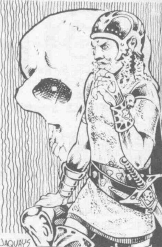
DeathA couple of stat block surprises: Death, for instance.

MOVE: Infinite

Well, that’s fun. I guess he has to move around pretty fast to travel from the dark underside of the world to collect all those souls.

CLERIC/DRUID: 30th Level Cleric
FIGHTER: 30th Level Fighter
MAGIC-USER/ILLUSIONIST: 30th level in each

Wow, Death really has a lot of merit badges. (By the way, 30th level seems to be the level cap for the gods: Odin, for comparison, has no class levels above 30th level, and Thor’s highest level is 20th as a fighter.)

THIEF/ASSASSIN 15th Level Assassin
BARD/MONK: 23rd Level Bard

OK, Death only has FIFTEEN levels of Assassin? He has more levels of BARD? You gotta figure, either Death has no assassin levels (your merciful 19th century solace-dispensing death) or he is the ULTIMATE ASSASSIN. As it is, though, if I had to choose one Nehwon god to inescapably kill a dude, and a different one to win a Battle of the Bands, right now it looks like I’m tapping Death for the battle of the bands, and I’ll take Rat God as my assassin.

The other peculiar entry in the Nehwon mythos is Pulgh:

Pulgh (hero)
Pulgh does not appear in any of the currently published works about Nehwon, although a cousin, Pulg, is mentioned in “Lean Times in Lankhmar”. Pulgh is the greatest warrior of Lankhmar (although when Fafhrd and Mouser are in the city, Pulgh would be hard pressed to claim he was the best in that place…)

What? He’s not in any “currently published works?” What does that even mean? Who is this guy? And what’s this about his cousin Pulg?
My D&D DMing Philosophy in a Nutshell

Friday, May 21st, 2010

Interestingly, this also sums up my Strengths + Weaknesses as a DM:

1. Spend like 80% of your prep time making awesome encounters. Spend the other 20% painting broad awesome strokes for your campaign. I’ve been in campaigns where the DM had tons of wheels behind wheels going and it was awesome, but frankly I’m not any good at that stuff. And if 75% of the session is going to be a combat encounter anyway, it better be awesome!

2. Constantly challenge your players with tough fights and moral dilemmas. Be uncompromising, even cruel: I don’t know about you, but when I feel like an encounter isn’t tough, I’m not having any fun, and if I’m putting in, say, 2-3 times more work into a game than my players, i think I deserve to have some fun too.

3. Make a TON of things up on the fly. Just spew the stuff out. Don’t even wait for players to come up with a cool idea necessarily (though that doesn’t hurt); just follow your whims and see where they take you. I do this so much lately its ridiculous. On a whim, I’ll just make up an NPC or mention something crazy that the players can check out. Or if I get the slightest hint that the players want to do something, I’ll grab a few books and scratch together a fight (or even easier, a skill challenge) on the fly. I made up an encounter the other day that nearly sent the PCs 10 years into the future during an important quest and a tense time period in the campaign. It would have been awesome and only didn’t happen because of a few quick dice rolls (See rule #9).

4. FOLLOW THE RULES 100%!: When i say make things up, I don’t mean the game rules. D&D is a game with complicated and interesting combat rules and has plenty of avenues to allow you to do awesome things within the game without changing the rules. I absolutely encourage my players to let me know if I’m doing something wrong and we’ll either look it up right then or I’ll make a judgment call (usually in their favor) and then ask them to look it up while other people take their turns. I like the idea that D&D can be a storytelling game that is also a Chess Match (i.e. a game where everyone knows the rules and tries to gain strategic advantage using them).

5. All NPCs are eccentric. Sometimes an NPC is a bad ass but in a weird eccentric way. In any case, generally NPCs are weird, have weird motivations, try to get under the PCs skins, and generally are trouble. Eccentric characters are easier to roleplay. This is probably more of a weakness than a style choice, but hey, that’s how I roll.

6. World Build World Build World Build: It’s fun and rewarding, especially if you take a no holds barred approach of just filling your bucket of a world with grains of awesome.

7. House Rule: D&D needs houseruling so don’t shy away from it.

8. Kill a PC every so often: If your PC bad mouths a god, go ahead and have him shoot a bolt of electricity right into his face-

9. Rolls Rule: But at the same time, make an attack roll. Even if it has a +50 bonus, make the roll and see if it hits. Then roll out the damage. Even if it’s 30d10, roll it out and see what happens. It’s hilarious to put someone’s fate in the roll of the dice and sometimes the dice pull the game in totally awesome ways.

10. Be whimsical yet cruel: Punish players for being stupid yet give them plenty of opportunities to be stupid in different and fun ways. Reward them when their stupidity pays off. Punish them when they do the right thing and get a few crappy dice rolls. See yourself as that delightful antagonist, always there to clap at their misfortune and curse good naturedly at their success. Delight in everything they do and sincerely congratulate yourself when you engineer their destruction.

I didn’t put in anything there about having fun, because that should be obvious. The goal of everything in life is to have fun or survive long enough to have fun, right?

You only need to remember things that benefit you

Friday, May 21st, 2010

I’m not a cheater (not a conscious one, anyway) but in 3rd edition, I often forgot to keep strict track of the duration of Haste, Rage and similar effects. My group tracked these durations by keeping a d6 face turned to the number of rounds remaining. Often a turn would go by… or three… and it wouldn’t occur to anyone to decrement the die. We’d finish a grueling battle and the Haste counter would still be turned accusingly to 6.

If I had a negative condition on me (blind for 4 turns, for instance), it was a different story. When I took an attack, I’d think about my blindness and about how I wanted to get rid of it, and I would decrement that die.

In the stark watches of the night, the time when, traditionally, good men must come to grips with their ethical failings as D&D players, I tell myself that I’m no more dishonest than other players; it is my subconscious that is a cheater. I think this is a universal human trait.
(more…)

OD&D + 2 many classes

Monday, May 17th, 2010

I’ve somehow ended up in two weekly 4e games, both of which were cancelled this week. With twice the thwarted D&D energy, I found myself reading OD&D books and speculating on some extreme kitbashing. OD+D + 2 Many Classes

In the past, James Maliszewski has suggested that the cleric class doesn’t have a lot of traction in fantasy literature, and that maybe magic users should absorb the cleric spell list (an idea which didn’t meet with universal approval).

It’s true, most sword-and-sorcery priests (most of whom are evil death priests) look more like wizards than anything else. Christian priests and monks appear in heroic literature, but they don’t have healing abilities: they may have the ability to banish demonic and fey influence, but so does a crucifix or a piece of cold iron, neither of which demand a loot share.

Meanwhile, a lot of OD&D people don’t like the thief class (which was introduced in a supplement anyway; and is a rare example of “power un-creep”.)

Hell, since we’ve already folded cleric into magic-user, let’s give every fighter thief powers! Backstab, climb walls, pickpocket, the works.
(more…)

May rules update highlights

Monday, May 10th, 2010

There were some long-overdue updates in the latest 4e errata. Here are my two favorites:

Daggermaster’s Action
Page 127: Replace the class feature with the following text: “When you use a rogue or a daggermaster attack power with a dagger, the power can score a critical hit on a roll of 18–20.” This change updates the feature to reflect the original intent.

I’ve definitely been guilty of exploiting the non-rogue daggermaster loophole (critical hits for all!!). It’s really fun to get crits, and so Daggermaster is a tempting option with a lot of classes and builds. I never sunk quite low enough to play the daggermaster sorcerer, but my daggermaster monk, Bolo, will miss critting on an 18-20 with his burst 1 at-will attack. At level 11 he crit every few turns, and he did something like 9d10 bonus damage. This takes a long time to roll if you don’t have extra d10s from your history of White Wolf gaming. Bolo was the second-most annoying character I ever played, after my 3.5 factotum who made a trip attack and a followup melee attack on every. single. turn.

The reduction in scope of Daggermaster will mean that when picking a paragon path, I no longer have to feel like either a rules-exploiting villain or a non-optimized fool.

Aid Another: The creature makes a skill check or an ability check with a DC equal to 10 + one-half the creature’s level.

The 10 DC For Aid Another was inexplicable. It was a weird holdover from 3e, and I have no idea how it survived this long. A 10 DC meant that it was reasonably challenging for unskilled level 1 characters; grew less fearsome as they got to around level 3; and by Paragon level, was basically unfailable. I’m all for different tiers feeling different, but I don’t think “occasional failure to help with a difficult task” needs to be a defining quality of low-level play.

I also note with pleasure that the DC of the check is 10 + 1/2 level, which is the pattern that I’ve been using for all skill checks, instead of the crazy, unlearnable, errata’ed chart. I don’t use a DM screen, and I need reasonable DCs I can calculate in my head whenever players try a skill, which is often. I’m actually hoping for an errata to the errata that will use 10, 15, 20 + 1/2 level for all skills DCs.

Also, there is now a -1 penalty for failing the Aid Another check! This was the other thing Aid Another needed to make it a non-bogus rule. 4e seems to be evolving into my houseruled version of 4e.

(Actually, I do use a DM screen: a first-edition screen our game host has had since childhood. So I’m set in case I need to know an assassination success percentage.)

leveling magic items

Thursday, May 6th, 2010

I’d written up ideas for levelling up magic items, Weapons of Legacy-style, for 4th edition, but I see that Jeff Rients beat me to the punch by a day or two. His implementation is not specifically for 4th edition, but he expresses some of the same concerns I do about previous attempts (Weapons of Legacy, etc) and both our ideas involve the concept of “awakening” the item. Parallel evolution, I swear!

Jeff says: “First start out by assuming that any magic weapon found in play with just a bonus (i.e. a plain ordinary sword +1, axe+2, etc.) is a dormant weapon.” This is the assumption behind my houserule too, although I descend further into absurdity: every item is dormant, even if it already has a special property.

The things from Jeff’s article I wish I’d thought of are a) the importance of names for magic items and b) illustrating your rules with example characters who don’t make it through the example alive. Not since the sample dungeon adventure in the 1st edition DMG, where the halfling is paralyzed and forced to watch as ghouls eat his innards, has there been such an example-character bloodbath. This has a salutary effect on other example characters, I think.

So here are my rules:
(more…)

Mapping the Feywild

Sunday, May 2nd, 2010

If you DM, you probably have a world map, or at least a continent map or local area map. However, I bet you haven’t made a map of the Feywild!

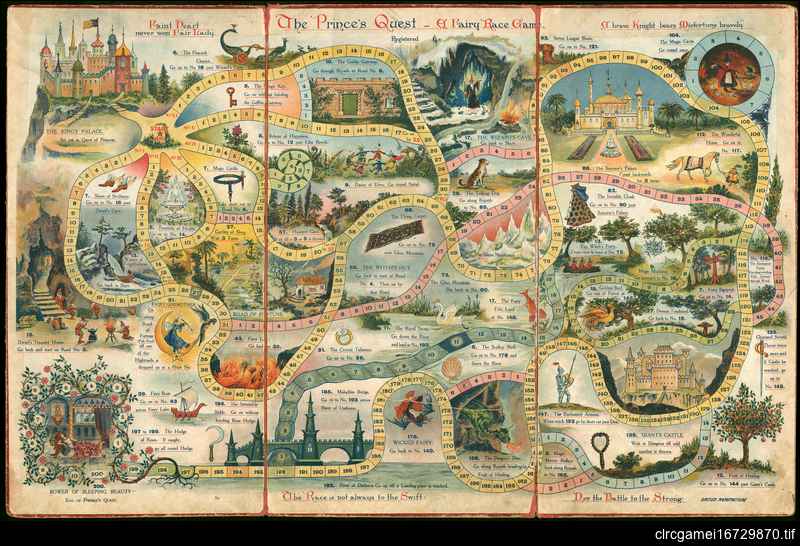
The Feywild is supposed to be an analogue of the natural world, so you could reasonably take an outline of your world map, color everything green for Forest, and dot it with some cool feywild locations. As an alternative, though, what about using something like this for your Feywild map?

“The Prince’s Quest: A Fairy Race Game” is a boardgame from 1890. It seems to play a bit like Candyland. It is probably not great as a game, but it has nice Victorian fairy art and some interesting locations that could be turned into strange encounters: for instance 28. The Talking Dog, 10. The Goblin Gate or 185. Malachite Bridge.

It seems thematic that the Feywild is all about following permissible paths, not about travelling freely in any direction. You can’t really map Fairyland: it resists definition, and directions and distances may be mutable anyway. The way to get somewhere is not to follow a map but to follow instructions: “Follow the setting sun until you get to the Glass Hill, then throw a straw in the air and travel in the direction it points, until you reach the Oracle, who…” etc.

You could either make the players play the game to travel, or just let them travel their speed along the paths.

The gameboard is sold as wrapping paper for $4 from Kate’s Paperie, which is how I got it: around a birthday present.

Heroes of Hesiod

Saturday, May 1st, 2010

Wizards has a new thing out, Monster Slayers, which is marketed as D&D For Kids!

Really, “D&D For Kids” is like “Jobs For Adults” or “Pince-Nez for Affected Fops!” D&D is already for kids, or was when I was a kid. But I see what they mean. It’s D&D for kids too young for D&D!

It’s an interesting take on D&D: a 14-page PDF, of which about 2 pages are rules, and the rest are monsters, pregenerated characters, an adventure, props and art. The adventure is supposed to take 30 minutes. Imagine running a D&D adventure in 30 minutes! This would be awesome. You could play D&D during lunch hour at work! You could play D&D 8 times in the time it usually takes to play once!

It’s interesting to look at a stripped-down D&D ruleset, especially in light of my earlier thoughts about what I thought was essential to D&D at age 8. D&D gets overcomplicated sometimes. It might be valuable to strip out a bunch of rules and see which ones you miss.

Here’s some notable D&Disms not found in Heroes of Hesiod:
(more…)

Class

Tuesday, April 27th, 2010

It occurs me that “class” is not really an obvious word to use to describe the fighter, cleric, etc. Really these are better described as “jobs”. Still, most D&D-influenced games use a “class system” – offhand, the only games I can think of that use “job systems” are some of the Final Fantasy games.

I’ve seen “class” so many times to describe D&D jobs that I almost think it’s an official meaning of the word. Obviously, though, the official meaning being used is “classification”, as in “This character is classified as a fighter.” It’s an interesting implication: classifying something is almost like rating it. It’s a semi-judgment call: like you’re inspecting real heroes and deciding which arbitrary category they best fit into.

I decided to look through the old Chain Mail rules to see if I could find out more of the history of the term. I found that, as is not uncommon, the word is used as a technical term with many different meanings. I guess Gygax had the word “class” in his head when he wrote these rules.

Here are the different meanings of “class”/”classification” in Chain Mail:
(more…)

Simple Campaign Idea

Tuesday, April 20th, 2010

So a simple idea I’m trying out for my most recent d&d campaign is as follows:

1. Every player has a public goal, which is one of the big reasons they’re traveling with the party. It’s either in the party’s best interest to pursue the goal or the goal is appropriately noble. Example: Create a center of learning that will draw people from throughout the land!

2. Every player also has a private goal, something that is probably secret and that they don’t really need the group’s help to accomplish. In fact, such a goal might even run contrary to the group’s goals. Example: Become a God!

3. The players are all united by a few principle goals that I set before them (assuming they care about them at all). Example: Discover the mystery as to why the  the boundaries between the planes are breaking down.

4. Because I’ve been really annoyed in the past at having to separate in game knowledge from out of game knowledge I’m instituting a rule where if some piece of information comes out at the gaming table, anyone can invent a reason why they might have figured it out. This is a little silly, but is my best guess for how to actually preserve a sense of intrigue at the table. So if someone is about to have an important conversation, I ask them if they want to have it in another room away from earshot of other players. And people are encouraged to slip me notes and the like.

5. Players all have quests and minor quests associated with their goals (which give XP to the entire group, naturally). Thus, mechanical reasons to pursue your goals!

The main goal is to encourage rich interwoven storytelling where what might seem like a straightforward adventure like exploring a cool tower actually has several layers of subtext. Plus it’s fun in D&D to have a personal sense of accomplishment that goes beyond the mechanical benefits of leveling up and the mundane satisfaction of saving the world yet again!