Archive for the ‘RPG Hub’ Category

it’s an important role

Saturday, April 17th, 2010

“The Lightning Thief” struck me as a natural translation of Harry Potter: teen, troubled in the real world, finds his inner, hereditary potential at a school for… fighters!

I just saw a preview for “The Sorcerer’s Apprentice”. Looks, on the surface, like the same thing, but with a ranged striker, complete with Chaos Bolt.

I’d like to see the Leader version. Whose superpower fantasy is of being the party cleric?

Wilderness Survival Guide

Wednesday, April 14th, 2010

I’ve taken Chatty DM’s post as a challenge: how can I make wilderness rules, with lots of dice-rolling for weather and other minutiae, useable in an actual game?

(read the rules)

My first goal was to reduce the Wilderness Survival Guide – everything the players need for adventuring – to one printable page. If you need to flip pages to find anything, the rules are too long. I can imagine separate single-pages for random dungeon or city adventuring, random encounter generation, and random treasure. The players could keep the appropriate page on hand – only one would be needed at once. This would be a fun board-game-style handout.

My second goal was to provide concrete resource-management mechanics for wilderness travel. Ideally I’d like the players to be able to make some strategic decisions. Take the low-level route or the high-level route? The civilized or wild path? The explored or unmapped path?

(more…)

Wilderness Survival

Monday, April 12th, 2010

In a recent post from Chatty DM, he says:

I bought the Wilderness Survival Guide (X-mas gift I wrapped for myself when I was 15-16) when it came out. I disliked it so much that I threw it away and never used it, disgusted that I would ask my players to roll percentiles EACH DAY for food and shelter.

The 1st Edition Wilderness Survival Guide is also a book I read once and never used. I don’t remember being disgusted with it, but it never fit into any of my games, possibly because nothing important happens in the wilderness.

DMs are in the business of peddling illusions: illusions of meaningful choice to players when they are really on the rails; illusions of danger in a combat when maybe a fraction of a percent result in a TPK. Books like the 1e Wilderness Survival Guide, on the other hand, peddle an illusion to DMs. The illusion is that their campaign world is a real place, run by laws different from, but mirroring, the laws of the actual world. By rolling on the appropriate charts, the DM is running a universe. Many sourcebooks, especially those late in the run of any edition, lavish detailed rule considerations on things that rarely or never come up in play. Some of these make great reading: they allow DMs to imagine the perfect D&D game, with the DM able to raise a glorious edifice of simulated creation, using a million charts, all on hand, for players with infinite appetite for randomly-rolled minutia.

The Wilderness Guide has about 50 charts. I’ll list a few highlights: imagine having one of these situations come up in play and asking players to hold on while you find the appropriate page in the Wilderness Survival Guide.

-Effects of Clothing and Armor on Personal Temperature (for instance, in temperatures of 0 to 30, you are 10 degrees warmer if you are wearing banded mail)
-Damage from Free Fall or Severe Slope (this is a replacement for the classic 1d6 damage per 10 feet fallen rule: damage ramps up more quickly in this chart, maxing out at 20d6 for a 50-foot fall.)
-Grappling Success (I thought at first this was modifiers to the Grappling rules, modified for fighting on a slope, which would be HILARIOUS; but in fact it is chance of using a grappling hook on various slopes, modified by how slippery they are.)
-Chance of Food Spoilage (modified by type of food and temperature)
-Campfire Characteristics (degrees of heat by different types of campfires, provided at 10-foot increments from the fire up to 60 feet: what circumstance ever forces anyone to remain more than 10 feet from the fire?)
-Availability of Fuel (maybe in the desert, you can only make a Small campfire, which is trouble for the guys 40 feet away from it!)
-Reactions of Animals (where you can find out, I kid you not, the effects of odors on a yak! The effects are “6/10/12”)

None of these charts, nor most of the rules, have any relation to what happens in actual play. In a real D&D game, the DM has plot points he wants to hit, encounters he wants to run, and a ton of books open. While the PCs journey from the city to the ruined temple, the DM could remember all the relevant charts in the Wilderness Survival Guide, flip to the appropriate pages, and roll on the various percentile charts – but it’ll be easier to say “Ok, you get there without incident”, which is probably what he’ll do.

It’s too bad: the DM-as-world-simulation is a beautiful illusion.

PAX East Dark Sun Preview

Monday, March 29th, 2010

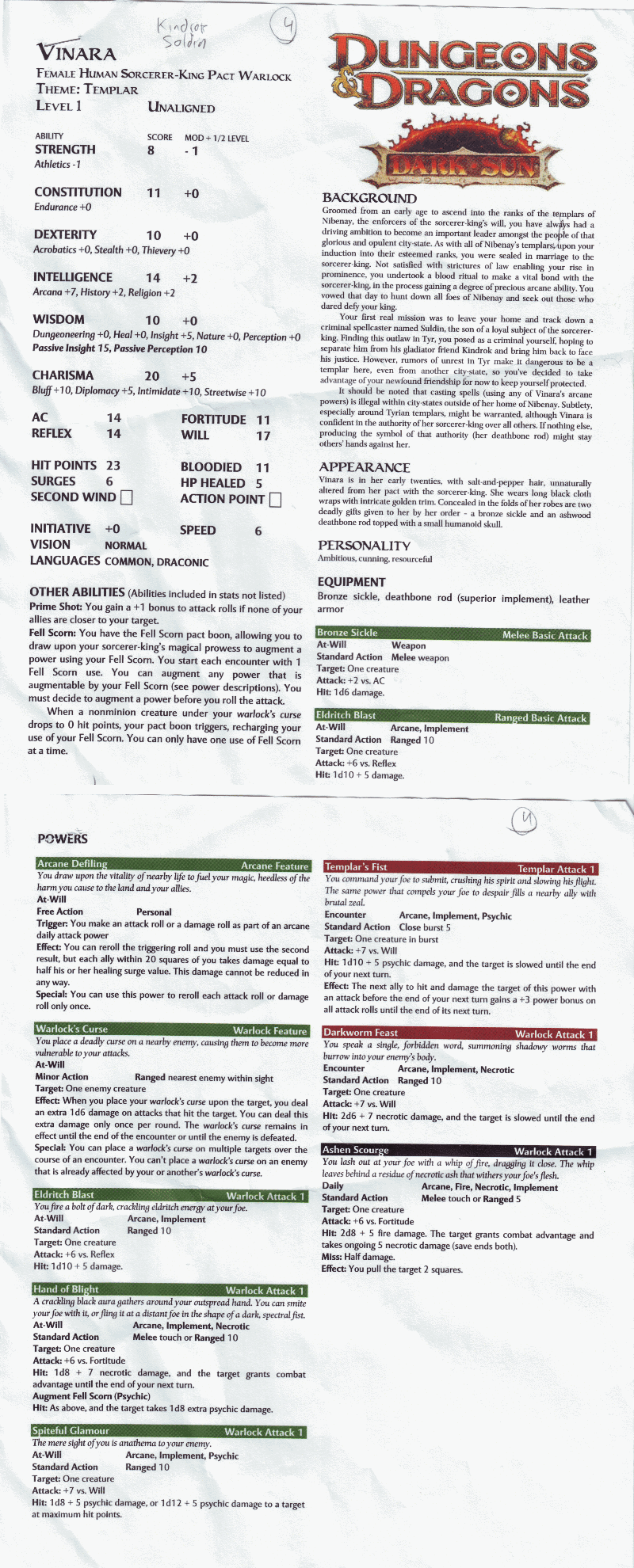
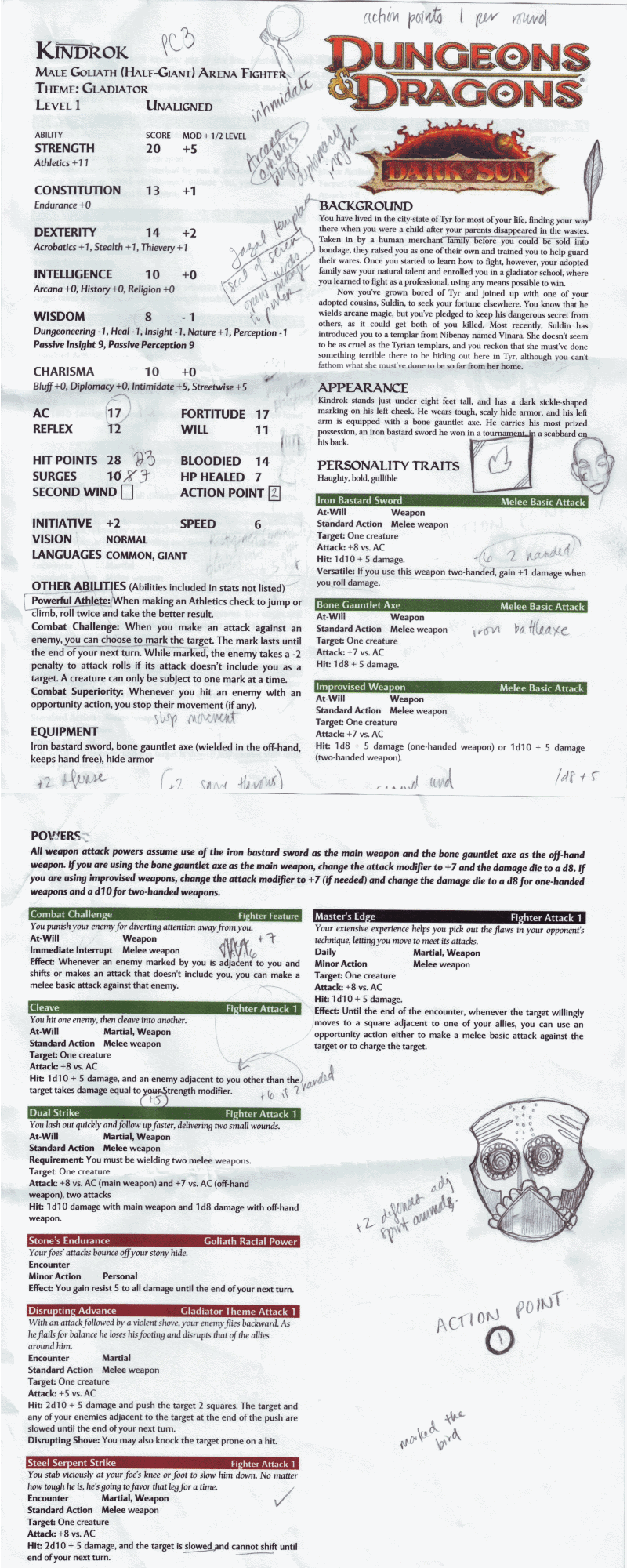
We played in a Dark Sun delve at PAX. We did a standard three-encounter delve through a gladiatorial arena, in which we fought, among other enemies, a savage halfling and some githyanki guards. I grabbed a couple of the 1st-level pregen character sheets (human warlock and goliath fighter) and noted a few fun Dark Sun-specific rules (critical fumbles, inferior equipment, and character templates, which seem to be the heroic-tier equivalent of paragon paths).

World Conceits

Flavor-wise, the world of Athas seems to cleave close to the 2e version: a darker and deadlier D&D; scarce metal; sorcerer-kings; templars; savage halflings; defilers.

New Rules

Inferior Weapons: Because metal is scarce, beginning characters have inferior weapons. Our fighter started with a bone battleaxe, and got a metal battleaxe as treasure during the adventure. The composition of the weapon affects the chance to break a weapon.

Breaking Weapons: If a character wielding an inferior weapon rolls a 1 on an attack roll, they have a choice: they may miss as normal, or they reroll their attack; if they miss again, their weapon shatterings. If the character happens to have a non-inferior (metal) weapon, they may do the same thing, but I think they have a smaller chance to break their weapon (on a roll of 1-5 on the second roll, I believe). This means that rolling a 1 has some of the flavor of a critical fumble, except that it is actually advantageous: it gives you choices.

I’m curious to see the full rules for this. It seems like a fun rule to use in early levels, but once you get a +3 sword you’re probably not going to want to break it in exchange for a reroll. On the whole, I like this rule: I think that something that elicits a cheer should always happen when you roll a 20, and something that elicits mockery should always happen when you roll a 1. Breaking your sword qualifies as mockery-inducing.
(more…)

A Pleasant Sort of World

Monday, March 22nd, 2010

I thought it would make sense to provide a link to the wiki for my campaign world here, since I’ve spend a fair amount of time working on it:

http://www.obsidianportal.com/campaign/a-pleasant-sort-of-world/

It’s pretty boss, and is built around the following general philosophies:

1. Points of Light: I really liked the new D&D points of light idea, and my world definitely runs with that; there are a few cool settlements dotted around the world, but for the most part it’s all wilderness and crazy dangerous places!

2. Heroes Matter: The basic assumption in my world (and this is another 4th edition concept, I believe) is that the world is in rough shape, and there aren’t a lot of badass heroes to keep things together. Enter the player characters who really are the people who keep things from falling apart. When they succeed, civilization continues another day, and they are rewarded heartily for their efforts! When they fail, the consequences are muttled at best and can indeed be quite dire!

3. Magic is powerful, present, and mysterious!: My world is filled with tons of crazy magical and fantastical sites, such as a tower that extends a mile into the air, gates that literally lead into the underworld, a sea that literally boils, and a wasteland that can only be navigated by a madman. However, most of it is incomprehensible or only half understood by ordinary and even educated people. So while magic is ever present, there aren’t a lot of people who can harness it for useful goals, and those who can are often guarded with that knowledge and highly valued.

The wiki is definitely still a work in progress and I add to it whenever new stuff happens in my campaign. I also plan to add a map for the world when I get access to a scanner!

do NOT put this blog inside a portable hole

Thursday, February 11th, 2010

This is a blog about D&D. Expect musings, house rules, and game recaps.

The blog authors are Paul and Rory. We worked hard to come up with our usernames. We considered “Malebrax, Consumer of Souls” for Rory, and I was torn between “Carnifex, the Butcher of the Tower” and “Gladiola, Princess of Oakheart Creek”, but we eventually decided to go with our first names. Saves bandwidth.