Author Archive

gaming with one of the original D&D players

Friday, January 6th, 2012
This entry is part 1 of 12 in the series D&D with Mike Mornard

Yesterday, Tavis enticed my gaming group to the Soho Gallery for Digital Art for a D&D art/gaming event. The bait on the hook included Doritos, new art by Erol Otus and other cool people, and a game DMed by Mike Mornard. Mike played in Gary Gygax’s DND game in 1971 AND in Dave Arneson’s game and Phil Barker’s game. The guy had a talent for finding cool gaming groups.

Since I’ve appointed myself a minor curate in the Church of Preserving Cool D&D History, I couldn’t resist the opportunity to pepper Mike with questions. I also got to play a session in his game, and made a real hash of being the party mapper. (What else would you expected from a 4e player?)

Mike showed off some of his autographed books: his 1e Player’s Handbook was signed to “Lessnard the Wizard”, one of Mike’s characters. Apparently, when he was level 1, Lessnard had the distinction of surviving a solo trip to level 3 of the Greyhawk dungeon. Lessnard was alone because he couldn’t convince any hirelings to join him – he had lost too many hirelings in the dungeon already. Mike produced that story to demonstrate that, contrary to common belief, a lowly level 1 wizard had plenty of survivability!

It sounds like Lessnard adventured over several solo adventures with Gygax, which seems to have been pretty common in the old days. I’d heard that low-level characters often travelled in groups while high-level characters adventured solo, with just their henchmen to back them up, but from the Lessnard story, it appears that even ill-advised level-one characters sometimes attempted the feat. On the other hand, Lessnard’s survival was notable enough to be memorable for 40 years, so maybe it wasn’t a common practice.

Mike gave a fascinating account of a typical early D&D game, with a peculiar detail that I’d never heard before. Gary never used maps or minis: maps and minis were Dave Arneson’s thing. Gary ran games in his office, which was provided with chairs, a couch, and file cabinets. While playing, Gary would open the drawers of the file cabinet and sit behind them so that the players COULD NOT SEE HIM. They only experienced the Dungeon Master as a disembodied voice.

During games, cross-talk was discouraged: the party caller did most of the talking, and other players only talked if they had something to contribute. If the players chattered too much, they’d miss what the Disembodied Voice was saying, and that would be, as Mike put it, “suicide”. “You could feel the tension in the room,” he added.

It’s a very different style than the way I and my friends play. We do a lot of joking and chattering, the DM doesn’t kill you for not paying attention, and apart from a few suspenseful moments, tension at the table is often low. I honestly don’t think one way to play is necessarily worse than the other, any more than comedies are worse than suspense movies or vice versa. I’d be happy to play in either style of game – preferably both.

Mike said a lot more. I’ll try to write up the rest of my notes – including answers to questions about mapping, classes, weapons, and roleplaying in the early days – in the next post.

Dust of Appearance, leveled

Wednesday, January 4th, 2012
This entry is part 8 of 13 in the series wondrous items, leveled

Cullen’s Dust of Appearance Any creature who enters the Dust of Appearance’s zone will sparkle. invisibility will be impossible, stealth will be at -5, and removing the sparkles requires either a wash or an extended rest. While sparkly, subjects leave a glittery trail that can be easily followed.

My old houserules for leveling magic items mean that every piece of magical treasure has the potential to gain power in ways that the players can’t predict. Furthermore, WOTC recently invented the concept of the “rare magic item,” but we don’t yet have lots of examples.

While some items may get mechanically better (for instance, a +1 sword becomes a +2 sword), it’s more challenging to improve items that don’t have numeric bonuses. I thought I’d go through the Wondrous Items in the 4e Player’s Handbook and give examples of how each could gain powers that reflect their history.

Adso of Melk’s Dust of Appearance of True Thoughts
When you sprinkle this dust on a page of text, handwriting appears in the margin, annotating the author’s true thoughts as he or she wrote the page. The new text is in the author’s handwriting, in a different color of ink. If the document was written in good faith, no new writing appears.

If the author is alive, you must make a wisdom, intelligence, or charisma attack against their will in order to see their thoughts appear on the page.

Adso’s dust is especially handy on diplomatic treaties and self-serving revisionist histories.

Dust of False Appearance
When this dust is sprinkled in a zone, in addition to its other effects, 1-3 illusionary monsters, of random type, are “revealed”. With a minor action, the dust’s owner may grant move actions to all the monsters. The monsters disappear if they are attacked or leave the zone, or at the end of five minutes.

rituals and alchemy as daily powers

Monday, January 2nd, 2012

Using money to restrict the use of rituals and alchemical items doesn’t work particularly well: the D&D designers have admitted this and aren’t exploring the ritual/alchemy design space much these days.

Here’s how I intend to fix the issues in my game:

1) Rituals and alchemical recipes are daily powers. You get one free use of each ritual/alchemical recipe you know. You automatically prepare the ritual, potion, or whatever during each extended rest.

During the extended rest, you can decide to prepare more than one use of the ritual or item: each extra use will cost you the item’s normal cost.

2) Rituals and alchemical recipes are given as treasures. Just as most magic items aren’t sold in magic shops, most rituals and recipes are long-lost prizes awaiting brave adventurers. Low-level parties will have access to only a few, while high-level parties, with access to lots of rituals and consumable items, will have a lot of versatility.

Rituals and alchemical recipes will be sharable among anyone who meets the requirement for using them. Knowing a recipe lets you create any version of that item of your level and lower: for instance, if a level 7 character knows the recipe for alchemist’s fire, he or she can create level 1 or level 6 alchemist’s fire.

3) There will be some common rituals and recipes. Just as characters can buy Common magic items like +1 swords, they will be able to buy well-known rituals and alchemical compounds.

Common rituals:
-All level 1 rituals
-Enchant Magic Item
-Brew Potion
-Linked Portal
-Raise Dead

Common alchemical items:
-All level 1 items
-tanglefoot bag
-alchemical silver

And for fun, here’s a new alchemical item:

Glowgas: Glowgas is stored in a vial, and thrown at enemies the same way holy water is. It has the same cost, range, and attack bonuses as holy water. It can also be applied to objects.

On a hit, the target takes no damage, but is surrounded by a swirling golden light. The target casts dim illumination within two squares, and has a -2 penalty to Stealth checks and all defenses. A creature or object in a glowgas cloud can be seen even inside a zone of darkness.

Once a turn, the target may spend a minor action to try to dissipate the gas: this allows a saving throw. Otherwise, the gas does not disperse until the next rest.

The glowgas recipe is used by dwarven drow hunters, and is only shared with those who prove themselves enemies of the drow.

Melancholia

Friday, December 30th, 2011

My New Year’s resolution: Class up my D&D game! Instead of tankards of ale, my barbarians will swig tankards of the ’55 Chateau Margaux. And instead of drawing adventure inspiration from pulp fantasy novels, I will use art movies and articles published in the Journal of Literary Theory.

First up: the Czech movie Melancholia, directed by Lars von Trier!

The opening sequence of the movie is a series of extremely slow-motion shots of Kirsten Dunst in and around a golf course. In one shot, Kirsten is moving at a minute-hand crawl, while a cloud of insects seemed to be moving at full speed. I thought that, at the rate they were flying, they might not even be visible in Kirsten’s time frame.

I’ve already run an adventure where the party bargained with friendly quicklings, which move so fast that humans cannot understand their speech. The quicklings overcame this obstacle by drawing pictures for the humans.

On the other side of the time scale, what if PCs needed to communicate with creatures that moved incredibly slowly? The creatures might be sentient trees, like a decelerated version of Tolkien’s Ents, or they might be living statues in a palace: few even know that they are moving at all.

Imagine a ritual that can cause you to slow down to their speed. As you cast it, the sun overhead would accelerate until it was flickering overhead. You’d hear a bass growl, which would raise in pitch until you recognized it as the speech of the trees, or statues.

You’d want to conduct your interview quickly. The DM would track the number of sentences you exchanged with the statues (or trees): each one would cost a month of game time.

(My review of the rest of Melancholia: Right before I went to see the movie, I read Nancy Balbirer quoting David Mamet: “In show business, women who are lucky enough to find employment are asked to do only two things in every role they ever play: take your shirt off and cry.” Melancholia did not disprove this postulate.)

7 feasts and 6 fasts

Friday, December 16th, 2011


“Did you not know that Lord Dillan is also a healer? He has taken the Inner Path, been a disciple of the Forest, with the Seven Feasts and Six Fasts behind him these many years.”
-Andre Norton, Star Gate (1958)

When I saw this as a descriptor of someone’s rank in a religious organization, I thought, “If he underwent a feast or fast every time he leveled up, that would put him at level 14 or higher.” Level 14 is pretty high in any edition: it’s around the time when someone should be world-famous.

The “Seven Feasts and Six Fasts” has a nicely ritualistic sound to it, and it dovetails with D&D spell lists, which already contain Heroes’ Feast and Traveller’s Feast. We just need a couple more feasts and fasts and we have some nice rite-of-passage flavor for clerics: and we have an in-game way for people to describe character level.

You might be able to base a cleric build around this – someone who gets a little class feature every level based on the feast/fast undergone. The actual ability might be on a fixed schedule, or shuffled, so that one cleric gets the Feast of St. Cuthbert ability at level 1 (maces can be used as holy symbols) while another doesn’t get it till level 10.

Holiday project: Come up with some feasts and fasts, along with the mini-power they grant!

christmas shipping for wandering monster posters, and new project preview

Wednesday, December 14th, 2011

Last chance to get a wandering monster poster as a Christmas present! I’ll be shipping the last orders at around 5PM on Thursday. After that, I’ll be leaving the country and won’t be able to ship till next year.

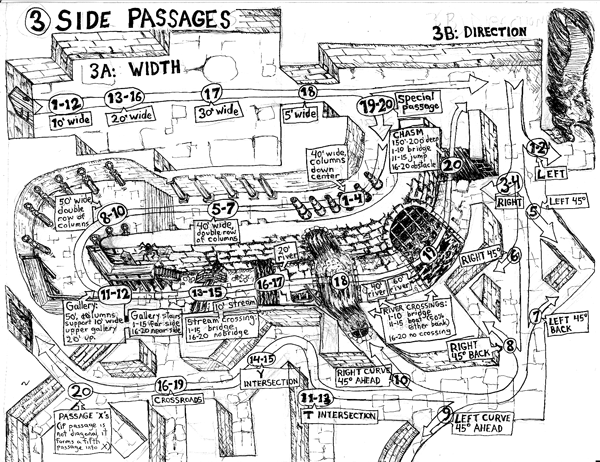
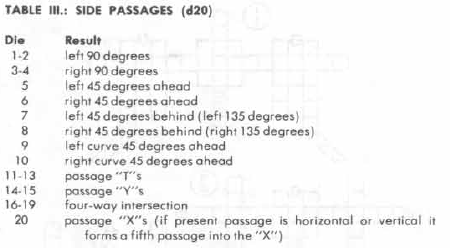
Also, here’s an unfinished piece of art from the poster I’m working on for next year. The random dungeon generator from the end of the 1e Dungeon Master’s guide, represented as a dungeon:

The original table:

99 rites of fairy creatures

Monday, December 12th, 2011

All fey creatures have a secret weakness rite – roll d100 on this table – and a secret strength rite – roll d100 on this table. If you accidentally perform a fairy’s secret weakness rite, you gain power over it – it is “beholden to you”, as they say. If it tricks you into performing its secret strength rite, you are beholden to it. Any fey creature’s rites can be learned with very hard arcana checks.

Fey creatures will expect one service or truth from creatures under their power. Fey in such a relationship will never attack each other.

Mortal beings tend not to understand these relationships, and may not honor the rules of service. Even mortals, though, feel the power of fey rites. A mortal beholden to a fairy creature, or a fairy creature beholden to a mortal, has a -4 to all skill checks and attack rolls against the master.

Even eladrin and elves have a weakness rite and strength rite, although most do not know it. Any mortal who drinks the emerald wine of the archfey gains a weakness and strength rite.

99 RITES OF FAIRY CREATURES
1 threaten to pick its one secret flower in all the world
2 surround it with water
3 weave a circle round it thrice
4 taunt it until it swells up to three times its size
5 carry it across a river in a bag over your shoulder
6 catch it bathing
7 wash its clothes in midnight’s blood
8 jump over it on deerback
9 act bored by everything exciting it says or does
10 find a bribe for its beetle butler
11 find its true feet
12 open the smallest door in its house
13 bring either a message or meal from its wife or husband
14 strike it with mistletoe
15 find the nest containing its babies
16 prick it with a thorn
17 make it taste honey
18 give it a clump of earth
19 draw its portrait
20 catch its reflection in a mirror
21 weave it a cloak
22 drink its tears
23 capture its mother
24 catch it in a lie
25 force it to admit it doesn’t know
26 heal its injury
27 boil it in a cauldron
28 step on a clover
29 listen to the birds’ advice about it
30 start every sentence with last word it said
31 call it by the wrong name
32 find a bat with its name
33 answer its riddle
34 beat it in a wrestling match
35 carry its heavy bundle of firewood
36 plant a seed ahead of and behind it
37 get its signature
38 drink dew from its footprint
39 sing a song it thinks no one can repeat
40 say a sentence it cannot rhyme (not orange, the fey made up the word “forange” to foil that tactic)
41 figure out its other form
42 owe it a debt of silver
43 pay its debt to someone else
44 tell it three different accurate names for yourself
45 control a fire it lit
46 dance to its tune
47 kiss it
48 sleep with it
49 walk behind it for a league of its choosing
50 walk widdershins around it
51 refuse a request thrice
52 get it to refuse 3 small favors
53 accept water from it
54 eat food it offers
55 steal its belt
56 throw a daisy chain over it
57 touch it with cold iron
58 behead it, then let it behead you
59 give it your hat
60 give it a silver coin
61 sip water from its cupped hands
62 draw a drop of its blood
63 pluck a rose from its house or hair
64 kneel before it while it stands
65 share an apple with it
66 walk on 9 of its footsteps in a row
67 dance with it in a circle
68 meet its eyes in a reflection
69 catch its breath in a box
70 swim after it
71 keep up in a race, neither winning nor losing
72 fall asleep while it wakes
73 wear a silver necklace
74 stand as godfather to its children
75 be blessed by a god
76 follow it dawn to dusk
77 repeat 3 phrases in a row
78 follow it home
79 find something it wants
80 call it king/queen
81 have it at weapon’s point
82 find its missing button
83 dance on its heart
84 convince it that it is ugly
85 give it a haircut
86 show it another creature that looks like it
87 sleep inside its mouth
88 herd its sheep for a day
89 name a real name it has never heard
90 step on its hand or catch its foot
91 let it dance around a hill under which is buried your name
92 point to its location on a map
93 lure it into your mouth with sugar cubes
94 touch it with an eggshell
95 ruin its hat
96 wash it clean
97 get it to believe you are a rooster
98 carry its head in a cedar box
99 beat it at a game 99 times in a row
00 roll again

bunny wights

Monday, December 5th, 2011

My wife “misremembered” some Eddie Money song lyrics:

Take me home tonight!
I don’t want to be a bunny wight

A bunny wight certainly doesn’t seem like the scariest kind of wight imaginable. Is there any way it could be given enough gravitas that it wouldn’t seem like something out of an April Fools edition of Dragon Magazine?

I think things from under the sea can be scary, so let’s say the bunny wights in question emerge, dripping and slimy, choked with weeds, from an angry ocean. They’re tall and anthropomorphic: pooka sized, taller than humans, with huge webbed bunny feet. They’re scaly instead of furry, as befits fishy creatures, and maybe with those rows of hundreds of sharp teeth possessed by predatory fish.

Bunnies are not predatory animals, though, so I don’t see bunny wights having the same hunger for human blood possessed by most undead. Rabbits are sort of tragic animals – the bottom of the food chain. Bunny wights come out of the water sad, leaden-footed, at the command of the creatures who once preyed on them. They walk in from the surf, one or two at first, with more behind, until an army of them is trudging on the shore, heads bowed, slimy ears dangling behind them like seaweed.

Each bunny wight has a thorn protruding from its chest: the claw that killed it. It’s a claw of the same terrible sea predator that now calls them to unwilling action. (Perhaps some spine-covered amenome from the far realms?)

I have a feeling that the bunny wights can fire their chest thorn as a weapon, and when they do, it tears out their heart and kills them.

I hope things work out for these bunny wights! They seem like they’ve had a tough time!

sorcerers as wizards (and vice versa)

Friday, December 2nd, 2011

This will probably be my last post about Roger Zelazny’s “Dilvish the Damned” short stories, which turned out to be one of my favorite D&D-ideas-inspiring sourcebooks ever, joining the motley collection of African Civilizations and Theophile Gautier’s Captain Fracasse. A lot of Zelazny’s fiction seems to be directly translatable to RPG content. And I haven’t even started Amber yet!

3e+ D&D takes a bunch of words for spellcaster that all used to mean the same thing – wizard, sorcerer, warlock – and makes them all different classes. In OD&D, Gygax took all the synonyms for wizard he could find and made them level titles – to lock up IP from potential competition, he said. But you can’t really copyright these words, and other authors are going to redefine them in their own ways.

Here’s Roger Zelazny’s definitions of wizards and sorcerers from Dilvish the Damned:

“But if that isn’t sorcery, what is?”

“Sorcery,” she replied, “is an art. It requires considerable study and discipline. One must generally apply oneself for a fairly long period even to obtain the relatively modest status I have achieved. But there are some other routes to magical power. One might be born with a natural aptitude and be able to produce many of the effects without the training. This is mere wizardry, however, and sooner or later–unless one is very lucky or careful–such a one gets into trouble from lack of knowledge concerning the laws involved in the phenomena. I do not believe that this is the case with your lady, though. A wizard usually bears some identifying mark visible to others in the trade.”

This definition – with sorcerers as academic porers over tomes and wizards as natural talents – is hilariously opposite the descriptions of wizards and sorcerers from third edition. Even many of the same words are used in the (swapped) descriptions. In the 3.5 PHB, sorcerers have “inborn talent” and “cast spells through innate power rather than careful training and study“. They are even “marked as different by their power“, like Zelazny’s wizard. The PHB wizard, on the other hand, must spend “years in apprenticeship“. Magic is “not a talent but a difficult art.

This kind of thing will happen a lot when you start ascribing different meanings to synonyms. For example, a different fantasy author could easily decide that hobgoblins were smaller than goblins. You’d also be perfectly justified in making goblins, hobgoblins, elves, dwarves, gnomes, and trolls all the same species.

a team of iron horses

Monday, November 28th, 2011
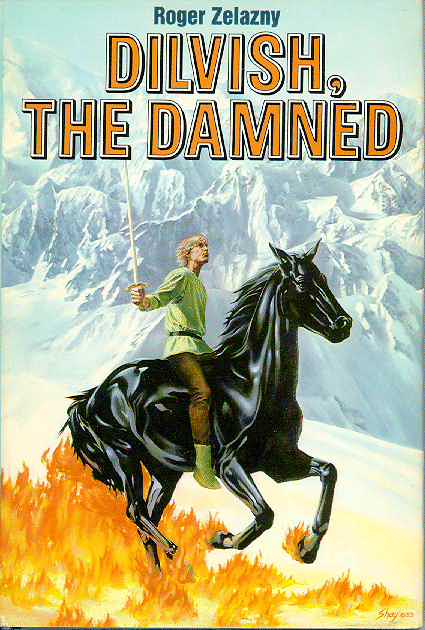
Her companion wore black breeches and green jacket and boots. His cloak was black, lined with green, and he wore a sword and dagger at his waist. He sat astride a black, horse-shaped creature whose body appeared to be of metal.
-Dilvish the Damned by Roger Zelazny, 1965
Rod froze, hand on the pommel of his sword; then he dug his heels into Fess’s metal sides, and the great black horse sprang toward the ruckus.
-The Warlock in Spite of Himself by Christopher Stasheff, 1969

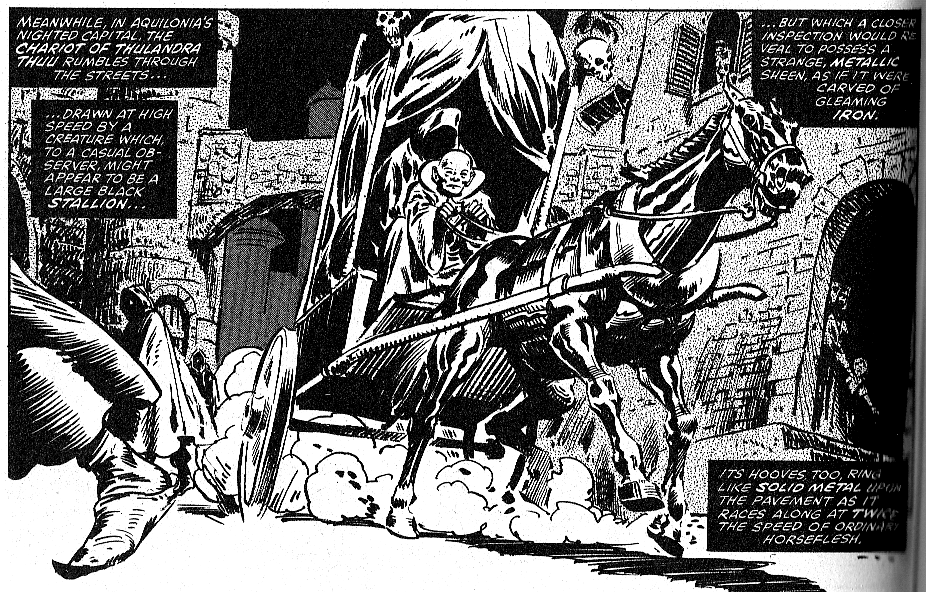
Meanwhile, in Aquilonia’s nighted capital, the chariot of thulandra thuu rumbles through the streets… drawn at high speed by a creature which, to a casual observer, might appear to be a large black stallion… but which a closer inspection would reveal to possess a strange, metallic sheen, as if it were carved of gleaming iron.
Conan comic based on Conan the Liberator by L. Sprague de Camp and Lin Carter, 1979.

What’s up with swords and sorcery being so hung up on black robot horses? I ran into these three just in books I read this year. Two of these sources predate D&D’s Obsidian Steed.