Author Archive

ancient junk in Gamma World

Wednesday, June 29th, 2011

Gamma world has exciting technological treasures (omega tech), but it also has an extensive Ancient Artifacts table that is, well, puzzling. It has a lot of the kind of items that the writers could see from their cubicles: hand lotion, mp3 players, etc. It’s a big percentile table that was included instead of the 4e rules on, say, charging, or recovering from unconsciousness.

It’s really hard to know what to do with any of this ancient garbage, but nevertheless, during character creation, you spend a lot of time determining exactly which junk you have. I actually chose to forgo a lot of my rolls on the Ancient Artifacts table. Then, during gameplay, we figured out what it could be used for. Ancient artifacts are currency.

We decided that the Dabblers (tech-loving raccoons) run stores, but they’re based on the barter system. You can get something you want (fuel for your motorcycle, ammunition) if you can get them sufficiently interested in the ancient He-Man lunchbox you dug up. We ran an entire barter-based session around acquiring cordless mice and a piece from a nonfunctional microwave from a dabbler warehouse (called “Beast Buy”: one of the players named it as a joke, and the GM went with it).

or they could be robots

Friday, June 24th, 2011

In Book 1 of the Thomas Covenant series, there’s a unit of 500 elite soldiers who are sworn to immortal service to a kingdom. The soldiers don’t age: they can only die in battle, or if they break their oath.

Such a unit are just as interesting as their oath of service. They’re totally trustworthy – to follow the letter of the oath.

If they’re sworn to serve and protect the king of a country, they can’t, of course, assassinate the king – but if the king’s younger brother performs the assassination, they will immediately transfer their loyalty to the murderer. If a userper takes the throne and performs the necessary rituals of kingship, who will they follow?

If their oath is to the king’s family, not to the Crown, they will keep on fighting after the king is deposed. After all but a handful are slaughtered, a few might decide that they can best serve the rightful king by spiriting him away and going in exile with him.

Imagine a young woman who doesn’t know her parentage. She’s served by two middle-aged servants who both exhibit motherly concern for her, and who have taught her considerable skill with weapons. At a certain age she’ll start to wonder why her servants have never appeared to age, and why she’s never had to pay them.

don’t plan it, He-Man it

Wednesday, June 22nd, 2011

When modern archaeologists excavate a site, they don’t dig everything up; they take samples. They do it because they have limited time and resources, and because they want to leave something for future researchers to examine.

That’s something I should remind myself while doing DM worldbuilding.

A complete archaeological excavation determines what’s present at a site, but it also determines what isn’t. A complete excavation would kill some of the magic of a site – strip it of its last mystery.

It’s a lesson that’s hard to learn. I’m the kind of person who feels the impulse to map out the whole D&D world, and determine where each monster lives – and which monsters don’t exist in my campaign.

Instead of that, I’m trying to switch to a core-sample approach, using the PCs as the core drill. We learn a lot about the PCs’ immediate area. Beyond that, there’s a lot of room left for future excavation.

The Chekhov Model

Years ago, I had the idea that everything had to be planned before you started a campaign. If your 3e campaign has a race of highly intelligent creatures who masquerade as ceilings (Cloaker, average Intelligence 14), surely a few Cloakers would have moved to the city and work as university professors or something. Like Chekhov’s Gun, every campaign element has to be introduced up front.

The He Man Model

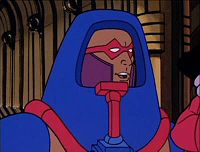
The thing is, he actually had many faces.

I’ve moved from Chekhov to a more appropriate literary model: He Man and the Masters of the Universe. He Man didn’t start with a huge cast of characters: it introduced new characters whenever the writers (or toymakers) thought of one. Where was Man-E-Faces before he was featured in an episode? Offscreen somewhere. Edgar Rice Burroughs’ Mars chronicles follow a similar model. Burroughs introduced a new continent, complete with a color-coded humanoid race, every time he needed an idea for his next book.

I’m trying to He-Man it from now on. I’m not banning dragonborn, for instance, but I’m not killing myself to detail their location in the world, either. If someone wants to be a dragonborn, maybe we’ll figure it out.

Halflings are a different story. Those little bastards are GONE.

what I learned from drawing the Monster Manual creatures

Monday, June 20th, 2011

From drawing all the Monster Manual creatures, I learned that some areas are not well suited for some PCs. For instance, you’re hard pressed to find any civilized opponents above level 10, or feywild creatures below level 6. I think that’s a feature, not a bug.

RPG video games where the encounters auto-level annoy me. I prefer video games with leveled zones, so I can move on to the next challenge when I feel I’m ready. In D&D it’s no different. If I was forced to pick, I’d rather have the world map marked out with levels, like an old-school dungeon map, than always be surrounded by monsters of exactly my level.

While both assumptions strain credibility, I posit that there is a speck of verisimilitude to be found in the “leveled world” hypothesis. Some wildernesses of the world ARE more dangerous than others. The Australian outback, where every animal seems to have the world’s deadliest poison, is more dangerous than Yellowstone. I hate to stone cold disrespect the grizzly bears like that, but there it is. Box jellyfish alone are way more dangerous than bears, never mind Australia’s 20-foot poisonous laser crocodiles.

a leveled world

If I create a level 11 area, does that mean that it’s brimming with level 11 villagers and farmers? No. I propose that the level of an area be the level of its most common PREDATORS. In D&D, villagers are at the bottom of the food chain – they’re PREY. Someone nearby – the king’s guard if they’re lucky, vampires or orc hordes if they’re unlucky – is more powerful than they.
(more…)

monsters in the palace of eternity

Friday, June 17th, 2011

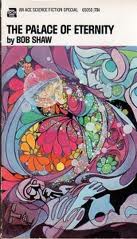
Bob Shaw’s “The Palace of Eternity” is a 1960’s sci-fi book featuring a pretty repellent alien race. They’re humanoid, except for

…the wide-set eyes, the two breathing mouths fluttering in the shoulders, and the vertically-slitted eating mouth on the central abdomen. […] The vital organs were externally positioned around the central spine, black and pale rubbery sacs which heaved and glistened wetly… and the aliens stank. […] A valve in the central alien’s lower gut popped loudly, spattering the other two with gray-and-white excrement.

Not a bad start for a horrifying Far Realms humanoid.

To start with, misplaced mouths are scary. This alien has three extra mouths, including a big “eating mouth” in his stomach.

There’s a lot going on here, so I’d make this creature a solo or elite monster. I’d make a fight against this monster a fight to stay away from the stomach-mouth. I’d give him long, multijointed arms, and have his main attack be to curl his arms, lover-like, around an opponent (a Grab), followed by an attack on the next turn which presses the victim tenderly against his chest, so that the eating mouth can start chewing.

The external organs are also fairly icky and should be spotlighted. I’d make them be separate targets which can be attacked by the PCs. A hit causes an explosion of vile fluids (a burst attack on everyone nearby) and ongoing damage to the monster as it leaks ichor.

The excrement is maybe too much, depending on how much you want to gross out your players. I’d change it to some vile-smelling acid, but keep some of the description the same (“A valve in the creature’s gut pops loudly, spattering acid on… [rolls dice]”

All in all, not a creature the PCs will want to fight a second time, especially the fighter who was half-chewed up by the monster’s torso teeth.

d&d and men’s jobs

Wednesday, June 15th, 2011

When I’m coming up with spur-of-the-moment NPCs, I have a bad habit of falling back on medieval gender roles. Unless I’m alert, I keep women out of certain NPC jobs.

In modern D&D, if you want to be a female barbarian with 18 strength, you can. Pronouns and sample characters in the 3e PHB and 4e are carefully mixed. (Although read John H Kim’s fascinating essay on gender roles in D&D and other RPG rulebooks: female sample characters in D&D books generally roll lower and get targeted by more attacks. But that’s beside the point.)

D&D is run by DMs, not rulebooks, though, so unconscious assumptions about gender archetypes will creep in. Thats why, in an anecdote I now can’t find, one of the 3e designers (Williams? Tweet? Cook?) designed NPCs first, and then flipped a coin for gender. This let him design an egalitarian world, despite whatever gender blinders he was wearing.

I always like to know what blinders I’m wearing, so I’ve been compiling a list of “men’s jobs:” NPC roles in which it doesn’t occur to me to put women. I’m going to try to change that, because unconscious stereotypes are boring and lead to the same types of NPCs appearing over and over.

Fence: I was designing a city for my picaresque thieves’ guild game, when it dawned on me that I could have my players sell goods to a female fence. Somehow this had never occurred to me. I blame literature, which has presented me with lots of examples of greasy, bearded old men acting as fences and pawnbrokers.

Come to think of it, I haven’t seen a lot of young men in this role either. My thieves’ world city has two fences known the the PCs: a greasy, possibly bearded old woman and an 8 year old boy.

Minion: D&D campaigns often feature lots of awesome female warriors, but where does that get you? 6 of the 12 Greek gods were female, many of them awesome, but ancient Greek women weren’t allowed to go outside.

I have some mental block that prevents me from putting women into the disposable minion category. Probably some gentlemanly impulse that it’s not OK to hit weak girls, but that it is OK to hit weak guys. But if there aren’t any low-level female fighters in the world, where do the high-level ones come from?

Sailor: Same deal as minions. My brain runneth over with pirate queens, but not with able seawomen swarming up the rigging to unfurl the mainsail. Sure, the Royal Navy, on which most shipboard fantasy is based, is a guys-only affair, but this is D&D, dammit! Women can have just as much aptitude as men for getting eaten by sahaguin.

Wizard: Some schools of magic suggest female NPCs and some do not. Enchantress? Sure. Witch? Sure. But I’m not likely to come up with a spur-of-the moment necromancer or alchemist woman.

Army officer: This is a strange one. The women I picture at the head of an army are usually warrior princesses, that sort of thing. Hereditary rulers. For some reason, I usually picture generals, colonels, and other high-ranking officers as male. What REALLY blows my mind is the idea of two armies facing each other, both led by a female general.

Innkeeper This one just occurred to me now: I have never, ever made up a jolly old female innkeeper. Barmaid, sure.

The next inn I make will be owned by a white-haired, talkative woman, probably with a name like “Tubbs”, who will do nothing but polish glasses and talk about broaching another cask of ale.

Farmer When I’m not careful, all the peasant women in my D&D countryside are farmers’ wives. In the D&D world, presumably property laws are egalitarian, and there are some gentlewoman farmers. Let’s get the ladies out there driving ploughs!

OK, with a few exceptions, these NPC jobs aren’t very high prestige. Maybe the women of my campaign world aren’t thanking me for their chances to become fences, peasants, and cannon fodder. Still. Breaking the glass ceiling! Or floor.

the silliest-looking 4e monsters

Monday, June 13th, 2011

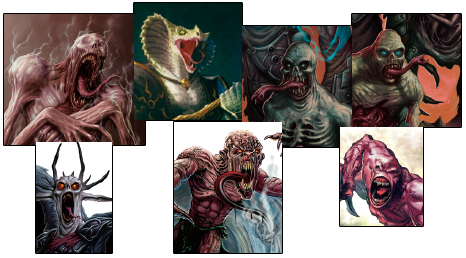
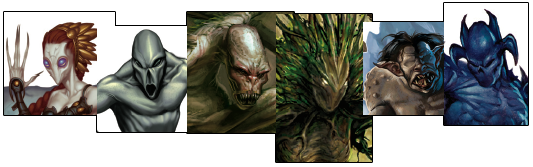
Drawing every creature in the Monster Manual made me realize how many silly-looking and/or undifferentiated monsters there are. Sometimes the same basic monster concept seems to pop up all over the place. That’s fine for time-tested concepts like “badass skeleton man with glowing eyes” (flameskull, lich, deathpriest hierophant, skeleton, skull lord, wight) and “bondage chick with creepy eyes” (marilith, succubus, doppelganger, drow, eladrin, shadar kai, vampire), but who asked for all these

Bald guys with long tongues

atropal, blood fiend, abyssal ghoul, devourers, sorrowsworn, yuan ti

atropal, blood fiend, abyssal ghoul, devourers, sorrowsworn, yuan ti

I’ll give the yuan-ti a pass, because being bald and having a long tongue is what snakes do. The rest of you guys should be ashamed of yourselves. Abyssal ghoul! Put that back in your mouth this instant!

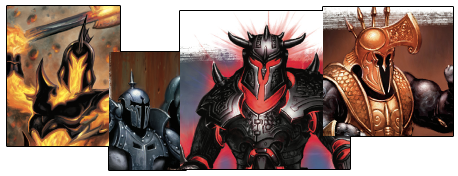
Guys who are helmets

archon, guardian, helmed horror, marut

archon, guardian, helmed horror, marut

There are some monsters, like the Death Knight, who are wearing helmets. These guys, though, all have heads that seem to be empty helmets. There might be some fire in there, but otherwise, that’s it.

guys who look like they’re wearing a stocking over part or all of their head

banshrae, bodak, choker, dryad, grimlock, nightwalker

banshrae, bodak, choker, dryad, grimlock, nightwalker

A monster with an alien, featureless face is pretty creepy. Get too many together, though, and it it just looks like they’re planning to rob a 7-11. This picture is like two faces spread over six guys.

the Little Lord Fauntleroy D&D campaign!

Friday, June 10th, 2011

D&D adventures based on a sentimental novel by the author of A Little Princess?

“There is a place,” said Fauntleroy, looking up at him with wide-open, horror-stricken eyes – “Dearest has seen it; it is at the other end of the village. The houses are close together, and almost falling down; you can scarcely breathe; and the people are so poor, and everything is dreadful! Often they have fever, and the children die; and it makes them wicked to live like that, and be so poor and miserable!

High-level D&D characters share a problem with Little Lord Fauntleroy’s grandfather (a crusty old aristocrat with a heart of gold). What the heck do you spend your money on?

3rd edition and early 4th edition D&D expects characters to buy their own magic items, but in other editions, it’s pretty easy to pile up piles of money and have nothing to spend it on. Besides money, D&D characters often accumulate honors (knighthoods, noble titles, etc).

Have a horrified NPC describe the miserable conditions on one of the PC’s new properties. It’s the PC’s responsibility to spend lots of money to fix things!

This might successfully drain money, but will it be FUN? It might be – if the DM imposes complications. People love to overcome complications. Maybe things don’t go well right away: someone is embezzling building funds, and the PCs need to find out who; or a criminal organization moves into the newly renovated village.

When everything has been worked out, the PC’s land becomes an idyll, and the PC starts getting some benefit from it. Maybe the PC gets rent income, or the ability to raise a loyal militia.

I wouldn’t run this as a full-scale adventure. Rather, I’d have this be a continuing mini-game where the PC make a few quick decisions every time they returned to town, either at the beginning of the session or maybe over email.

where did Iron Rations come from?

Thursday, June 9th, 2011

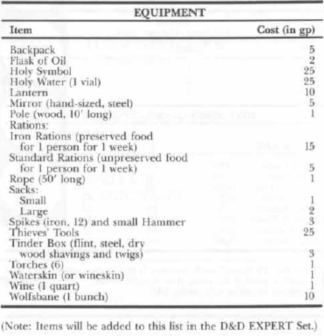
Old school D&D players resonate to the term “Iron Rations”, but where the heck did it come from? Is it even a thing?

1983 Basic equipment list.

1983 Basic equipment list.

From Wikipedia:

“Iron Ration”

The first attempt to make an individual ration for issue to soldiers in the field was the “iron ration”, first introduced in 1907. It consisted of three 3-ounce cakes (made from a concoction of beef bouillon powder and parched and cooked wheat), three 1-ounce bars of sweetened chocolate, and packets of salt and pepper that was issued in a sealed tin packet that weighed one pound. It was designed for emergency use when the troops were unable to be supplied with food. It was later discontinued by the adoption of the “Reserve Ration” but its findings went into the development of the emergency D-ration.

Apparently iron rations were based on World War I-era rations, something Gygax and his historical-war buffs friends would have been familiar with. I’d always assumed that the D&D iron ration was like a badass trail mix, or maybe a granola bar. The actual World War I iron ration sounds solidly less delicious than that. The chocolate bar sounds OK though.

I do remember reading a few adventure books from the World War I era where action-hero types ate chocolate in order to power up. Nutritionists must have recently discovered its energy-boosting properties. One instance I remember is in the Richard Hannay books (spy adventures by John Buchan, including The 39 Steps, later made into a Hitchcock movie). Richard Hannay is ALWAYS talking about chocolate; it is part of his standard adventuring kit, very much the way iron rations would be for a D&D character.

I just did a quick search on Google Books: in the four Richard Hannay novels, chocolate is mentioned 18 times. Usually it’s part of travelling food: “I have some food in my rucksack – biscuits and ham and chocolate”, “sitting on a rock munching chocolate and biscuts”, but it’s also used as a poor man’s stimulant: “I rubbed his arms and legs and made him swallow some chocolate.”

I wonder if this means that chocolate is canonically in the D&D universe now, the way it is in the Star Wars universe?

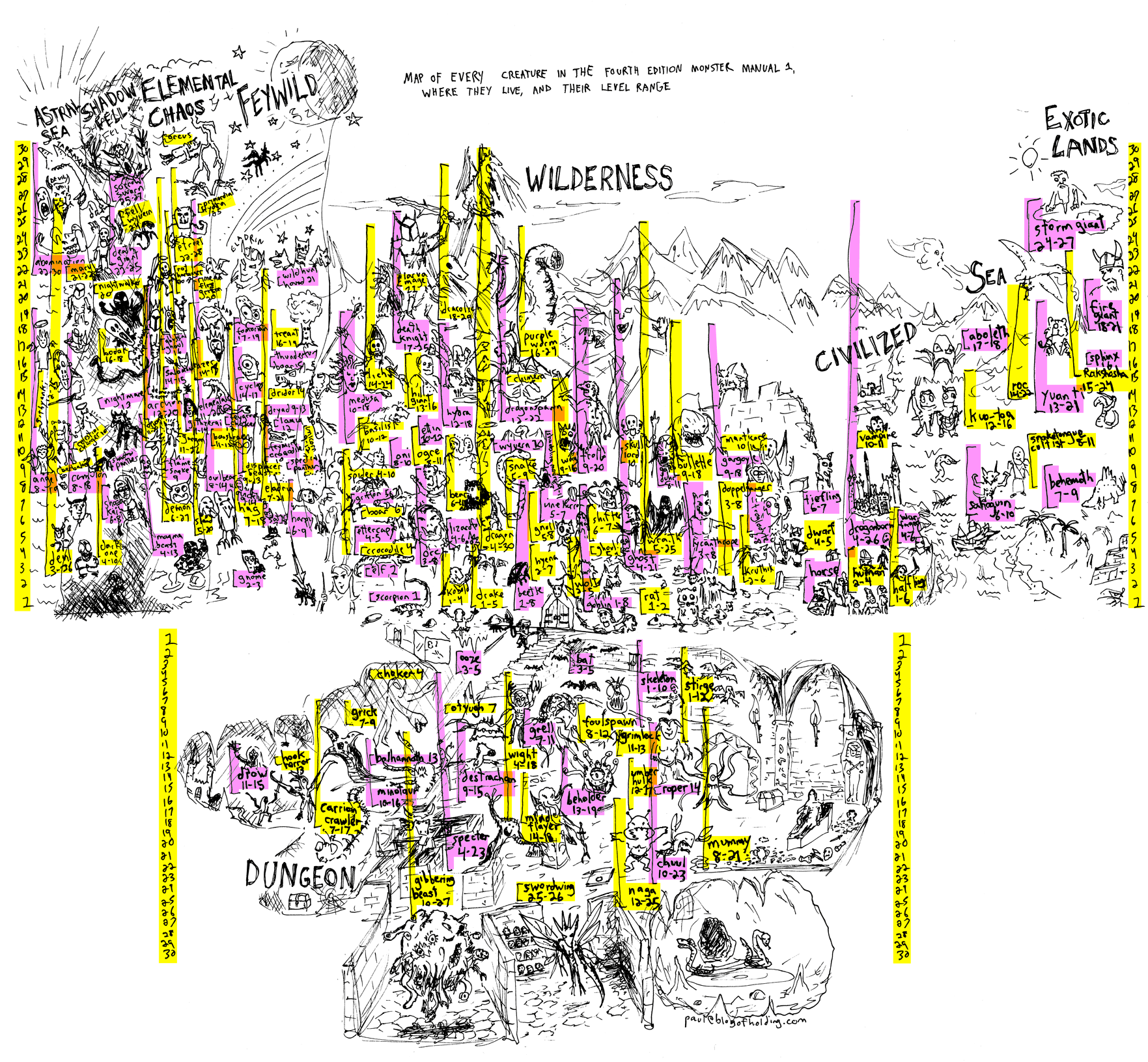
a picture of every creature in the Monster Manual 1, where they live, and their level range

Monday, June 6th, 2011

Every creature in the Monster Manual

(Click for unreasonably large size)

I crammed pretty much every MM1 creature on one image.

Every monster has a level band, showing the level range between the highest and lowest version of the monster. Monsters are divided up according to their most common location: the planes, the wilderness, civilization, the sea, exotic lands, and the dungeon.

Although it’s not necessarily the best way to make encounters, you could cross-index the level and location of your party and see at a glance all the monsters they’re likely to encounter.

Assumptions:

  • For level band purposes, I’m ignoring minions, which I believe are game constructs for representing monsters of significantly lower level.
  • I’ve made a lot of judgment calls. Some creatures with planar origins are common in the natural world, but I only drew them once. I tried to rely on flavor text. A lot of undead can be found anywhere; I’ve somewhat arbitrarily split them between the wilderness and dungeon, depending on whether I associate them with crypts.
  • I didn’t plot monsters constructed by wizards, such as battlebriar, boneclaw, colossus, eidolon, flameskull, golem, guardian, helmed horror, homunculus, and zombie. I did include skeletons, which tend to outlast their creators.
  • I’ve also identified some monsters as “exotic”: creatures likely to be found on lost continents, distant deserts, and frozen wastes, not the magical Europe that most D&D campaigns start in. Culturally imperialist distinction? Perhaps.
  • I’ve generally anchored monster names at the bottom of the level bands because I think that the low-level versions usually represent the bulk of the species, and the high-level versions are usually leaders or champions.