Author Archive

Critical hit! On my Religion check!

Thursday, May 12th, 2011

I figured out how knowledge checks fit into the 20 and 1 are magic rule.

If you roll a natural 20 on a knowledge check, you write down on your character sheet that you have expertise in a particular sub-branch of knowledge. From then on, you get a +5 bonus to all such knowledge checks. For instance, if you crit on a knowledge check about the Death God’s sacrificial rites, you write down “expert in Death God rites”.

If you roll a natural 1 on a knowledge check, you write down your ignorance on the subject (“ignorant about Death God rites”.) From then on, you automatically fail on any checks on that subject.

This lets you collect knowledge like treasure, and randomly fills out your character’s interests. It also lets a good or bad Knowledge check inform further ones.

flaming oil through the editions

Wednesday, May 11th, 2011

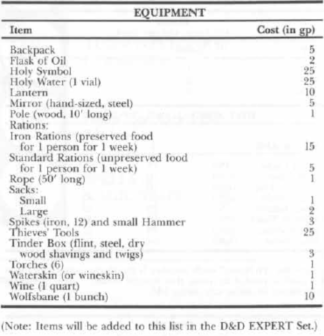
I just looked up flaming oil in my Basic D&D book. It did 1d8 damage on the first round and 1d8 in the second. Of course, it was more complicated than its watered-down 4e equivalent, Alchemist’s Fire: with Flaming Oil, you had to douse a guy with oil and then make an easy attack roll to set the enemy on fire.

1983 Basic equipment list.

1983 Basic equipment list.

Still, 2d8 was a lot of damage in Basic D&D. Keep in mind that all weapons do 1d6: variable weapon damage is still listed an optional rule in my 1983 Basic set. Even with the optional rule, oil’s average of 9 damage is the same average as a fighter with 18 strength and a +2 longsword. It’s enough, on average, to kill a 2-hit dice creature in one shot. It’s hard to compare, but in 4e, to kill a 2nd level creature in one hit would take about 40 damage.

There wasn’t much monetary inflation between Basic and 4e – a Basic sword costs 10gp and a 4e sword costs 15 gp – but Basic flaming oil costs 2gp. That’s a tenth of its cost in 4e. Cheaper and more effective.

By the way, I notice that the new 4e alchemist theme allows you to use a free alchemical item as an encounter power. That improves alchemy considerably.

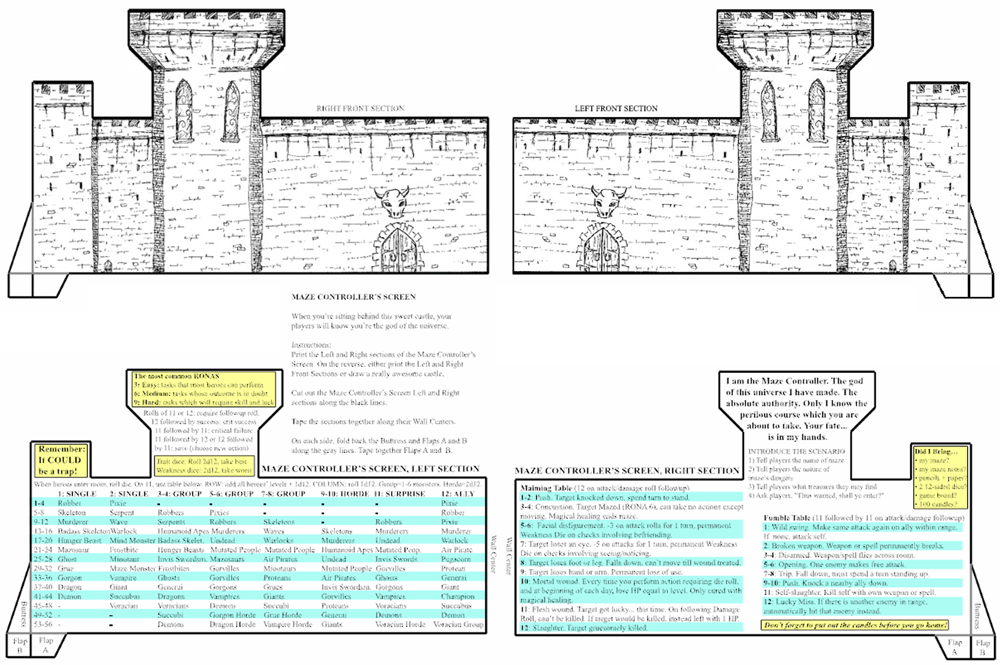
Finally you can have your own sweet Mazes and Monsters GM screen!

Monday, May 9th, 2011
This entry is part 33 of 34 in the series Mazes and Monsters

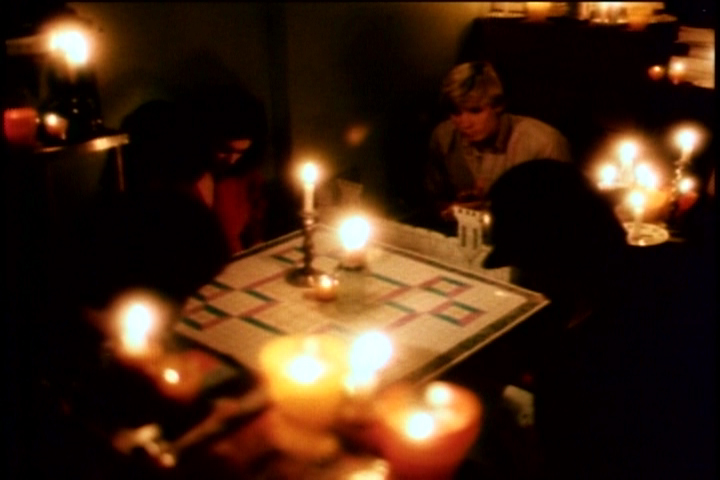
The original Mazes and Monsters MC screen.

The original Mazes and Monsters MC screen.

Or Maze Controller’s Screen, to be more precise. Just like the one that Daniel rocked in the movie.

I’ve made a printable screen that is JUST AS COOL as the original, and it has all the Mazes and Monsters charts you need to run the game. (Edit: I’ve added a blank template as well, for use with other games: see below.) Wandering monster matrix, Maiming Subtable, it’s all here. It looks something like this:

Click for a bigger view

Click for a bigger view

Here are all four PDFs you need to construct it. They’ll be in the completed M&M PDF.
left front section
left section
right front section
right section

Or if you want blank templates so that you can play with your own rules of choice but LOOK like you’re playing Mazes and Monsters, you can use these instead of the left section and right section:
left section (blank)
right section (blank)

I’ve tried printing and cutting it out, and the completed castle looks pretty nifty. I can’t wait for my next M&M playtest.

Atta

Friday, May 6th, 2011

Atta by Francis Rufus Bellamy

Atta by Francis Rufus Bellamy

I’ve always found giant ants to be a boring monster. The foot-long giant ant dungeon pests of 1e are actually OK for an encounter; but the horse-sized formians and similar races seem to require a whole adventure or episode of their own, and the idea of raiding an anthive and killing hundreds of identical monsters fills me with a naptime feeling.

Francis Rufus Bellamy’s 1953 adventure novel, about a guy who shrinks to half an inch tall and adventures among the ants, strikes me as the right way to go about using formians in a game. This way, you don’t need to put aside a part of your world to be ruled by a giant ant kingdom; you can vary the encounters with battles against giant bees and grasshoppers; and you can have a boss fight against a badass shrew. Those guys are super mean and scary looking! And they can be any size from half an inch to a foot long! You can use any of the excellent official D&D shrew minis already in your possession.

A super weird looking shrew.

A super weird looking shrew.

While your PCs are shrunk, have them make discoveries about their familiar surroundings they couldn’t normally make. Perhaps they climb into a tiny crack in the wall, and discover Diamond as Big as the Ritz, or a giant gold ring. When they return to their normal size, they can retrieve it. (Come to think of it, a ring makes some interesting defensible terrain for ant-sized PCs, forming a little fortress around one or four squares, behind which they can take cover.

The key to an interesting ant adventure is to make the ants sentient, as Bellamy did. Have the PCs choose sides in a war between an ant colony and a rival colony of slave raiders. Have them befriend ants, and ride them like mounts in daring cavalry attacks. When the PCs return to normal size, maybe they’ll have different feelings about the ants scuttling beneath their feet, over whom they now have such power.

burning through your flaming oil

Wednesday, May 4th, 2011

I’m reconsidering last week’s post about making alchemical items into encounter powers. Maybe part of the charm and flavor of flaming oil, holy water, and the rest are that they are expendable resources, like potions – part of the long-term resource management aspect of the game. In old school D&D, you’re like, “I have some money… I’ll get some chain mail, and some iron rations, and… let’s say 3 flasks of oil.” I dunno. Is the expendability an integral or nonessential property of a flask of oil?

What’s more fun:
a) “Holy crap, this is a dire situation! I’ll use my flask of oil to set these guys on fire.”
or
b) “It’s round 4 of combat and I’ve used my encounter powers. I’ll use my flask of oil to set these guys on fire.”

Keep in mind that in situation b) you get to set a lot more guys on fire.

Complete Gary Gygax Enworld Q&A, all on one page

Monday, May 2nd, 2011

If you’re interested in the history of D&D, one of your best resources is the long-running enworld “Ask Gary Gygax” threads. From 2002 to 2008, Gary Gygax answered a heck of a lot of fan questions. Unfortunately, there are over 500 pages in the Ask Gary threads, so if you’re looking for a specific anecdote, you have a lot of message board pages to click through.
For your Ctl-Effin’ convenience, I’ve compiled all of “Col. Pladoh’s” Ask Gary message board posts onto one (long) page.

Note: I edited Gary’s enworld posts into a book, Cheers Gary, for the Gygax Memorial Fund. At the request of the Gygax Memorial fund, I have removed this complete transcript of the Enworld Gygax Q&A. If you want to read his opinions, you’ll have to read them on enworld or await a second edition of Cheers Gary. I wish the Fund the best and hope they get the second edition printed soon.

treasure of the unicorn gold

Friday, April 29th, 2011

The Magazine of Fantasy and Science Fiction, Oct 1981

The Magazine of Fantasy and Science Fiction, Oct 1981

I lost my 1981 issue of the Magazine of Fantasy and Science Fiction, so I can’t make a scan of the bizarre real mystery it contains.

Among the usual contents of the magazine (fantasy and science fiction stories, mostly) was an ad for “unicorn gold”. I don’t remember the ad very well, but I don’t think it was clear about what it was for. I think it was one of those oblique buzz-creating ads, like the spots in the old Strategic Review magazines that just said “The Dragon is coming!!”

The Unicorn Gold ad caught my eye because it had messages written in runic. Because of a childhood misspent playing the Ultima games, I can sort of read runic script. I remember translating the runes – but I’ve now forgotten what they said. I feel like the dad in Indiana Jones and the Last Crusade. “I wrote them down so I wouldn’t have to remember!”

After my copy of the magazine was stolen, I went online to see if I could find any information about the ad. What was it for? Did anyone else remember it? And that’s when things got weird.

It seems that it was part of a promotion for a 1980 Steve Jackson RPG called The Fantasy Trip. One of the RPG products was called “Treasure of the Unicorn Gold”. As part of the advertising campaign, the book was part of a real treasure hunt: a real golden unicorn statue was buried somewhere in the United States. The RPG book contained hidden clues to its location, most of them oblique and many of them in heiroglyphics or other ciphers.

Here’s the thing: the publisher, Metagaming, went out of business before the contest ended. The golden unicorn was never found. The people who buried it have stayed silent about its location.

Here’s a story about a guy who went on a road trip to find the unicorn, and his solution for the puzzles. He didn’t find the unicorn, but he thinks he came close.

The unicorn statue is probably long gone – or, in the midst of Metagaming’s financial troubles, they never buried it at all. That would explain their later silence on the issue. But maybe it’s still buried, and some intrepid puzzle solver will find it some day.

I keep thinking about the ad in my lost copy of the Magazine of Fantasy and Science Fiction. I haven’t been able to find any scans of it online, or mentions of it in the lists of Golden Unicorn clues. What did that runic message say? Was it a clue, like the message on the back of the medallion in Raiders of the Lost Ark that tells searchers to subtract 1 kadam from the measurements given on the front?

There’s a fantasy for you. Maybe there’s a treasure still out there, buried somewhere in the United States, just waiting for someone who can find and read the map.

If you want to run an alchemist character, you probably want to roll on random tables

Thursday, April 28th, 2011

Yesterday I proved (to my own satisfaction) that 4e alchemy doesn’t work, and suggested using Gamma World ammo rules as a fix. Today, let’s tackle problem 2: that 4e alchemy is not enough fun for the type of people who want to be alchemists.

There are two reasons to use alchemical items:
1) to fill out your party’s abilities with a few situational attacks, for instance burst attacks or attacks with a certain damage type
2) because you want to play a giggling experimenter, like Dragonlance gnomes or Warcraft goblins

The first group is pretty well served by the existing alchemy rules, which basically provide wizard-like powers to anyone who can throw a vial.

The second group is going to be disappointed by alchemy. It’s a predictable power level? I don’t mix anything? I won’t accidentally cause an explosion, from which I will emerge, comically sooty, and pronounce “IT WORKS!”? What kind of alchemy is this, anyway?

If ever there’s a character archetype who needs random charts to roll on, it’s the alchemist.

Let’s try this:

People with the Alchemy feat get access to a new encounter minor action called “Tinker”.
(more…)

alchemy makes you go bankrupt

Wednesday, April 27th, 2011

In this post, I set out to

  • propose that the 4e alchemy system is overpriced for its power;
  • prove it; and
  • offer a solution.

    Alchemy is not used

    I remember that in earlier editions, my D&D groups relished tossing holy water, and, even better, dousing enemies with oil and lighting them on fire. However, in my current group, no one seems very excited about the alchemy rules.

    Furthermore, I don’t think there have been a lot of message board posts, Dragon articles, or gamebook support of alchemy after its introduction in Adventurer’s Vault in 2008. People don’t seem very interested in the 4e alchemy implementation.

    My first intuition is that alchemy is overpriced: the cost for making a one-shot level 1 alchemical item is 20 gp! That’s a big chunk of change for a level 1 character, comparing unfavorably with “free” for at-will, encounter, and daily powers, so they’d better deliver. I decided to crunch the numbers and compare alchemical items against at-will attacks.

    CRUNCHING NUMBERS

    STEP 1: How much damage do alchemical items do?

    I’ll look at 3 representative items: holy water, alchemical acid, and alchemical fire. I’ll assume level 1 characters using level 1 alchemical items vs level 1 monsters. All these items attack Reflex with a +4 bonus, which is comparable to level 1 characters’ other attacks, and hits the average level 1 monster’s Reflex defense around 60% of the time. Damage expectation will be based on 60% of the damage scored on a hit plus 40% of the damage scored on a miss.
    (more…)

  • a city map you can use

    Monday, April 25th, 2011

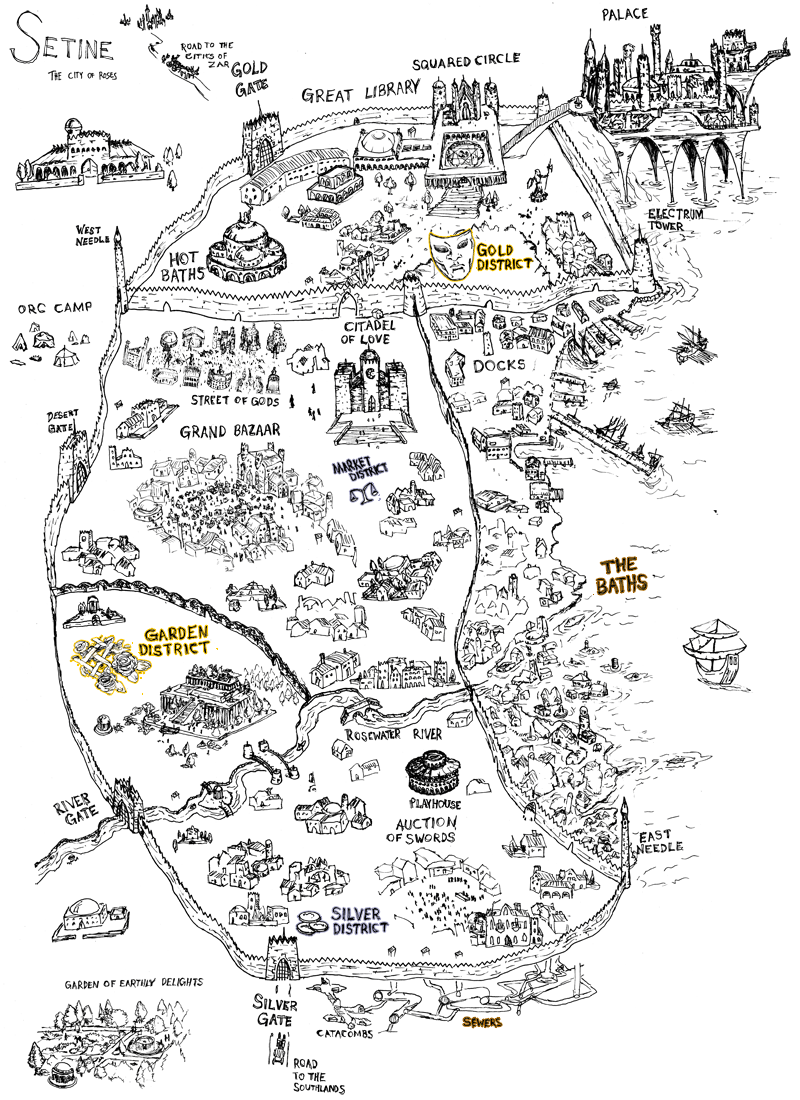
    I drew this map for two marathon sessions of picaresque gaming this weekend, and the players seemed to like it. You guys can use it if you want:

    If you’d like to print it, here’s a PDF version.

    Here’s a couple of things that happened in Setine over the course of the weekend:

    -Rory (playing the new Vampire class to the hilt) purchased the loyalty of enough guild beggars to attract the notice of Vomit, the leader of the beggar’s guild. Vomit looks to be gearing up for a turf war.

    -The cleric of St. Jimmy has gotten his ludicrous cult recognized as an official civic religion. Tenets of the religion include the fact that St. Jimmy has a volcano in his forehead and there are mermaids swimming in your well water. The business formerly known as Hank’s Hardware is now known as St. Jimmy’s Temple, Hardware, and Gifts.

    -Claire, the disgraced paladin, discovered the rotten core at the center of the Temple of Love. (The PCs subsequently stole the rotten core and fenced it for much less than it was worth.)

    -The Playhouse is performing a 15-minute-long onomatopoeic play by Bang the Wizard, in which an eladrin falls off a ladder. It sounds pretty artsy to me, but apparently it’s doing pretty well. Unfortunately, Bang didn’t read the fine print of the contract and accidentally signed herself into a five-year commitment.

    -The apprentice thief needs to plan a masterwork robbery in order to be promoted, and couldn’t be happier. On the other hand, the avenger is beginning to discover the nature of his god, and isn’t quite as happy about it.

    -Lord Percival spent a lot of his money on a horse, which he lost, and the rest of his money ended up in the pocket of his butler.