Author Archive

fantasies and scenarios

Monday, January 17th, 2011
This entry is part 20 of 34 in the series Mazes and Monsters

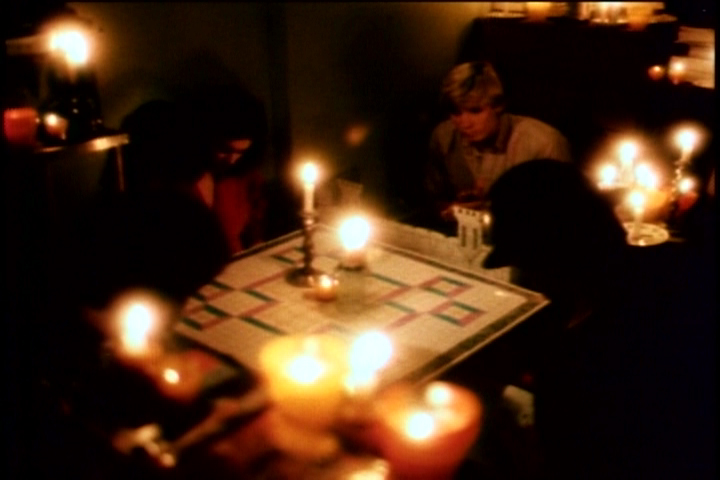
Mazes and Monsters board

TOM HANKS: I played a game called Mazes and Monsters a little too much.
KATE: No kidding. What level?
TOM: Uh, nine. Ninth level.
KATE: So am I! Isn’t it wonderful to be finally creating your own scenarios?
TOM: Yeah, yeah, and your own fantasies too!

OK, the above dialogue raises a few questions. For instance:
WHAT

It’s hard to see how these fit into standard RPG structure, and, indeed, upon first hearing, it sounds like arrant nonsense – nonsense that merits slaps to the writer. But if we’ve learned nothing else, we’ve learned to TRUST MAZES AND MONSTERS. If we haven’t learned that, we’ve learned nothing.

And we’ve been wasting our time.

Scenarios

Here’s my theory: a “scenario” is the intro text that introduces an adventure. For instance, “You stand before the palace of the Ghosts of the Gravelands. Fell spirits float through its ancient corridors. It is rumored that among the palace’s treasures are mighty gems that may trap men’s souls.”

At ninth level, players gain the ability to write this intro dialogue, thus choosing the nature of the maze, typical monsters or a boss who inhabit the maze, and the kind of treasure that can be gained. The Maze Controller still writes and controls the adventure within these parameters. After all, the Maze Controller’s powers are like unto those of a god. Even gods take suggestions, I guess.

Fantasies

We know that Mazes and Monsters grows progressively more psychologically difficult (and powerful) as you advance in level. However, we haven’t really explored the dangerous world of the unconscious mind. Our current rules sound like pretty vanilla 80s RPG design. We need to push the pop-psychology envelope with our Fantasy rules. As Blondie says, “We work out our problems in the caverns and then we leave them there.”

Like scenarios, fantasies must give players some agency over the perils they face. Again, Mazes and Monsters anticipates the shared narrative of modern indie RPG design.

Let’s start by getting some information about the players’ psyches. We’ll use this information to populate the game’s mazes with suitably cathartic (or destructive) challenges. At various levels, every player rolls a d12 to select a question from the following chart and gives the answer to the Maze Controller.

1. What makes you angry?
2. What betrayal do you fear?
3. In what way do you feel like a failure?
4. What part of your behavior feels out of control?
5. What’s one thing you’d like to preserve from harm or change?
6. What would you like to tell someone so they really understand? Who?
7. What do you worry about most?
8. What would make you a success?
9. What would you like people to admire about you?
10. Describe your most frightening nightmare.
11. What event could drive you to madness or despair?
12. What magical power would allow you to solve all your real-life problems?

Armed with this information, the Maze Controller can create thinly-disguised, hamhanded challenges and rewards that have real psychological effects on the players. These are called “fantasies”. For instance, if a player says that they would like the power of resurrection to bring back a dead relative, you make up a pretend relative of the character, kill them off, and then offer the character a quest that will let them conquer Death! The Maze Controller can do real psychological healing! Or harm. Hard to predict which. That’s part of the fun!

Example of play:

Maze Controller: OK, Tom, your real brother died, right? Your character, Pardieux, has a brother, and he just died. You watched him fall off a building! As he fell, he called, “Help me, brother!” but you were too far away!
Tom: (weeps)
Maze Controller: If you can find the Clock of Chronos, you can reverse those events! It will be as if it never happened. The Clock of Chronos is in the Dungeon of Lemnos…

At level 9, players can “create their own fantasy”. Once per level, they may seize control of the story and narrate their own thinly-disguised challenge, quest or hero’s journey. The Maze Controller sets all the RONAs and makes the dice rolls, but otherwise, the player has control over the fantasy until it has been conquered – or until it conquers!

Example of play:

Maze Controller: OK, guys, you’ve just returned from the Maze of Whispers. You –
Tom: Just a minute: I’m creating a fantasy. My character gives his earnings to his brother, who immediately runs away and gets lost in the city. After a few days, he has been robbed and beaten. He’s starving in an alley… he’s attacked by thugs… he cries out! “Brother! Save me!” but I’m to far away to help! He’s… (weeps)
Maze Controller: Right. Guys, if you can run through the mazes of the Slums of the Golden city, you MIGHT be able to intervene before Tom’s brother is killed.

Wow, it sounds really irresponsible to hand that kind of manipulative emotional control to people with no psychological training! Unless, of course, those people are fully licensed Maze Controllers or players able to play at the 9th level.
Next week: traits!

interrupting spells in 4e

Friday, January 14th, 2011

“He’s a dark elf wizard and he’s put some kind of hold on Derek!” Elistan cried. “Keep him from casting spells!”

-The Magic of Krynn (Dragonlance Tales, Volume 1)

Every D&D rule change comes with tradeoffs. In 4th edition, wizards were rebalanced. The advantage is that they are no longer overpowered compared to other classes. The disadvantage is that they are no longer overpowered compared to other classes.

I kind of miss the panic that set in when earlier-edition parties met a wizard, and all the maneuvering (by the party and the DM) to hit a wizard before he finishes his spell. However, honestly, 4th edition works perfectly well without it.

That’s not a reason to tinker with what ain’t broke, though. I’d like to try to return wizards to their place as fearsome super-artillery without overpowering them (much). Here’s my plan.

4e wizards may cast attack spells normally, or they may cast them as a “rite” (sort of halfway between an attack spell and a ritual, and analagous to 3rd edition spells with a full-round casting time). Casting a spell as a rite ends your turn and has no immediate effect.

On your next turn, you may finish the rite as a standard action. You cast the spell normally, except that any hit by the spell is a guaranteed critical hit.

During your casting of the spell, you are saying magic words, performing ritual gestures, and doing other wizardy things. If your concentration is broken, you lose the spell. Non-damaging forced movement, being knocked prone, being grabbed, etc. forces an Endurance check of 5 + 1/2 the attacker’s level to avoid breaking concentration. If damage is done to the wizard, the DC of the Endurance check is equal to the damage.

Is this option too underpowered (never used) or overpowered (always used)? It seems to me that it will be situational. Spending two turns to do slightly more than double damage starts out pretty balanced; if it’s successfully used with a daily power, it’s quite good indeed. However, if there is any chance of the rite being interrupted, it might be too risky to use it. Wizards might only use it when they’re in a position where they think they can avoid attack for a turn.

Rites might be used by the DM more often than they are used by PC wizards. A wizard who has begun a rite becomes a fearsome threat and may cause an abrupt change in the PCs’ tactics.

the mountains are coming

Thursday, January 13th, 2011

From my folder of half-conceived plot hooks:

a diviner has a dream, and is terrified. All he does is repeat “The mountains are coming!”

level 1 nuke spell

Tuesday, January 11th, 2011

I must be insane. It occurred to me to give a SPELL THAT AUTO-KILLS EVERYONE to EVERY WIZARD. And I kind of think it’s a good idea.

Let me explain my thinking. Ever since 1e, one of the fundamental conceits of D&D has been that the PCs wander through a dungeon and run into bite-sized encounters. Even if the dungeon is occupied by, say, a tribe of orcs, the orcs never mass into an army: they run into the PCs in dribs and drabs until they are all slaughtered.

It would be pretty stupid to try to find an in-game explanation for this. But let’s start down that dark path. How can we justify this?

If it was well-known that every wizard had a daily spell that allowed them to effortlessly slaughter armies, it would change the world’s military tactics. You wouldn’t mass into an army as much. If you did, you’d risk losing your entire army to one spell. You’d be better off dividing your army into several units which traveled separately. Suddenly, military forces look a lot more like D&D adventuring parties and their adversaries.

What if an adventuring party invaded your dungeon? You’d have your units widely spread apart, hunkered down in separate rooms. That way, you’d be nullifying the advantage of the wizard’s nuke spell.

OK, that’s my “simulationist” thinking. Here’s my “gamist” thinking.
(more…)

mazed in monsters

Monday, January 10th, 2011
This entry is part 19 of 34 in the series Mazes and Monsters

OK, we’ve got pretty much a complete game out of Mazes and Monsters. We’ve figured out combat, skills and spells: everything we need for a generic sword-and-sorcery game.

All that’s remaining are a few Mazes-and-Monsters-specific rules hints dropped by the characters. Frankly, a lot of them don’t receive a lot of rules support in the movie at all, and some almost seem like offhand fake-jargon that’s being made up on the spot. But we know that
THAT’S
NOT
TRUE.

There is Underlying Truth to be found here: we just have to dig it up.

Get your shovels!

Mazed

One of the focuses of Mazes and Monsters is the thin line between fantasy and reality.

Equally thin is the line between players and characters. Both players and characters can become confused about what’s real and what’s not.

We’ve determined that when a character is confused, they enter the “Mazed” condition. A Mazed character’s mini is placed in a special square on the Mazes and Monsters gameboard, which I will call the “Maze Prison”.

Mazes and Monsters boardWhen a character is Mazed, their perception of reality can be skewed by whoever is imposing the condition. Friends may appear enemies and vice versa; an open door may appear to be a solid wall; or the character may be totally immersed in a fantasy world that has no connection to reality (or, technically, a fantasy world that has no connection to the shared fantasy world of Mazes and Monsters: a higher level of fantasy, if you will.) All details of the fantasy are determined by the creature or effect that imposes it.

The power of a Maze is measured by the RONA check to escape it. Like other RONAs, it ranges from 3 (Easy) to 9 (Hard).

When an effect Mazes you, you may make an immediate RONA check to shake off the illusion. If you succeed, it exerts no more power over you. If you fail, you are locked into the illusion until some outside force challenges your delusion. Such an event is called a Maze Disruption, and it allows you to make a new RONA check, against the same difficulty, to break free of the illusion. If this new check fails, you incorporate the disruption within the Maze delusion, and that same effect will no longer provide you with a chance to break free.

Example Maze Disruptions:
-If you’ve been Mazed to believe an open door is a solid wall, you may make a new RONA check if someone passes through the door.
-If you’ve been Mazed to think that your friend is a fierce Gorville, you may make a new RONA check if your friend talks to you and reminds you of your shared friendship.

Caution: According to Mazes and Monsters, these are rules for real life as well!

Next week: We’ll cover more movie jargon, “fantasies and scenarios”! Will this be the sexiest Mazes and Monsters article yet??

African Civilizations: best sourcebook ever

Friday, January 7th, 2011

African Civilizations by Graham Connah

African Civilizations by Graham Connah

Wow, I got more than a dozen blog posts about game ideas out of this book. This book gave me more D&D inspiration than most WOTC sourcebooks I can remember. Not surprising: books of archaeology and history are likely to spur a lot of campaign settings ideas.

A book about Africa is uniquely suited to D&D idea mining. For one thing, it’s unfamiliar. Your D&D group may have some medieval history buffs in it. Fewer groups have any Africa experts. I never learned about pre-colonial African history in school. (In fact, a lot of its history was entirely unknown until archaeological work in the last few decades.) As far as my familiarity with the subject matter went, the history in this book might as well have been the history of an alternate Earth. Which is basically what a D&D campaign world is: that plus magic.

After my reading, I didn’t end up with an Africa-themed campaign: I still have a typically Western European fantasy world. However, the interaction of these two milieus provided some interesting and peculiar details. The Plateau of Spirits and the Raid Year, the sacrifice of the Stag King, the roadside altars, the Wind of No Return, the Elves of the Ruins, and the dwarven soul discs give specificity to my campaign world.

harvestmen

Thursday, January 6th, 2011

Have you guys heard the term “harvestmen”?

“Harvestman” seems to be a folk name for what I always called a daddy long-legs: a scarier, more awesome name, I think. It’s ominous even before you know that harvestmen are giant freaky spider-things.

The name “harvestmen” practically comes with a built-in adventure. Imagine a village where people keep on warning the PCs about the coming of the Harvestmen. Maybe no one in the village is older than 30. Then these leggy spider guys finally show up. They’re harvesting the older villagers, including any older PCs.

Real harvestmen have a stink attack that they use when threatened, and their legs continue to twitch after they are severed, which in D&D terms means, I think, that severed legs attack independently.

By the way, harvestmen reproduce sexually. Maybe only female villagers are harvested. Creepy!

legal battles on the battlegrid

Tuesday, January 4th, 2011

Let’s say you’re running a city campaign, and you decide (for whatever reason) that you don’t want your players to treat your city like a dungeon with no roof, kicking in every door and murdering indiscriminately. On the other hand, everyone likes a fight, and you want to pack in at least one combat per game session! This can send mixed signals to a player. How will they know when it’s “this guy is dangerous, but we can’t just murder him” time and when it’s “kill the threat to the city and get a medal” time?

Bring law onto the battle grid. Historically (or at least historical-fictionally), dangerous cities had codes of acceptable violence. Dueling laws separated honorable heroes from murderers.

The laws don’t have to be complete, and they don’t even have to make much sense. There’s just one quality they need: they must be SHORT. Players don’t have space in their brain for a whole new legal system. The entire law code should be no longer than, say, a feat description.

Here’s one potential law system, or at least the part that’s relevant to players:

The Blood for Blood Law
If you kill someone who has not physically injured you or an ally, you are guilty of murder.

Make this a strict rule in your city. Anyone who breaks it (with witnesses) will face serious consequences. Let the players know that this is the rubric for when they are not allowed to kill people within city limits. (There are other laws, of course. An assassin who is injured by his mark doesn’t get off scot free. At the very least, he’s breaking and entering.)

The lawmakers’ intent behind the Blood for Blood Law was to prevent murders masquerading as duels. If an adventurer forces a shopkeeper into a duel, and kills him, is it a fair fight? If the shopkeeper got in a hit, maybe it is. If the adventurer beats the shopkeeper without taking a scratch, that suggests that the adventurer was far more skilled than the shopkeeper, and it’s MURDER.

Say the PCs are attacked by their enemies: enemies who could be… awkward if left alive. Are the PCs allowed to kill them? Not until the enemies get some hits in. Once they smack a PC for a few points of damage, they become fair game. Also: that guy in the back, shooting arrows at the PCs and missing every time? He’ll have to be dealt with nonlethally. Or you can make a Bluff check to blame a self-inflicted wound on him.

Does it make sense? Not really. But it’s the law of the land. And it works better with D&D than more sensible rules: it doesn’t forbid combat, it just saddles it with arbitrary restrictions.

the elves of the ruins

Tuesday, December 28th, 2010

The Zimbabwe plateau is filled with monumental stone structures, built during the European medieval and renaissance period. Archaeologists don’t really know what people built them. In the 19th century, archaeologists found that the people currently living in the ruins didn’t know who had built them either, or what they were for. They had just moved into some empty ruins.

African Civilizations by Graham Connah

African Civilizations by Graham Connah

OK, so it would be cool to have a people living in and among the ruins of an unidentified higher civilization. Who should the current inhabitants be?

Old-school elves are surprisingly good candidates.
(more…)

christmas ghost stories

Wednesday, December 22nd, 2010

Christmas-day passed as it generally does in the country, that is to say, in a most jovial, social way; and after fun, frolic, sport, pastime, forfeit, dance, and cards, I stood once more within the haunted chamber with the strange sensation upon me, that though I had met with nothing so far to alarm me – this night, a night when, of all nights in the year, spirits might be expected to break loose, I was to suffer for my temerity.

(“Haunted by Spirits”, by George Manville Fenn, 1867)

It may seem strange to us today, but in the Victorian era, Christmas was a traditional time for ghost stories. A Christmas Carol is really the only one that’s survived, but there were lots more. (Also note the peculiar line in “It’s The Most Wonderful Time of the Year:” “There’ll be scary ghost stories and tales of the glories of Christmases long, long ago.”)

If your D&D group isn’t on holiday break, maybe you should continue this Victorian tradition by running a ghost-story one-shot.

Here’s a prompt: Write a ghost story in which one of the characters is named Tiny Tim. Charles Dickens wrote one such story. There are other possibilities. And in many of them, Tiny Tim is terrifying.