Author Archive

Wilderness Survival

Monday, April 12th, 2010

In a recent post from Chatty DM, he says:

I bought the Wilderness Survival Guide (X-mas gift I wrapped for myself when I was 15-16) when it came out. I disliked it so much that I threw it away and never used it, disgusted that I would ask my players to roll percentiles EACH DAY for food and shelter.

The 1st Edition Wilderness Survival Guide is also a book I read once and never used. I don’t remember being disgusted with it, but it never fit into any of my games, possibly because nothing important happens in the wilderness.

DMs are in the business of peddling illusions: illusions of meaningful choice to players when they are really on the rails; illusions of danger in a combat when maybe a fraction of a percent result in a TPK. Books like the 1e Wilderness Survival Guide, on the other hand, peddle an illusion to DMs. The illusion is that their campaign world is a real place, run by laws different from, but mirroring, the laws of the actual world. By rolling on the appropriate charts, the DM is running a universe. Many sourcebooks, especially those late in the run of any edition, lavish detailed rule considerations on things that rarely or never come up in play. Some of these make great reading: they allow DMs to imagine the perfect D&D game, with the DM able to raise a glorious edifice of simulated creation, using a million charts, all on hand, for players with infinite appetite for randomly-rolled minutia.

The Wilderness Guide has about 50 charts. I’ll list a few highlights: imagine having one of these situations come up in play and asking players to hold on while you find the appropriate page in the Wilderness Survival Guide.

-Effects of Clothing and Armor on Personal Temperature (for instance, in temperatures of 0 to 30, you are 10 degrees warmer if you are wearing banded mail)
-Damage from Free Fall or Severe Slope (this is a replacement for the classic 1d6 damage per 10 feet fallen rule: damage ramps up more quickly in this chart, maxing out at 20d6 for a 50-foot fall.)
-Grappling Success (I thought at first this was modifiers to the Grappling rules, modified for fighting on a slope, which would be HILARIOUS; but in fact it is chance of using a grappling hook on various slopes, modified by how slippery they are.)
-Chance of Food Spoilage (modified by type of food and temperature)
-Campfire Characteristics (degrees of heat by different types of campfires, provided at 10-foot increments from the fire up to 60 feet: what circumstance ever forces anyone to remain more than 10 feet from the fire?)
-Availability of Fuel (maybe in the desert, you can only make a Small campfire, which is trouble for the guys 40 feet away from it!)
-Reactions of Animals (where you can find out, I kid you not, the effects of odors on a yak! The effects are “6/10/12”)

None of these charts, nor most of the rules, have any relation to what happens in actual play. In a real D&D game, the DM has plot points he wants to hit, encounters he wants to run, and a ton of books open. While the PCs journey from the city to the ruined temple, the DM could remember all the relevant charts in the Wilderness Survival Guide, flip to the appropriate pages, and roll on the various percentile charts – but it’ll be easier to say “Ok, you get there without incident”, which is probably what he’ll do.

It’s too bad: the DM-as-world-simulation is a beautiful illusion.
identify

Monday, April 5th, 2010

I applauded the removal of the Identify spell from 4th edition. It didn’t seem to add anything to have a “this item is unusable” period between the acquisition period and the use/sell period. Still, I now miss one thing about Identify: it gave the DM time to think.

I tend to DM pretty off-the-cuff, and I wish there was some way to drop treasure without either sticking slavishly to wishlists or preplanning everything. I’m thinking of changing the rules so that magic items enhancement bonuses are determined right away, but their properties are identified after an extended rest, or possibly at the DM’s discretion. That way I could decide to drop a character’s economy-mandated axe +3, but not have to immediately determine which of the scores of potential axes +3 it is. I could browse the Character Builder while the PCs are exploring or planning; or even react to the PCs’ adventures (a PC who hits with an opportunity attack finds herself holding an Opportunistic Axe).

PAX East Dark Sun Preview

Monday, March 29th, 2010

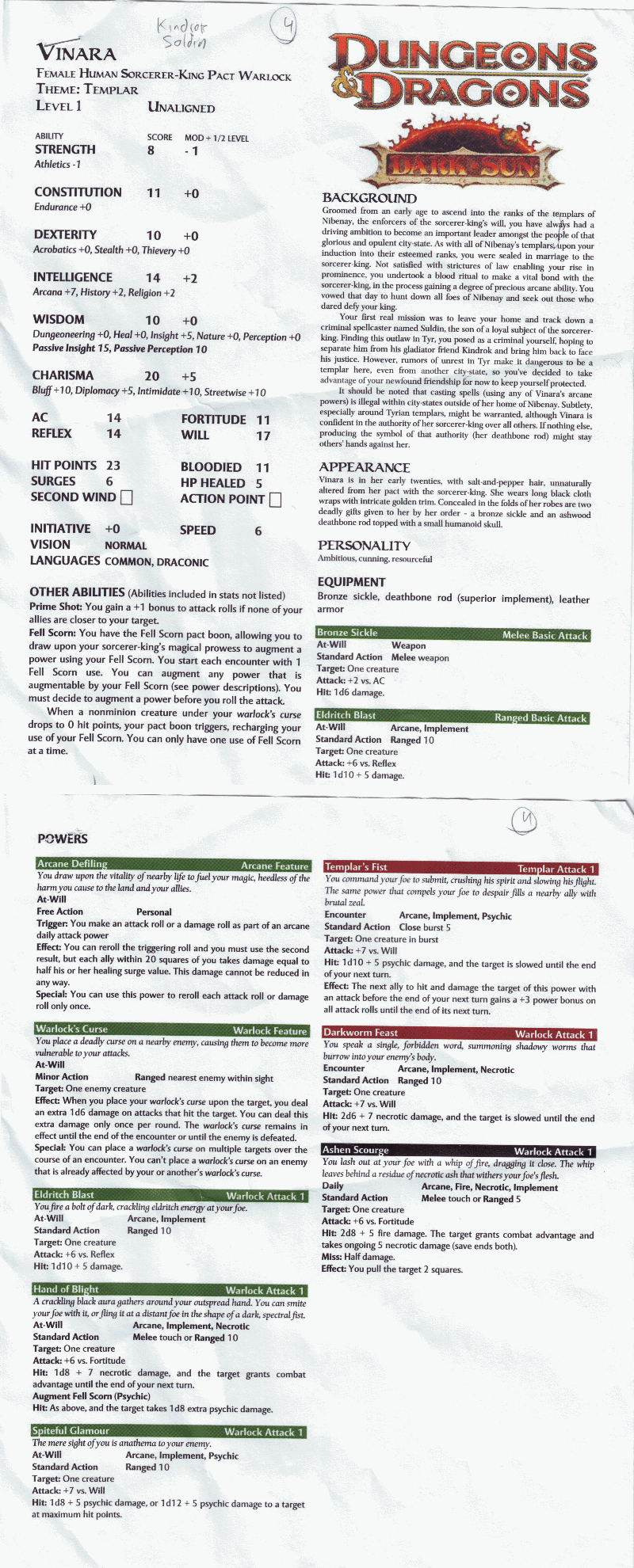
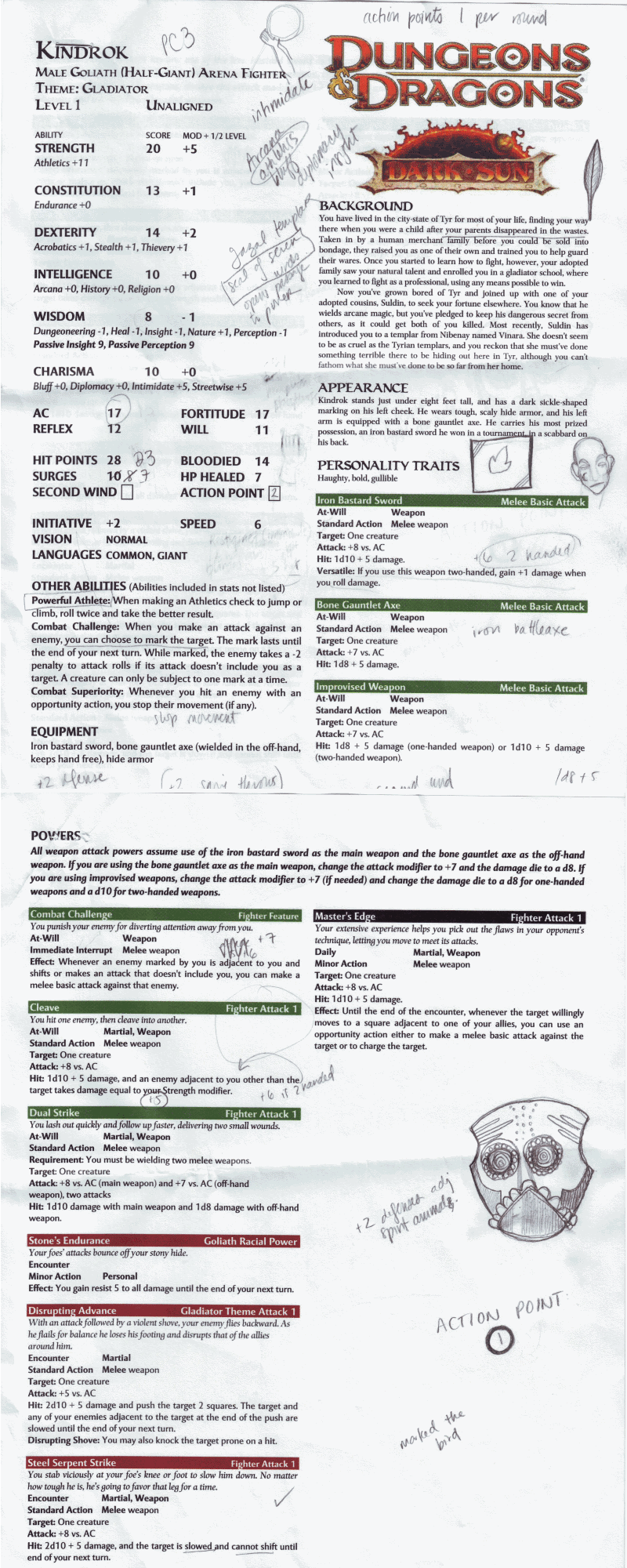
We played in a Dark Sun delve at PAX. We did a standard three-encounter delve through a gladiatorial arena, in which we fought, among other enemies, a savage halfling and some githyanki guards. I grabbed a couple of the 1st-level pregen character sheets (human warlock and goliath fighter) and noted a few fun Dark Sun-specific rules (critical fumbles, inferior equipment, and character templates, which seem to be the heroic-tier equivalent of paragon paths).

World Conceits

Flavor-wise, the world of Athas seems to cleave close to the 2e version: a darker and deadlier D&D; scarce metal; sorcerer-kings; templars; savage halflings; defilers.

New Rules

Inferior Weapons: Because metal is scarce, beginning characters have inferior weapons. Our fighter started with a bone battleaxe, and got a metal battleaxe as treasure during the adventure. The composition of the weapon affects the chance to break a weapon.

Breaking Weapons: If a character wielding an inferior weapon rolls a 1 on an attack roll, they have a choice: they may miss as normal, or they reroll their attack; if they miss again, their weapon shatterings. If the character happens to have a non-inferior (metal) weapon, they may do the same thing, but I think they have a smaller chance to break their weapon (on a roll of 1-5 on the second roll, I believe). This means that rolling a 1 has some of the flavor of a critical fumble, except that it is actually advantageous: it gives you choices.

I’m curious to see the full rules for this. It seems like a fun rule to use in early levels, but once you get a +3 sword you’re probably not going to want to break it in exchange for a reroll. On the whole, I like this rule: I think that something that elicits a cheer should always happen when you roll a 20, and something that elicits mockery should always happen when you roll a 1. Breaking your sword qualifies as mockery-inducing.
(more…)

disadvantages

Tuesday, March 23rd, 2010

I’ve been reading the first few issues of the Dungeons and Dragons comic from the 80’s. Spoilers ahead: in the first issue, the paladin fails in battle against the BBEG, and is struck with a Rod of Withering which renders his sword arm useless. Despondent, the paladin abandons his calling and becomes a drunken beggar – until a band of unlikely heroes convince him to return to adventuring!

I thought, this character would be fun to play! A severe combat limitation that would change your battle tactics, coupled with the kind of broad, slightly-overboard characterization you can get across in a RPG session.

At the end of the comic, the paladin’s stats were given. If I remember correctly, his post-withering strength was 3.

I thought, wow, that character would not be fun to play at all! Even in 1st edition, a strength of 3 would impose a -3 to attack rolls. In 3rd and 4th edition, that would be -4. In 4e math, where a primary stat of 16 (+3) means about a 50% chance to hit against most creatures of equal level, that would mean a character with 3 strength would hit on an 18-20. Of course, with the penalty to damage, you’d do about 1-2 damage when you did hit. That might be fun for an encounter, but it would be hard to maintain your enthusiasm throughout a combat-heavy adventuring career (or however long it took you to find Gauntlets of Ogre Power).
(more…)

background benefits

Thursday, March 18th, 2010

WOTC introduced Backgrounds in PHB2, more than a year ago now. In that book, backgrounds were billed as a story element with only minor mechanical effects. Indeed, the mechanical benefits were limited to a piddling +2 to a skill or the ability to train in a cross-class skill – unarguably worse than a feat.

I assumed that the background benefits would inflate in the coming months, but they didn’t. New books are coming out all the time, introducing new backgrounds with new fluff, and all with the same small benefits applied to different combinations of skills. This shows restraint that I’m not used to seeing in D&D or in any frequently-updated game.

The only books that provide non-generic background benefits are campaign books: for instance, Forgotten Realms has location-specific background benefits that are often as good or better than most feats. This implies that non-trivial background benefits are tied to specific parts of a campaign world. This has kind of amazing implications. A DM using a homebrew world, who bans campaign-specific content, has implicit (though unfortunately not explicit) design space: player benefits that are
a) tied to parts of the DM’s campaign, which provides a convenient way to trick players into learning about its history and geography;
b) not in competition with WOTC-designed benefits, so the DM-created content won’t be ignored by players cherrypicking the best mechanics from all the books; and
c) created by the DM, so they can be designed for specific characters that the DM or players would like to see.

PHB3 isn’t out yet; I hope this trend continues, and, if it’s intentional, I hope it’s made official at some point so every DM can start creating their own homegrown backgrounds.

The Essential D&D

Tuesday, March 9th, 2010

WOTC is coming out with “D&D Essentials”, intended to be a 4e version of the D&D Basic line that ran parallel to 1st edition. Seems like a good time to think about what “D&D Essentials” means.

I have a lot of nostalgia for older D&D versions, and I try to be aware of that nostalgia. Still, it’s hard to pick through and figure out which of my favorite things about old D&D editions were actually cool, and should be brought back or included in future versions, and which were accidents, or nonessential parts of its coolness: elements I love, where my love has more to do with my history with D&D than with their objective loveability.

One of the ways to make this distinction might be to try to separate what I loved when I was a kid newly introduced to D&D, versus what I love now.

My 8-year-old Essentials list:

-Dragons: My first D&D edition was the 1983 red box Basic set, when I was 8 or so. I have a distinct memory of thinking the page of dragons was awesome: their hit die total was so much higher than the other monsters in the bestiary. They were badasses! Also, you could subdue them, which meant that you would have your own dragon. Awesome!
-Dungeons: I liked drawing them as much as playing them. I drew a lot of dungeons, using the dungeon symbol key (squares for doors, dollar-sign S in the wall for secret doors); more dungeons than I ever played.
-Equipment: The idea that you could equip your character for the unknown with wolfsbane and 10′ poles – really be ready for anything – appealed to me. And, of course, I liked the power fantasy of getting magic weapons and items, and the gambling aspects of rolling for treasure on the treasure table.
(more…)

Balancing Minions: An Experiment

Sunday, March 7th, 2010

I’ve been thinking for a while that D&D minions needed some beefing up. As a player, I’d rather face four minions than one regular opponent. They only take a round or two to wipe out, and it feels like they usually don’t end up doing a lot of damage.

But what good are my anecdotal experiences with minions? D&D is SCIENCE! Since I was home sick from work, I decided to employ the Scientific Method in a series of laborious experiments.

Hypothesis

I hyphothesize that four minions fighting a single standard creature with similar stats will be crushed. If that’s the case, then I think minions are underpowered and not worth the XP they provide.

Control Group

I chose a representative, low-level creature, the Human Guard, for my experiment. He’s a level 3 soldier with 47 HP. He has no burst or area attacks; just a couple of melee attacks which are, for our purposes, identical, since doing extra damage or knocking prone on a hit can never affect a minion.
(more…)

Cumulative Chance

Sunday, February 28th, 2010

If you want to see a hilarious list of bad things that happen to a D&D character, look through the 1e DMG for the word “cumulative”. Gary invented the peculiar mechanic, which as far as I know wasn’t widely imitated in other editions and games, of the “cumulative chance”. If something had a 1% cumulative chance of happening, there was a 1% chance the first time, 2% the second, 3% the third, etc. The cumulative chance was invariably used for calculating the odds of something terrible happening to a PC.

It seems logical to have a bad event become more likely the more times you do something stupid, but “cumulative chance” is strange because normal chance is already cumulative. If there’s a regular old 1% chance of a bad outcome of an action, and you do it 50 times, your odds of triggering the outcome are reasonably close to 50%. (Actually 40%.) If you have a 10% chance of the event, it takes between 5 and 6 times to bring you to 50%.

Cumulative chances accelerate the process in a startling way. A cumulative 1% chance has a 50% chance of having triggered after only 11 uses; a cumulative 10% chance after 3 uses. Cumulative chances give you a pretty good chance to survive a handful of repetitions of a dangerous activity: then, WHAM! Brutal punishment is almost inevitable. Of course, all this is tracked secretly by the referee: the PC’s only clue is the fact that the DM makes a note and maybe gets a pokerface every time he uses the Horn of Blasting. Typical arbitrary cruelty that makes old-school gaming so hilarious.

For your enjoyment, here are some of the appearances of the cumulative chance mechanic from the 1e DMG:

-There always exists a chance of discovery, no matter how simple the mission. The base chance to be discovered is a cumulative 1% per day of time spent spying, subject to a maximum of 10%, minus the level of the spy. Even if the latter brings chance of discovery to a negative percentage, there is always a 1% chance.
[This one is peculiar: seems like a lot of calculation for something that is happening offscreen, and a good argument to hire a level-9 spy. And never shell out extra for a level-10 spy.]

-If continually provoked and irritated in order to get a response, there is a 1% cumulative chance per round that the insane individual will react with homicidal mania.

(more…)

Is this overpowered? Or, the Iron Weapon Expertise of Ruin Rule

Friday, February 26th, 2010

I like to tinker with the 4th Edition rules, which means I’m always in danger of breaking them. Luckily Rory has an infallible ability to discover broken abilities, which means that I can always pass an idea to him and he can instantly tell me the massively game-breaking implications of my proposed new mechanic.

When Rory’s not around, I use a rubric called the “Is it more powerful than Weapon Expertise, Staff of Ruin or Iron Armbands of Power?”

This feat and these two items are so good that they make it hard for competing feats/items, no matter how cool they are, to get chosen.

Weapon Expertise

It’s pretty well agreed that the Weapon Expertise and similar feats were introduced as a math fix for runaway monster defenses, and that D&D R&D intends that everyone take the feat. Luckily, except at very early levels, everyone has lots of feat slots, so you can take other, more flavorful feats in addition without feeling like you are shooting yourself in the feat. Still, under normal (non-math-fix) circumstances, I’d say that any feat that was a must-have for all characters was clearly overpowered.

Staff of Ruin

Staff of Ruin is a different matter. Every staff-using character should probably use this item. That means that every other staff is obsolete, and can only be taken by perverse players who like to play intentionally suboptimal characters – the half-orc bards among us. Most implements have daily powers, but Staff of Ruin reliably does lots of extra damage on every hit. A +1 staff of ruin that does an extra 1 item damage isn’t so unbalanced, but a +5 staff of ruin, doing 5 enhancement and 5 item damage on every hit, competes well even with many +6 magic staffs.

Not convinced? A staff of ruin is level 23. How much damage is a level 23 wizard with a +5 staff doing with encounter powers? 4d6+Int+5, or around 25 damage to each opponent, possibly with some status effect. Let’s be generous and say that with the other hit effects, a wizard encounter power is worth double its straight damage, or 50 damage. A wizard probably hits each opponent about 60% of the time, so that’s a damage expectation of 30 HP per opponent.

A +6 magic staff adds 1 to damage – let’s call it 51 damage now – and increases the chance to hit to 65%, which translates to an expectation of another 3 or so damage per opponent. So for encounter powers, with generously assessed damage, a staff +6 is worth 4 points of damage more than a staff +5. A staff of ruin +5 beats that by a point.

(more…)

do NOT put this blog inside a portable hole

Thursday, February 11th, 2010

This is a blog about D&D. Expect musings, house rules, and game recaps.

The blog authors are Paul and Rory. We worked hard to come up with our usernames. We considered “Malebrax, Consumer of Souls” for Rory, and I was torn between “Carnifex, the Butcher of the Tower” and “Gladiola, Princess of Oakheart Creek”, but we eventually decided to go with our first names. Saves bandwidth.