Archive for the ‘RPG Hub’ Category

the badass skeletons of the Fiend Folio

Wednesday, May 23rd, 2012

The 1e Fiend Folio spent years in the doghouse. As a kid, I wrote off the Folio as a collection of gimmick and useless monsters – including the adherer, flail snail, carbuncle, and flumph – topped off with an unnecessarily large helping of badass skeletons.

Lately, there’s been a bit of a reclamation project, with various game designers and bloggers returning the the Folio for inspiration. I’ll do the same today. I’m leaving the flumph for someone else, though; as part of the May of the Dead carnival, I’ll be rating, in alphabetical order, the Fiend Folio’s many, many badass skeletons.
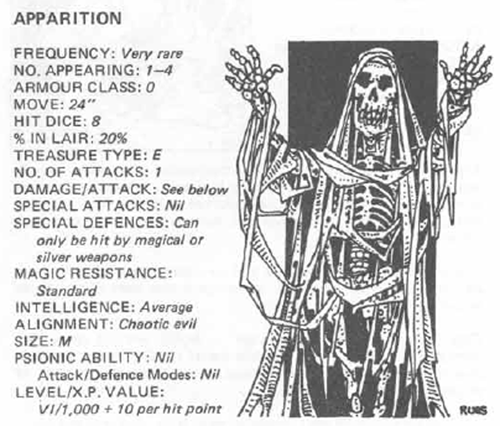
Apparition

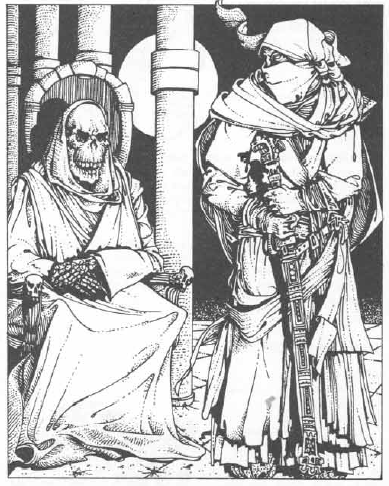
Non-Badass Appearance: As badass skeletons go, the Apparition is pretty conservative. He’s only half-heartedly swathed in mummy bindings, and no sinister fires burn in his eyesockets. Only the Russ Nicholson art saves him from mediocrity.

Badass Mechanics: The Apparition has 8 HD and 0 AC, and, like many of the Fiend Folio critters, it has unique insta-death mechanics. If you roll over your Intelligence AND Constitution on 3d6, you “suffer a massive heart seizure and die instantly.” I like this monster because if you’re sufficiently smart, you’re totally immune to its powers. Stay in school, kids!

Badass Rating: 1 Skeletor

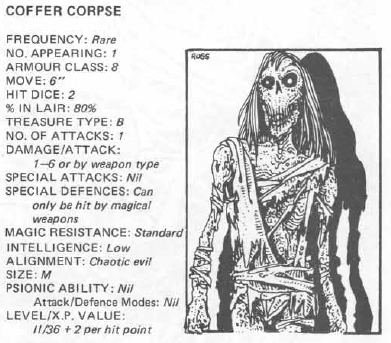
Coffer Corpse

At 2 HD, the Coffer Corpse is one of the few low-level badass skeletons.

Badass Description: The Coffer Corpse is “found in stranded funeral barges”, so keep that in mind when you are planning an adventure on a stranded funeral barge.

Badass Mechanics: The Coffer Corpse doesn’t cause you to save or die. He just grabs you by the throat and, like Bryan Adams, never lets go (until you kill him, which shouldn’t take too long as he has an average of 9 HP.)*

Badass glowing eyes: Check.

Badass Rating: 3 Skeletors

*I mean until you kill the coffer corpse. But Bryan Adams also has 9 HP.

Crypt Thing

The Crypt Thing just sits in his crypt all day (% in lair: 100%) and uses his special mechanics to puzzle wayward adventurers.

Badass Mechanics: The Crypt Thing teleports each saving-throw-failing party member 100-1000 feet in a random direction, and lies to the rest of the party, claiming that the teleported creatures have been disintegrated.

Badass Motivation: Although they are neutral, “their aim appears to be solely that of obtaining pleasure by creating confusion and dissent.” I guess it’s the kind of neutral that is slightly chaotic and slightly evil. For a skeleton with glowing eyes, though, it’s practically Lawful Good.

Badass Appearance: This guy looks a lot like Skeletor, so full marks for that.

Badass Rating: 3 Skeletors

Death Knight

Badass Story: The Death Knight is a lich created by Demogorgon from a fallen human paladin. Every word of this sentence drips with Metal!

Badass Hit Points: The Death Knight has 9 HD, but he’s so awesome that they’re TEN SIDED DICE. I guess because they’re from paladin class levels.

Badass Stats: The Death Knight has high stats even by paladin standard, which is saying a lot. He has 18/00 Strength and his Intelligence is Average-Genius. He also speaks 3-6 bonus languages!

Badass Mechanics: The Death Knight has more kickass powers than you can shake a femur at. Highlights include 75% magic resistance that, 11% of the time, reflects spells at their caster; power word kill; a 20-dice fireball; and a gate spell.

Badass Steed: The Death Knight rides a nightmare. That’s the gold standard for villainy. If you’re a bad guy and you have to ride a regular horse, you might as well hang it up.

Badass Rating: 5 Skeletors

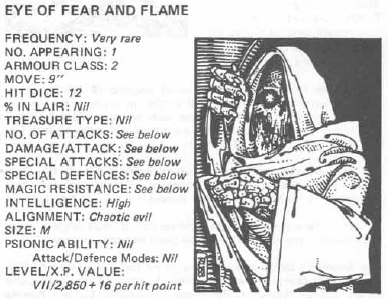
Eye of Fear and Flame

Badass Life Goal: “It constantly stalks the underworld seeking lawful or lawful/neutral parties or individuals. It will command an individual, or member of a party, to perform evil deeds.

Badass Mechanics: One eye fires a 12-die fireball every three rounds. The other acts like a fear wand every round. That’s a lot of magic that it’s slinging around. That’s what you get if you don’t perform evil deeds.

Badass Glowing Eyes: Yes, and they are gems worth 1,000-2,000 GP each.

Badass Rating: 3 Skeletors

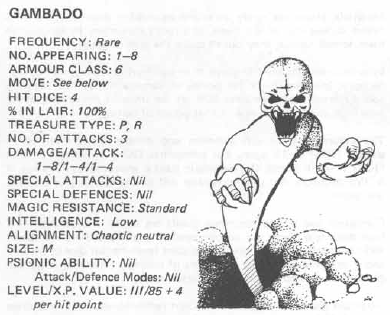
Gambado

Non-badass Description: “Supported on its thin (but very strong) neck is a skull – usually of an animal but sometimes of primitive man.” A primitive man? Like a soccer hooligan? How can you tell that from the skull? Or is it, like, a hominid? Anyway, the gambado’s body is like a cylindrical spring. It hops.

The gambado better be, like, a South American legend or something, otherwise this is pretty lame. (consults dictionary dot com) No, “Gambado” is just an old fashioned word for a hop. The gambado hides in a thin little hole and gambadoes out at people. STUPID.

Badass rating: 0 Skeletors

Huecuva

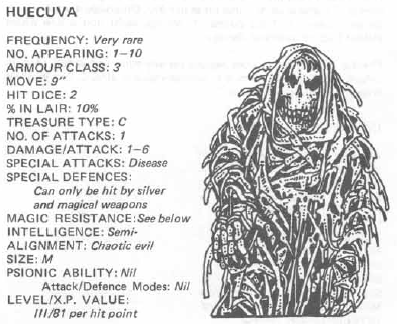
The Huecuva is a 2-HD monster, “similar in appearance to a robed skeleton”. It has two gimmicks: it is able to polymorph self three times a day, and its touch infects the victim with acute cardiovascular-renal disease. I kid you not. Mechanics based on the Diseases chart in the DMG!

This one IS based on a South American legend. A point for that.

No points for the mummy wrappings. It looks like the Huecuva saw the illustration for the Apparition and thought to itself, “I can get more wrappings than that guy.” There is such a thing as TOO many wrappings, Huecuva. You look like a kitten that got into the yarn: there’s a thing called self-control. Don’t give me that look.

Badass Rating: 1 Skeletor

Necrophidius

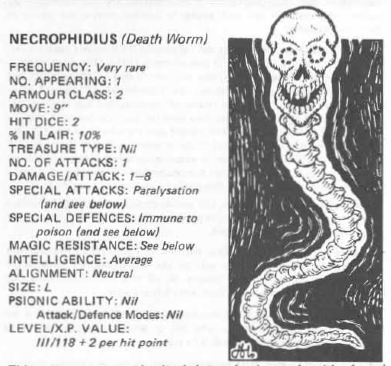
Badass Name: Necrophidius. Great name. “Drown in your tears of terror, for I am Necrophidius the Malificent!” “Ladies and gentlemen, the next president of the United States: Necrophidius!” “Necrophidius, bring the car around front.” Necrophidius.

Badass Mechanics: The necrophidius is another hopping snake skull-head like the Gambado, but at least it can execute the Dance of Death (treat as hypnotism).

Badass Construction: You can make your own necrophidius! The ingredients include “the complete articulated skeleton of a giant snake (poisonous or constrictor) and the skull of a cold-blooded murderer killed in the last 24 hours.” The good thing about this is, after you kill the murderer in order to make your snake, YOU are a cold-blooded murderer, so your skull can be used to make a second necrophidius!

Badass Glowing Eyes: Yup.

Badass Rating: 4 Skeletors

Revenant

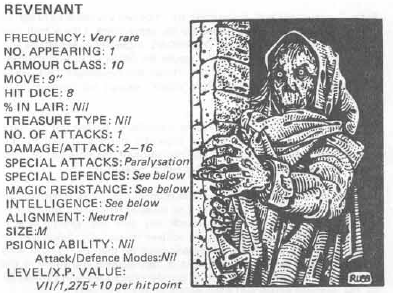
Badass Backstory: “Under exceptional circumstances, those who have died a violent death may return from beyond the grave to wreak vengeance on their killer – as a revenant.” Revenants do all sorts of creepy stuff to their killer: “lock its claw-like hands around its victim’s throat,” “stare into his killer’s eyes” causing the killer to be “paralysed with terror”, and track the killer “wherever he may be.”

Badass Indestructibility “Weapons – normal and magical alike – do not affect the creature.” If it is somehow dismembered anyway, its limbs continue to act. It regenerates 3 HP per round. It is immune to acid. I see why the description talks about the revenant tracking its victim – this is a guy you want to run away from.

Badass Entry Requirements: In order to become a revenant, you need Wis or Int greater than 16, Con 18, and total characteristics totaling to 90 or more (wow! 15 average! Although it’s not quite as difficult if you use the Comeliness stat.) Even so, you only have a 5% chance of coming back. Why are we getting all this info about how hard it is to become a revenant? It seems to imply that PCs will want to become revenants.

Badass Glowing Eyes: “Its eyes – sunken in the face – are at times dull and heavy-lidded but, particularly when nearing its intended victim, they will blaze up with unnatural intensity.”

Badass Rating: 4 Skeletors

Skeleton Warrior

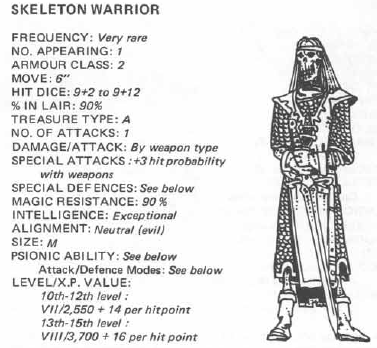
As Death Knights are the lich versions of paladins, skeleton warriors are lich versions of high-level fighters. What’s up with thieves? No one wants to make lich versions of thieves.

Badass Jewelry: A skeleton warrior’s soul is trapped in a golden circlet. If you put on the circlet, you may control the skeleton. While you’re not in control, it tries to kill you. There’s lots of text about how exactly this works.

Badass Intelligence: Skeleton Warriors have Exceptional intelligence, and are neutral (tending towards evil). If you wore the circlet, could you force the skeleton warrior to work as a college professor, even if you didn’t have a high enough intelligence to do it yourself? I bet Skeleton Warriors are tough graders and they love to fail you. “This will not be sufficient, Mr. Necrophidius. I said five pages, and this is four and a half.”

Badass Rating: 2 Skeletors

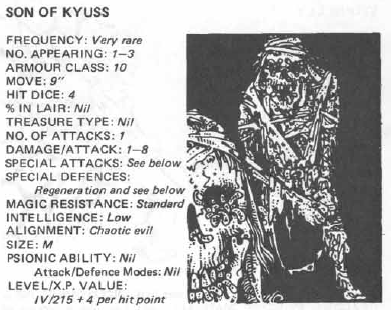
Son of Kyuss

Badass Dad: Kyuss was an evil high priest who invented a new form of undead. Living the dream, Kyuss.

Badass Mechanics: Sons of Kyuss radiate cause fear, regenerate like trolls, and their mighty punches inflict leprosy. More diseases from page 12 of the DMG!

Badass Gross Worms: Sons of Kyuss have “fat green worms” crawling out of all of their skull orifices. “One worm per melee round will jump from a son’s head to an adjacent character”, potentially turning the character into a son of Kyuss in 1-4 melee rounds.

Badass Rating: 3 Skeletors

Eleven skeleton monsters is probably too much for a monster manual supplement! But, as my wife notes, it is almost enough for a calendar. How awesome would that be? I wonder if Russ Nicholson has all of the original art?
posters and pandas

Monday, May 21st, 2012

All the posters have shipped! Actually, this was true a couple of days ago, and I’m late with the announcement: many of you have probably gotten your posters by now.

Dan from GameSalute gave me this graphic, which has a number you can call if you haven’t gotten a poster by this Friday the 25th.

Dan sent me this image on Thursday, so it’s actually only 1d10-4 days till you get your package.

Thanks, Dan and GameSalute, for your help with shipping these posters. It would have been pretty much impossible for me to do it alone.

While I’m thanking people: let me tell you about Rich Burlew.

When my kickstarter was approaching 1% of the Order of the Stick total, and I asked Rich if he’d help me out with art, he not only drew me a sticker that same day, he waved off any honorarium or payment. Instead, he asked me to make a donation in his name to one of his favorite charities, like the World Wildlife Fund.

When we passed 2 Burlew Points, it seemed appropriate to make another donation to WWF. It’s against the rules of Kickstarter to raise money for charity, so I’m now using my own funds, not Kickstarter profits, to make a donation, which just happens to be 15% of the profits of the kickstarter. The donation is in honor of the amazing D&D kickstarter community.

the whimsical fairies of a dead sun

Friday, May 18th, 2012

In 1912, William Hope Hodgson wrote the very long and very bizarre novel The Night Land. It’s one of those novels that seems like it’s more a D&D sourcebook than a novel. If I were running a fourth-edition game set in the Shadowfell, I’d actually take The Night Land over the D&D Gloomwrought boxed set.

The Night Land presents some obstacles to the reader. It’s written in High Faux Archaic, with a ratio of five semicolons to the period. It’s long and repetitive, describing every uneventful journey, camp, and meal break. It’s got weird gender politics, even for 1912. But it’s also got some powerful images. H. P. Lovecraft said of it, “The picture of a night-black, dead planet, with the remains of the human race concentrated in a stupendously vast metal pyramid and besieged by monstrous, hybrid, and altogether unknown forces of the darkness, is something that no reader can ever forget.”

Oddly, this book, which contains a great Shadowfell setting, starts with an evocation of its fourth-edition opposite, the Feywild. The main character and his soul mate have had shared dreams of Fairyland:

And one evening, that I ever remember, as we wandered in the park-lands, she began to say—-half unthinking-—that it was truly an elves-night. And she stopped herself immediately; as though she thought I should have no understanding; but, indeed, I was upon mine own familiar ground of inward delight; and I replied in a quiet and usual voice, that the Towers of Sleep would grow that night, and I felt in my bones that it was a night to find the Giant’s Tomb, or the Tree with the Great Painted Head, or-—And surely I stopped very sudden; for she gripped me in that moment, and her hand shook as she held me; but when I would ask her what ailed, she bid me, very breathless, to say on, to say on. And, with a half understanding, I told her that I had but meant to speak of the Moon Garden, that was an olden and happy fancy of mine.

Some good Feywild place names there! Also, you can see that I was not kidding about the semicolons.

D&D Next Idea: Cast Any Spell in 10 Minutes

Wednesday, May 16th, 2012

Mike Mearls talks about plans for the Wizard in his latest D&D Next article, Balancing Wizards in D&D.

One of his ideas is that using a scoll would require expending a spell of that level to use; so the idea is that scrolls wouldn’t increase overall power, but they would allow for more versatality. This sounds like a great solution for allowing a wizard to get some use out of those corner-case spells that have utility only in specific situations, while still maintaining overall power balance.

This implementation reminds me of an idea Paul and I discussed a couple weeks ago for how to handle the same problem. It could be used in addition or in place of the above system for handling scrolls:

A wizard can cast ANY spell they know by expending a spell slot of that level and increasing the casting time to 10 minutes. 

Thus, when you memorize your spells for the day, you can focus more on spells you know are going to be useful, such as offensive or powerful utility spells, since you can always cast the more situational spells, such as Stone to Mud or Disguise Self, out of combat if they are needed.

Of course, there are still going to be some situational spells that you may want to memorize since you’ll be able to cast them in a single round, so it is not necessarily just a matter of loading up on your most obviously powerful spells, especially if you have reason to believe (such as by advance scouting or information gathering) that a certain spell will be useful.

The main advantage of this approach (or of the new approach for scrolls) is that it allows more of those fun wacky spells that rarely see use to come into the forefront when they will really be needed out of combat. When I am playing a wizard in 3.5 or previous editions, there are certain spells I never touch until higher levels (when I have enough lower level spell slots to diversify); it would be fun to see those spells coming into play earlier on.

Random Dungeon pdfs sent

Tuesday, May 15th, 2012

I sent emails to backers of the Random Dungeon kickstarter, letting them know that they could download the poster PDFs (and the DM notebook, for $22+ backers). Let me know if you’re a backer and you didn’t get an email.

What the 2e PR can tell us about 5e

Monday, May 14th, 2012

When I got that giant box of D&D stuff in the mail, one of the first things I did (after reading the original owner’s game notebook and the In Search of The Unknown module) was settle down with a random Dragon issue I’d never read before: Issue #121, from 1987.

There’s a hilarious article by David “Zeb” Cook, trying to allay people’s fears about the coming Second Edition. It’s hilarious because, as an avid consumer of Fifth Edition previews, I find it so familiar.

Really, I do want to avoid having to do a Third Edition -— at least having to repeat what I’’m going through on Second Edition! The only way to do this is to build a set of core rules that can accommodate the inevitable changes and additions that will come. Just as the First Edition was not perfect, I know that new and better ideas will surface after Second Edition is done.

Our current plan is that we haven’’t got a plan. We are still looking at a lot of different ideas. Currently, all of them revolve around building a core set of rules that can be used by all players. One thought is that there would be two hardbound rule books — the Players Handbook and the Dungeon Masters Handbook (note the title change). These would present the core rules for the game, what everyone needs to know.

This sounds a lot like the marketing for D&D Next: the base 5e game will be very modular. We’ll have core rules, and a bunch of room to add optional rules. That way, we can avoid having to do a sixth edition.

(Also, what happened to the proposed name change to Dungeon Master’s Handbook? Was there public outcry against it?)

The article goes on to describe the “core” and “optional” rules in ways almost identical to the descriptions of the current new edition, except with the addition of a middle “tournament” rules tier:

TSR’’s attitude about “official” rules has changed. You know and I know that people create variants and house rules for use with the AD&D game. Trying to demand that they play only the “official” rules is pointless. That’s why we’’re planning on marking rules in the core set as “Standard,” “Tournament,” and “Optional.” Standard rules are the absolute minimum you need to play something that is passably identifiable as the AD&D game – the races, character classes, attack rolls, etc. Tournament rules add the rules that will be normally used in any TSR-sponsored tournament. After all, in a tournament, you should be reasonably certain that you will be playing the same game as your neighbor, a useful thing to ensure fairness at a convention! Best of all, for all you tinkerers out there, the Optional rules allow you to make the game yours, filling your game with as much richness and detail as you want – weapon-based armor-class modifiers, create-your-own character classes, spell-casting times, proficiencies, casting components, and more. Optional rules are just that; if you don’t like ’em, you don’t use ’em.

Compare that to this Rule of Three article from 2012:

We want to put as many tools as possible in the hands of DMs and their players so they can tailor the game to their preferences. Part of this process involves providing a number of what you’ve heard us refer to as “rules modules”—that is, packages of optional or alternative rules that we have designed, developed, and playtested that help create a certain game play experience, either for a single player or the entire game table.

The second half of that process is one that should also make it easier for homemade rules modules: creating a streamlined base to the game that rules modules can be added to easily. With a clean, lean, and dependable core to the game, we hope to be able to communicate to players and Dungeon Masters what the basics of the game are, and then provide advice for designing your own material to work with that.

It actually seems like the spirit of the fifth-edition revision has more in common with the second edition than I realized.

I don’t know if we can make any predictions about 5e based on the optional and tournament rules of 2e, but, for fun, I flipped open my new Second Edition PHB and found the items in the Table of Contents listed as Optional and Tournament:

Proficiencies (Optional)
Encumbrance (optional rule)
Basic Encumbrance (Tournament rule)
Specific Encumbrance (Optional Rule)
Encumbrance and Mounts (Tournament Rule)
Spell Components (Optional Rule)
Weapon Type vs Attack Modifiers (Optional Rule)
Group Initiative (Optional Rule)
Individual Initiative (Optional Rule)
Weapon Speed and Initiative (Optional Rule)
Parrying (Optional Rule)
Jogging and Running (Optional Rule)

What do you think? Will 5e’s “clean, lean and dependable core” be leaner and meaner than 2e’s “absolute minimum you need to play something that is passably identifiable as the AD&D game” (which core, presumably, included every rule except the ones mentioned above)?

There were a couple of other quotes in the article that I found interesting, not in relation to D&D Next, but to 2e’s eventual replacement, Third Edition:

Now, 100% compatibility is just not possible. There are things that must be fixed. There are inevitable improvements and new ideas. These things are going to prevent Second Edition from being 100% compatible. Just what percent compatibility we wind up with, I can’’t say. Indeed, the need to keep things compatible results in us not making some changes that would only confuse the issue. Take the armor class numbering system. To many players, it does not make sense that the worst armor classes have higher numbers, and it would seem simple to change it. However, reversing the order of the armor class numbers would invalidate every AD&D game campaign and product in existence. For compatibility’’s sake, it is better to make no change, since this change is not worth the trouble it will cause.

Ascending AC was something that was done in the bolder rules changes of 3e. It’s interesting that they were already thinking about it in 1987.

and

Ultimately, there will be people out there who will be playing Version 1.0, Version 1.5, Version 2.0, and probably even Version 2.3 of the AD&D game. Perhaps we should figure out some type of numbering system like that used on computer programs!

It would take this prediction 16 years to come true, with the publication of D&D 3.5.

mr. meeson’s will

Friday, May 11th, 2012

Mister Meeson’s Will, by H Rider Haggard, tells the story of a veddy propah Englishwoman who is shipwrecked on a desert island and must have a dying tycoon’s will tattooed upon her back. It’s part of the 19th century tradition of novels exploring outlandish corner cases of the law, like Wilkie Collins’ Man and Wife.

The informational tattoo idea has been explored in fantasy. The tattoo treasure map has been done before: I remember seeing it first in some Ultima game. In D&D, tattoos of spells have been mentioned as alternatives to spellbooks.

Worst case D&D scenario: someone is tattooed with an expendable spell. They’re essentially a living scroll. Scrolls self-destruct when used.

This might lead to a rough situation for a poor sailor. He passes out at the tattoo parlor, and wakes up a living – and disposable – piece of ordnance. If the ship is attacked by pirates, the ship’s wizard might decide that there’s nothing to be done but read the scroll and expend the sailor.

Either that or someone is tattooed with Explosive Runes.

Any other weird D&D consequences of an ill-considered tattoo?

The magic quantity: How to scale everything important in the D&D world

Wednesday, May 9th, 2012

D&D is a game where you spend half your times killing monsters and half your time interacting with the world (adjust proportions to taste). In every edition, the killing-monsters part is very well-defined, mathematically speaking. The interacting-with-the-world part has a few data points here and there: how much do things cost in shops? How many men-at-arms does a level 9 fighter get? for how much can you sell a subdued dragon? At first it all seems like little islands of subsystem in a sea of dm-use-your-judgment, but what would you say if I told you it can all be distilled into a formula THAT ONLY I HAVE DISCOVERED?

You’d rightly tell me that I was going math crazy, like the guy in Pi. So I won’t say that. I’ll instead offer a rule of thumb that can be surprisingly useful, and offers surprisingly coherent results, that you can use when you don’t know how the size of something, how many there are, how much it costs, or any other game-world number.

The Magic Quantity: How Many at What Level?

Every level has a Magic Quantity (and vice versa). It’s meant to answer this question: “If I have one of something at level 1, how may will I have at level x?” The magic quantity for level 1 is 1. The magic quantity for level 30 is 1000.

TRANSLATING LEVEL TO QUANTITY:
Level 1 to 10: quantity = level
Level 11+: quantity = 10 per level above 10
Level 21+: quantity = 100 per level above 20

TRANSLATING QUANTITY TO LEVEL:
10 items or less: level = quantity
11+ items: level = 10 + 1 level per 10 items (round down)
101+ items: level = 20 + 1 level per 100 items (round down)

What do you do with a magic quantity?
You multiply it by things. Gold coins, soldiers, miles of land.
x1000 GP: That’s how much PCs can earn per level.
x1000 GP: That’s the price of a really awesome thing that’s appropriate for a given level (pet monster, castle, airship)
x1 mile: That’s the diameter of the domain PCs can control.
x1 soldier: That’s how many soldiers PCs can defeat singlehanded.
x10 soldiers: That’s how many soldiers PCs can command.

Level Quantity
1 1
2 2
3 3
4 4
5 5
6 6
7 7
8 8
9 9
10 10
11 10
12 20
13 30
14 40
15 50
16 60
17 70
18 80
19 90
20 100
21 100
22 200
23 300
24 400
25 500
26 600
27 700
28 800
29 900
30 1000

Disadvantages of this system:

  • it’s spiky (it’s linear for 10 levels and then changes by an order of magnitude). Linearity means that, between level 1 and 2, a number is multiplied by x2, while between 8 and 9 it is multiplied by x1.125. Still, this is not new to D&D: this is also how hit points work.
  • There is a weird repeated value at level 10 and 11, and again at 20 and 21.

    Advantages of this system:

  • It’s spiky. It changes the focus of play at what 4e calls heroic, paragon, and epic tiers. Suddenly, around level 12, new possibilities open up.
  • it is easy to learn: It replaces several different charts with a learnable rule. It also generates some convenient short cuts: 10x the number of something is always 10 levels higher.
  • It generates results not out of the realm of plausibility, which I will demonstrate below.

    I think this rule of thumb is strong enough to be the backbone of several D&D subsystems. Below, I’ll try a couple, and compare my work against existing D&D rules.

    TREASURE PER LEVEL

    If you multiply the Magic Quantity by 1000 GP to generate treasure by level, a character might get 1000 GP at level 1, 2000 GP at level 2, 20k GP at level 12, 100k at level 20, and 1 million GP at level 30. (Or less. This might be the total treasure the DM puts into the adventures, but no party clears out the whole dungeon.)

    This not too terribly far off from the 3e expected Wealth By Level. A WBL character would earn 900 GP as opposed to 1000 at level 1. By level 20, a character using the magic quantity system would have accumulated about 600,000 GP; a 20th level WBL character is expected to have wealth of 760,000.

    (For first edition, where GP=XP, wealth by level is irrelevant. You level up as soon as you collect the right amount of money.)

    AWESOME THINGS

    I recently posted a giant list of things for high-level characters to buy. I used the Magic Quantity rule to price the items.

    The awesome-things economy is based on the same multiplier as the treasure-by-level economy – x1000 GP – so you can always spend your level’s worth of treasure for one level-appropriate cool thing. This might be a magic item, in campaigns where you can buy magic items; a new spell; or cool stuff like hippogriff eggs, castles, and flying pirate ships. To determine a cool thing’s price, just figure out the level at which you’d expect it to show up in the campaign. For a pet monster or henchman, this is the level of the monster. For instance, if a hippogriff is a level 3, encounter level 3, or 3 HD monster, you could price a hippogriff at 3,000 gp.

    How well does this stack against canonical rules? OD&D specifies that a party can sell a subdued ancient red dragon for about 50k GP, so I presume they can buy it for 100k GP. That means that, if a red dragon were for sale, a level 20 character could afford to buy it. Badass! Similarly, in AD&D, hippogriffs are 3 HD monsters whose eggs and fledglings sell for 1000, 2000, or 3000 GP, depending on age.

    From the 1e DMG, it’s hard to tell how much it costs to build a typical castle – the construction menu is complicated – but I priced a four-tower castle of a couple thousand square feet at around 20,000 GP, which would make it suitable for level 12. Sure.

    LAND CONTROLLED

    Let’s say we use the magic quantity for the diameter, in miles, of a PC’s area of control: 1 mile at level 1, up to 1000 at level 30. That means that a level 1 character will find enemy monsters 20 minutes from his house, while a level 30 character can control an area about the size of Europe.

    How well does this stack against canonical rules? We’ll sanity-check this against the only D&D data we have for determining characters’ areas of control: the rules for PCs building strongholds at name level. At level 10, when an OD&D fighter is clearing five-mile hexes for his stronghold, a Magic Quantity character can control a ten-mile-diameter area (about four hexes). OD&D specifies that a character can control land up to 20 miles distant from a single stronghold: that’s a diameter of 40 miles, and, according to the magic quantity rule, would require a level-14 character. This is plausible for the level of a character who has maxed out his stronghold. For it to grow any further, a character will need to become a monarch or other ruler of vassals.

    If you want to be a serious big-time king, you need to conquer an area the size of England. It’s about 300 miles from the north of England to the south, making England a level-23 realm. (France is level 27.)

    SOLDIERS DEFEATED

    How many soldiers (or, more strictly, level 1 creatures) can a character expect to beat? Using the magic quantity for this might, or might not, match with actual combats run in different D&D editions. It’s hard to say for sure, because D&D doesn’t handle battles against 100 opponents very well. It’s also inexact because it varies a lot by class and situation: a flying wizard can lay waste to legions while the rogue is better away from the battlefield. The numbers are reasonably plausible, though: A level 1 character can beat one soldier (sure, PCs are better than NPCS). A fifth-level fighter can defeat 5 soldiers, a 15th-level fighter 50, and a 25th-level fighter 500.

    How well does this stack against canonical rules? I think it works reasonably well up to level 10, especially if you use the fighter as your yardstick. High-level PCs don’t engage in melee with dozens of orcs, so let’s turn away from D&D, towards literature, and see if we’re capturing the right feel for battlefield might.

    For an example of a paragon-level fighter – over level 10 – I usually think of Inigo Montoya, one of the best duelists in the world, who helpfully comments that, even at his best, he could not defeat 60 men. If he could defeat 50, that would put him at a very plausible level 15. For over-the-top epic heroes, one of the best is mythical Irish warrior Cú Chulainn. When he’s singlehandedly defending Ulster from the army of Connacht, he flips out and kills “one hundred, then two hundred, then three hundred, then four hundred, then five hundred, where he stopped” – making him a level 25 barbarian. Archbishop Turpin, one of Gygax’s inspirations for the cleric class, supposedly killed 400 Saracens in a battle, which means he’s a level 24 cleric.

    Now that that’s set in stone, we can settle an old debate! What level are the Lord of the Rings characters? At the Battle of the Hornburg, Gimli kills 42 enemies to Legolas’s 41, so both characters are level 14. That’s settled!!

    SOLDIERS COMMANDED

    Let’s say that a PC war leader usually has access to a number of level-one troops equal to 10 x the Magic Quantity. Thus, a fighter might command 10 troops at level 1 (as a sergeant), 100 troops at level 10 (as a lord), 1000 troops at level 20 (as a king), and 10,000 troops at level 30 (as an emperor). 100 at level 10 is in line with the followers granted to 10th-level fighters in the 1e DMG, and 10,000 is a realistic historical size for a medieval army from a powerful (non-points-of-light) country like France. (The largest late-medieval armies are larger than the ones generated by these rules, but human populations are probably smaller in a fantasy world shared with a hundred hostile species.)

    How well does this stack against canonical rules? A level 9 AD&D fighter collects between 60 and 120 troops – 90 average. In OD&D, every group of 30 bandits has a 4th level leader, 50 bandits have a 5th or 6th level leader, and 100 bandits have an 8th or 9th level leader.

    I’ll go more into this later: for instance, I think you could put the troop guidelines together to make a decent mass combat system.

  • kickstarter posters shipping this week! In the meantime, run a barony!

    Monday, May 7th, 2012

    GameSalute has been busy. They’re doing shipping and fulfillment for my project as well as the Dwimmermount, Sunrise City and Empires of the Void kickstarters, as well as some others. Still, Dan at GameSalute says he’ll begin shipping the posters this week. Thank you all for your patience!

    Around the time that posters are shipped, everyone will get a URL where you can download PDFs of the posters and, eventually, the other rewards as they become available. Most of the other PDFs (all-star adventure book, board game, etc) aren’t ready yet, but one reward that WILL be ready for $22+ backers (and $15 backers) is a PDF version of Paul’s DM Notebook!

    I’ve been working on the DM notebook for a lot of hours over the past month, and it’s just about done: I just need to do one or two more illustrations. It weighs in at 64 pages. This will be a beta version of the book. I’d love it if you guys each tested something from the notebook in your next game and sent me some feedback. Next month or so, I’ll update the notebook and make the final version available as a PDF and on lulu.

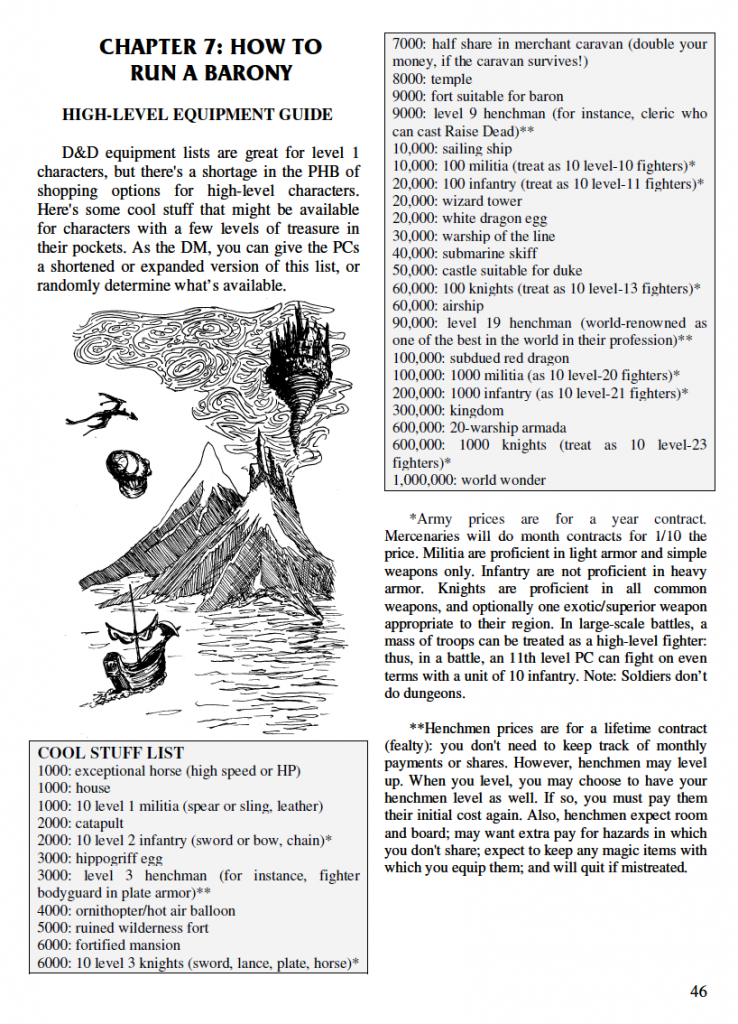
    In the meantime, here’s a big chunk of Chapter 7, which includes prices for big-ticket items like castles and armies, and gives rules for running a barony of your own.

    (Download chapter)

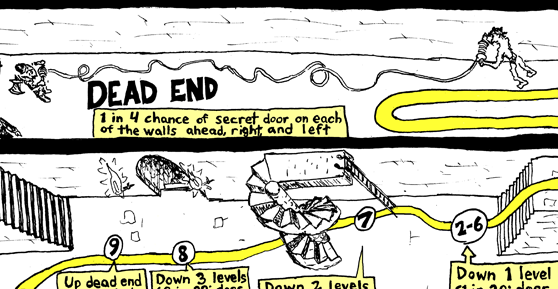
    Also, here’s a picture I drew yesterday, for the Epic Adventures section of the book.

    in search of the unknown

    Friday, May 4th, 2012
    This entry is part 9 of 12 in the series D&D with Mike Mornard

    I’ve heard a lot of references to the 1981 module “In Search of the Unknown:” it came with the first edition of Basic D&D, and a lot of people have fond memories of it. I’ve never read it. When I got a heavy box of D&D books in the mail, it was the first module I grabbed.

    I’ve been on a search of my own lately, exploring the D&D I missed before I entered the hobby. As a kid, I played in bizarre junior high versions of Red Box Basic and AD&D, and as an adult I’ve mostly played third and fourth edition. It’s been fun playing OD&D: I’m slowly getting a handle on a different style of D&D than one I’ve ever played.

    I was delighted to find Mike Carr’s lengthy “how to play D&D” essay at the beginning of the module. It’s pretty similar to advice in the OD&D and Dungeon Master’s Guide books, but since I’ve never read it before, it’s fresh. I have two other fresh experiences with which to compare the advice: my OD&D games with Mike Mornard and my extremely close study of Gary Gygax’s Random Dungeon Generation tables from the Dungeon Master’s Guide. There are a lot of parallels to draw here.

    mapping

    Here’s what Mike Carr says about the dungeon in In Search of the Unknown:

    The dungeon is designed to be instructive for new players. Most of it should be relatively easy to map, although there are difficult sections – especially on the lower level where irregular rock caverns and passageways will provide a real challenge.

    I didn’t realize until Mike Mornard spelled it out for us that mapping was intended to be one of the big challenges of D&D. The labyrinth is as dangerous as the minotaur. In Search of the Unknown is explicitly teaching mapping skills. The assumption is that more advanced modules will be bigger mapping challenges.

    It is quite possible that adventurers (especially if wounded or reduced in number) may want to pull out of the stronghold and prepare for a return visit when refreshed or reinforced. If this is done, they must work their way to an exit.

    When we play in Mike Mornard’s D&D game, he makes us use our maps. We can’t say “We leave the dungeon.” Every time, we have to specify our twists and turns back to the entrance. This still feels foreign to me. I think I’ve quoted Baf of The Stack before: a game is about what you spend your time doing. OD&D is a game about mapping. Exploration takes more game time than combat. Coming from 3e and 4e, I feel like I’ve been playing a different game.

    I love the 1e Player’s Handbook illustration of the troll re-winding the twine trailed by the fighter. (I referenced it in my poster.) Mornard related this story: Once in Dave Arneson’s Blackmoor game, some guys decided to leave string behind them instead of mapping. Eventually, the rope jerked out of their hands and started unrolling, and then they heard a slurping, like someone eating spaghetti. Mapping is a necessary skill: don’t try cheat your way out of it.

    caution

    One player in the group should be designated as the leader, or “caller” for the party… once the caller (or any player) speaks and indicates an action is being taken, it is begun – even if the player quickly changes his or her mind (especially if the player realizes he or she has made a mistake or error in judgment).

    Before playing in Mike Mornard’s game, my eye would have skipped over this classic bit of old-school advice as irrelevant to me. Now I’ve seen it in action:

    DM: There are passages north and west.
    US: We go south.
    DM: Bump… bump… you bump into the wall.

    More ridiculously, I recently had my thief start down the magic staircase into the chamber of Necross the Mad, even though I knew that the stairway hadn’t been summoned yet. A merciful DM would have reminded me of that fact – what adventurer would step off a ledge? – but Mike Mornard took me at my word, and I fell. Mike only gave me one point of damage, where perhaps Gary Gygax or Dave Arneson would have assigned more.

    Mike says that his game is pretty close to the Gary and Dave game in rules and in content, but where their influences ran more to swords and sorcery, Mike brings more Warner Brothers to the table. There is a lot of laughing in Mike’s game, where Gary and Dave’s were grimmer. But in all three games – and in Mike Carr’s game as well – you need to listen to the DM, and visualize what you hear – and think. As Mike Carr’s introduction says elsewhere, “Careless adventurers will pay the penalty for a lack of caution – only one of the many lessons to be learned within the dungeon!”

    time

    Every third turn of adventuring, the DM should take a die roll for the possible appearance of wandering monsters at the indicated chances (which are normally 1 in 6)… Some occurrences (such as noise and commotion caused by adventurers) may necessitate additional checks… Wasted time is also a factor which should be noted, as players may waste time arguing or needlessly discussing unimportant matters or by simply blundering around aimlessly. … You set the tempo of the game and are responsible for keeping it moving. If players are unusually slow… allow additional chances for wandering monsters to appear.

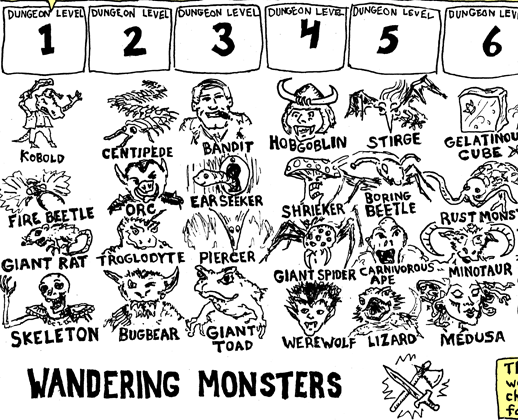
    This passage will feel very familiar to the players in Mike Mornard’s game. We’ve all grown to fear the d6, which comes rolling out at us whenever we’re “needlessly discussing unimportant matters or simply blundering around aimlessly” – which is often. Wandering monsters disappeared from 4e (and from many 3e games) because they slowed down the game pointlessly. What Mike Carr is suggesting here, and what we’ve learned from Mike Mornard, is that wandering monster checks are actually a way to preserve pacing. Once you’re in the dungeon, you can’t afford to get bogged down in bickering over minutiae. How I wish that work meetings came with wandering monster checks.

    mysterious containers

    The dungeon includes a good assortment of typical features which players can learn to expect, including… mysterious containers with a variety of contents for examination.

    The typical D&D treasure announcement isn’t “You find 1000 GP in a chest:” it’s “You find an old wooden chest. What do you do?” Containers are important. The Appendix A random generator has three separate tables for rolling up characteristics of treasure containers. Here are a couple of the ones I’ve encountered in OD&D:

    Contact poison on trap: One of the cardinal OD&D rules is “check the chest for traps.” As the party thief, I make sure to incant this formula. I think that the Greyhawk supplement has rules for finding traps, and I imagine that my odds of success are quite low, but in the last game, Mike told me, without requiring a roll, that the lock was covered with a brownish paste. Good enough warning for me to wear gloves. This transforms a 50/50 chance at arbitrary death into a game element that rewards a methodical, cautious play-style: quite in keeping with the mysterious OD&D “player skill.”

    We considered taking the chest with us so we could brush it against opponents, but Mike’s beatific expression – that of a DM who’s thought of flaws in PCs’ plans – warned us to leave it where it was.

    Invisible chests: Invisible chests are are oddly common in dungeons made with the Appendix A random generator – and hard to illustrate. They always seemed to me oddly pointless. Why include a treasure you can’t possibly find?

    In our case, we passed the invisible chest on the way into a room, but tripped over it on the way out. I can imagine it working like OD&D’s 3 in 6 chance to fall in a pit: there are rewards, as well as dangers, you might never know you passed.

    Our invisible chest contained 1000 or so gold, but we were all struck by the advantages of owning our own invisible chest. My character in particular, who frequently leaves his bandit hirelings unsupervised at home, has every need of a way to hide his treasure.

    There’s probably a lot more of interest in In Search of the Unknown, but I’ll leave the rest unread – just in case I can get someone to run it for me. After all (says Mike Carr,) “this element of the unknown and the resultant exploration in search of the unknown treasures (with hostile monsters and unexpected dangers to outwit and overcome) is precisely what a DUNGEONS & DRAGONS adventure is all about.”