Archive for the ‘RPG Hub’ Category

using the Ravenloft board game to make 4e less “board gamey”

Tuesday, November 30th, 2010

Castle Ravenloft uses simplified D&D mechanics. Movement speed and tactical positioning are of reduced importance, so, ironically, the Ravenloft board game points to a version of 4e D&D that can be played off the battlemap, without minis.

Most Ravenloft monsters move 1 room per turn. Extremely fast ones, like wolves, move 2 rooms. A room is a dungeon tile: it might be, say, four by four squares. At this lower level of granularity, though, we’re usually not dealing with squares; we’re dealing with zones or range bands: concepts used by RPGs that are less finicky and tactical than D&D.

If you applied these movement rules to D&D combats, most combatants will probably end up in the same zone. Suddenly, it becomes pretty easy to track everyone’s position without a map. Chances are, all the melee fighters are going to be in the same zone, and some ranged guys will be one or two zones away. You could track this on a little zone chart, or even in your head.

This is not a ready-to-play 4e D&D houserule: 4e has too many game elements that involve shifts, pushes, pulls, and other square-based movement. It’s more of a wishful fantasy for 5e. Sometimes I like playing a tactical encounter on a battlemat, and sometimes I like to run a combat in everybody’s imagination. In my magical perfect D&D game: let’s call it Pauls and Dragons: every such rule would have two rules writeups, one for battlemat play and one for no-map play. Example:

Battle Push
Tactical map rule: The target is pushed up to 3 squares to a square that is not adjacent to any other creature.
Mapless rule: On the target’s next turn, it must spend a move action before it makes a melee attack.

In this imperfect world, one might want to play mapless 4e even without the full Pauls and Dragons rules being available. Here are some quick rules substitutions for zone-based D&D:

Adjacent: Everyone in the same zone is considered to be adjacent to everyone else.

Combat advantage: Movement can be used to gain abstract positioning.

When a push, pull, slide, or shift power is used, the actor makes a saving throw, with a bonus equal to the number of squares pushed, pulled, slid, or shifted. On a success, the actor gains combat advantage against another creature in the same zone. Combat advantage lasts until the actor or the subject moves again.

Hindering terrain: Pushes, pulls, and slides can move a creature into a pit or other dangerous terrain in the same zone. The pusher/puller/slider makes a saving throw, with a bonus equal to the number of squares pushed, pulled, or slid. On a success, the victim is moved into the hindering terrain. (The victim gets its usual saving throw to avoid being moved into the terrain.)

RONAs and monsters

Monday, November 29th, 2010
This entry is part 16 of 34 in the series Mazes and Monsters

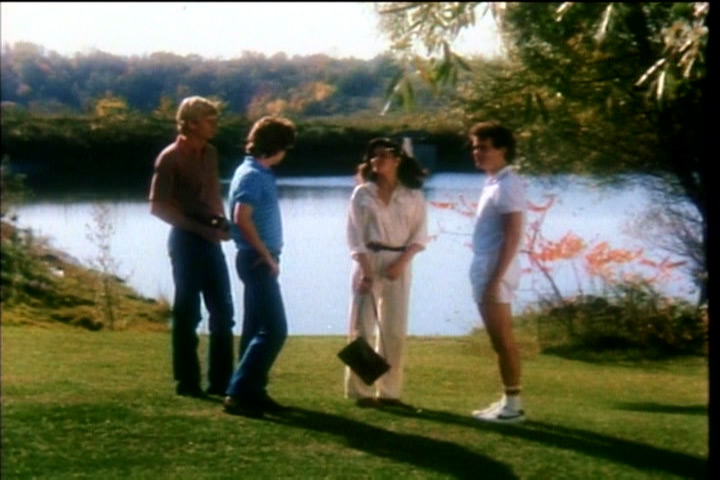
From watching the Mazes and Monsters movie, we’ve managed to glean a lot of the rules: adventure structure (a maze with a single end boss), a spell system (spell points), and a handful of races, classes, monsters, spells, and items.

We’re almost ready to hammer our Mazes and Monsters rules into a complete game! But before we publish, there’s a couple of tiny rules we need to figure out.

Notably missing: AN ACTION RESOLUTION MECHANIC and A COMBAT SYSTEM. All the times that Tom Hanks stabbed a pretend lizard, we never got the needed play-by-play from a Maze Controller. How hard would it have been to have Jay Jay voiceover, “The lizard rolls an 11! He misses! Tom rolls a 4 on his counterattack!”

Today let’s work on the Action Resolution Mechanic. We’ll save the combat system for next week.

For reference, here’s Iglacia the fighter’s character sheet. We can refer to this as we work out our rules.

click for larger version

RONA

So far, we know that most actions are resolved by rolling exploding d12s and trying to hit a target number called a RONA (Roll-Over Number for Accomplishment). We are using a somewhat peculiar exploding-die mechanism: rolls of 1-10 are treated normally, while 12 is a critical success (add 10, roll again), and 11 is a critical failure (originally, I said that you rerolled and subtracted your new roll, but let’s simplify it to “subtract 10, roll again).

We also know that characters don’t have numeric stats: Iglacia has “courage”, for instance, not “courage 12”. Therefore, we probably don’t use a D&D-like system where stat bonuses are added to a die roll.
(more…)

you find 400 gp and 50 cattle

Thursday, November 25th, 2010

For most of history, cattle were the primary form of wealth. This is a form of treasure that would be extremely annoying for PCs to deal with, and therefore should be exploited.

Let’s say that there is a people that exclusively uses cattle for wealth. Gold jewelry may be valued as a luxury good but is not used as currency. The PCs need to buy something from the king of this people.

To strike a deal with the king, the PCs will have to go to the nearest place that accepts gold, and buy a herd of cattle. They will then have to drive it to the king and enter negotiations.

I’d make the cattle drive a skill challenge. Besides nature checks, any smart decision made by the PCs (for instance, to hire experienced cattle drivers) would count as a success. More successes would mean that less cattle wandered away during the cattle drive.

Also, a lot of cattle-wealth cultures area also cattle-stealing cultures (highland Scots for instance). Therefore, there would be a few combat encounters on the way to the king; raiders whose intent was not to kill the PCs but to distract them long enough to panic the herd and make off with a few cows.

When the PCs meet the king, he’d say something like “My spies inform me that you lost x% of your cattle on your way.” He’d judge the PCs accordingly. If the PCs had done a bad job, he’d be more likely to think the PCs were weak and steal the rest of the cattle himself.

the bed problem

Wednesday, November 24th, 2010

D&D has an interesting resource-management mechanic, Hit Points, to represent the increasing difficulty of fighting successive battles. However, it’s essentially a toothless system because fighting successive battles is optional.

No edition has offered a mechanical benefit for forging onwards. 4th edition made a vague wave at the idea by doling out Action Points regularly, but it’s still always better to hit the reset button by taking a nap. Sure, the DM can provide story reasons to fight multiple battles, and players may do the honorable thing and journey onward. However, neither DM-based or player-based efforts to route around a rules problem constitute a valid solution to the problem.

The mantra recited by the D&D designers during their pre-4e marketing campaign was “decisions should be interesting.” Now consider this decision:

Should I go to bed?

  • Yes, if I want to be stronger
  • No, if I want to be weaker

    To offer a compelling choice, dwindling HP (or healing surges) need to be opposed with increasing power along some other scale. The choice should be something like:

    Should I go to bed?

  • I’m getting dangerously low on hit points
  • on the other hand, if I go to bed, I’ll lose all these cool advantages I earned

    I haven’t thought of a good fix yet, though I have a feeling it has something to do with action points. The ideal solution would

  • provide just enough motivation to do multiple battles that it was an interesting choice
  • not make the PCs massively overpowered even if they manage to do, say, 8 battles in a day
  • not encourage weird PC behavior, like, say, purposely doing badly in fights in order to get benefits
  • replace the ungainly “1 action point every 2 encounters” rule. I hate keeping track of whether it’s an odd or even encounter.

    I call this problem the “bed problem”. I will award the Bed Prize and 1,000,000 imaginary dollars to whoever comes up with a satisfying, fun solution that will address the points above.

    Note: I pre-reject the solution “The DM should just force the players to do multiple encounters in a day.”

  • mazes and monologues

    Monday, November 22nd, 2010
    This entry is part 15 of 34 in the series Mazes and Monsters

    We’re in the last scene of Mazes and Monsters! In a week or so I’ll be preparing a free PDF of the complete rules. For now, let’s finish up the movie.

    Last time, Tom Hanks’ friends found an insane Tom Hanks about to jump off the World Trade center and saved him by DM fiat.

    Some time afterwards, the friends pile in a car to visit him at his parent’s house. They’ve heard he’s “doing better” and are excited to see him. They exchange news about their own lives: Kate, for instance, has gotten over her writer’s block! Oh yeah, she’s a writer, and she had writer’s block. I remember that from all the times that came up.

    They find Hanks sitting under a tree out behind his house. They’re thrilled to see him! He quickly demonstrates, though, that he hasn’t recovered; he still thinks he’s Pardieux. That’s the bad news. The good news, though, is that his role-playing has never been better! He delivers a magnificent in-character monologue that generations of Mazes and Monsters players would do well to study and imitate, for both style and content. I present it here, with rules annotations in a right-hand column. Aspiring actors, I strongly recommend you memorize this piece for future audition work.
    (more…)

    every book’s a sourcebook: Traps from The Ginger Star

    Friday, November 19th, 2010

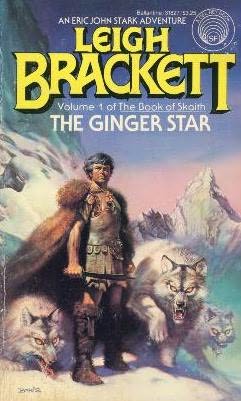
    The Ginger Star by Leigh Brackett

    The Ginger Star by Leigh Brackett

    Another good classic D&D trap from The Ginger Star: A windlass at the top of a staircase that drops part of the staircase. You can either go old-school D&D, and have a goblin run out and turn the windlass while the PCs are on the stairs (falling damage, no save, go down a dungeon level, roll on the wandering monster table) or 4th edition it and have the PCs have, say, three turns to fight their way up the stairs to stop the goblin before he can turn the windlass 3 times.

    I think I prefer the old-school method. It feels so classic I’m surprised it’s not in the AD&D random dungeon features appendix.

    name day: Whisperwood

    Thursday, November 18th, 2010

    What is the Whisperwood? What does it whisper, and to whom?

    the paladin’s steed returns

    Tuesday, November 16th, 2010

    I’d guessed that the Essentials Cavalier paladin would come with a summonable mount (based both on the general retro-ness of Essentials and on the etymology of the word Cavalier). When Heroes of the Forgotten Lands came out, though, it looked like I was wrong.

    Just when all seemed lost, D&D Insider came galloping to the rescue, with The Cavalier’s Steed, which provides a poké-horse as an alternative to the Cavalier’s class feature Pace of the Virtuous Charger. (Pace of the Virtuous Charger is the one that lets a cavalier get a speed boost on charges. Somehow it makes me picture the paladin galloping into battle, possibly while riding one of those horse heads on a stick. I think I prefer the real horse.)

    The article also provides mounted feats, including upgrades to the Paladin’s summoned mount. My favorite:

    Improved Steed (Celestial Battle Tiger)
    You have learned how to summon a large, powerful battle tiger from the celestial realms to serve as your steed.

    Finally, my He-Man-themed D&D campaign can get off the ground!

    mazes and monsters: pointless

    Monday, November 15th, 2010
    This entry is part 14 of 34 in the series Mazes and Monsters

    I said I’d wrap up Mazes and Monsters today, but there’s just TOO MUCH GOOD MATERIAL in this movie. Every word falls from these kids’ mouths like gold coins from the mouth of the girl in that one fairy tale. The fairly tale with the frogs, maybe? I believe Tom Hanks is the frog in this analogy. The point of the analogy, in case you’ve forgotten it, is that it will take me two weeks to finish extracting game material from Mazes and Monsters.

    I should have learned by now that when it comes to blogging Mazes and Monsters, I should always double my initial estimates. I originally thought this would be a 6-post series. It looks now like it will be at least 16 posts, and maybe something like 20,000 words. And I’m only scratching the surface of what could be done! Mazes and Monsters is a game so different from other RPGs of its time that a company could devote a whole product line to it. It really merits expansions, modules, a line of paper minis, and a Saturday morning cartoon with Vin Diesel as the voice of Tom Hanks. And vice versa!

    I’ll do one more week of recap, and then maybe a week or two where we can grapple with some unresolved rules questions, like “What exactly is the combat system?” My hope is to make available a PDF of the complete game system by Christmas!

    Now on to the recap:

    Last time, we followed Tom Hanks on his murderous rampage through Manhattan. This time, his friends have figured out that Hanks’ map bearing the legend “The Two Towers” isn’t a Tolkien reference: it refers to WTC. That means we get a cringe-inducing chase through the Twin Towers, that goes on forever. Seriously, I think Hanks and his friends visit every floor. It’s like that interminable part of Final Fantasy VII inside the Shinra building, except more boring and uncomfortable.

    Tom Hanks’ friends finally corner him on the roof just as he is about to jump off.

    JJ: Pardieux, what are you doing?
    Hanks: I’m going to join the Great Hall!
    Blondie: (with infinite guile) You can’t! It’s a trap!
    Hanks: I have spells! I’m going to fly!
    JJ: You don’t have enough points! I am the maze controller, and i have absolute authority in this game.

    POINTS! Confirmation that Mazes and Monsters uses a spell point system. Could Gary Gygax’s DMG reference to alternate game systems, with their cumbersome spell-point mechanics, have been targeted at Mazes and Monsters?

    Sadly, since we’ve mostly seen Iglacia the fighter’s character sheet, we don’t have any idea what the scale is for spell points. We saw Tom Hank’s character sheet, but it was a childish chickenscratch scrawl. So we’ll have to guess.

    Based solely on the fact that Iglacia had 181 Hit Points at level 9, let’s say that Spell Points are in the ballpark of 20 points per level. So at level 9, Pardieux the Holy Man can’t cast Fly. Of course, he may have already used up some of his Points: on that failed spell against the thugs, for instance. (What was that spell? It seemed to involve flower petals. Maybe it was a Wizard of Oz-inspired sleep spell.)

    Why do Holy Men get 20 points per level, and not, say, 10? Maybe spells cost around 10 points per level, and the design intent is that spellcasters can cast 2 spells of the highest level during an adventure, or multiple lesser spells. Maybe less-powerful casters get less points.

    Spell Points
    Characters find magical Spells, Tricks, and Powers during maze exploration. These spells can be used over and over again – they are not used up. The characters, however, have a limited capacity to cast these spells represented by Spell Points.

    Holy Men gain 20 Spell Points per level. Frenetics gain 10 per level. Fighters don’t gain Spell Points and thus cannot use Spells, Tricks, or Powers.

    When characters cast a spell, the spell’s cost is deducted from their Spell Point total. Spell Points regenerate to their maximum value only after characters leave the maze forever. (There may be other items and features, like magical springs or bitter roots, that restore spell points as well. This is up to the discretion of the Maze Controller.

    With this info, we can start slotting in spells. We’ve seen Fly; we’ve theorized Sleep; and earlier, Tom Hanks failed at casting a Raise Dead spell.

    Spells

    Sleep: Level 9. Cost: 90 SP. A single subject must make a RONA check or fall unconscious. (The points are spent whether or not the subject is affected.) This is a favored spell of Holy Men and others who prefer to resolve combats without bloodshed.

    Fly: Level 10. Cost: 100 SP. The caster, or another character of his choice, is able to fly for the next hour.

    A flying character who takes off from a sufficiently high point (at least 1300 feet off the ground) who flies straight up for the entire hour can reach Heaven.

    Raise Dead: Restores a dead person to life. It only works for a short period after the person’s death; after that, you need to fly to Heaven to find them.

    Next week, Tom Hank’s magnificent monologue, in which he delivers a performance on par with Skeletor’s monologue from “Masters of the Universe!”

    every book’s a sourcebook: Thieves’ World

    Friday, November 12th, 2010

    Thieves World ed. by Robert Asprin

    Thieves' World ed. by Robert Asprin

    Reading Thieves’ World for the first time makes me want to run a picaresque city campaign (which I always want to do anyway). Andrew Offutt’s story “Shadowspawn” hits both the heist and the double-dealing aspects you’d want to highlight in such a campaign. It also gets the economy right.

    The ultimate prize of the heist is enough coins to fill two saddlebags – silver coins, not gold, which would be too noticeable. The amount of money isn’t given, but the bags are heavy enough to slightly slow the main character, who is specifically described as having bulging calf muscles and biceps. It’s also mentioned that it’s more money than an elite king’s guard will ever earn. I’m guessing it’s at most 100 pounds of silver coins – in 3e+ D&D terms, that’s worth 500 GP. This is enough money to murder or risk your own life for, even if you’re one of the highest-level characters in the city. (Of course, for picaresque characters, copper is enough to murder for.)

    A picaresque campaign has to be on the silver standard, at the highest. Anyone throwing gold around is either a mark, or a con man pretending to be a mark. And that might not be real gold anyway. Remember that in literature, whenever anyone gets a gold coin, they bite it. There must be a reason for that. At least a quarter of gold is probably counterfeit.