I made some cosmetic changes to the Mearls game:
I have a feeling there will be some bugs in this version, so put them in the comments to let me know.

I made some cosmetic changes to the Mearls game:
I have a feeling there will be some bugs in this version, so put them in the comments to let me know.
I’ve been DMing the Mearls crowd-sourced D&D game for a week, and one thing is clear: the PC, whose every turn is controlled by a committee of up to 50 or so players, has that elusive quality “player skill”.
The communal player avoided a trap; killed two and charmed one orc without ever hazarding personal combat; and has been steadily pilfering everything of value, despite the watchful eye of the orc ally. The player has been creative, greedy, and hasn’t made a single rash decision. It would be interesting to run a Mearls through a true Tomb of Horrors-style deathtrap dungeon or an old tournament module. I have a feeling that we’d do better than most human parties.
Watching the votes come in has been fun. While the first-offered alternative has a slight edge in the voting, it’s been interesting to see that a late-suggested, but clever, option frequently wins the voting.
There’s accepted wisdom about committees making bad decisions. On the other hand, there’s a famous story about the “wisdom of the crowd”. In a contest to guess the weight of a bull, the average of all the guesses was within .1% of the true weight.
It’s been fun to run this D&D game: there are plenty of mindless little CRPG games you can use to waste the odd ten minutes at work, but nothing’s quite like reacting to a real person (or real people) in a true RPG. I’d judge the experiment a success, and I’m thinking of keeping it going.
Here’s what I propose:
If you haven’t joined the game yet, jump in! Right now we’re at a crucial decision point: should the PC fight four ghosts, or try to teach them about the evils of sexual harrassment?
More quotes from Sepulchrave’s D&D stories:
Finally, note that the magic item exchange is fairly typical of my campaign. I never allow such things to be purchased on the open market, and generally insist that they are either made by the characters (as time permits), or are exchanged for like items. It tends to effectively limit items in circulation.
This seems like a great idea, and is much more palatable to me as a DM than a world with a magic item store. Trade means that players can still get what they want, but they potentially have to trade away a piece of their own power (a magic item.) It also helps introduce a stable of NPCs with whom the PCs have relationships.
Here’s one of Sepulchrave’s PCs proclaiming his trade goods to a prospective deal partner:
“An Iron Horn, Winged Boots and a bag of emeralds to the value of twenty-eight thousand gold crowns,” Ortwin said in a matter-of-fact way.
Clearly, money can’t be used to buy magic items outright, but it can still be used to sweeten a deal.
In April 2011, Mike Mearls did something cool with his “Legends and Lore” column. He intentionally misused the weekly poll software. Instead of asking “do you like the ideas in this column?” he asked “You stand at an intersection, with passages heading to the north, south, east, and west. Which way do you go?”
His crowd-sourced, poll-administered D&D game only lasted a few months, but it was a great idea. From now on, I propose that a play-by-poll D&D game be called a “Mearls”. I wrote some Mearls software, and I’ll be running a game this week (and maybe beyond).
D&D isn’t D&D unless it’s open-ended. Therefore, in this Mearls, there will be no pre-written choices. If you have an idea, you can suggest it. If people like it, they will vote for it. You can change your vote any time.
As the DM, I’ll advance the game two or three times each day. Join the game to get alerts!
The Little Sisters of the Sun had caught one group on their mountain and sacrificed the lot, singing the Hymn of Life. Wild bands had eaten another group…
-Leigh Brackett, The Hounds of Skaith
Leigh Brackett can put a lot of horror into a few sentences. The Little Sisters of the Sun, mentioned here in passing, seem sinister enough to deserve their own D&D adventure.
Between the Little Sisters and the wild bands of cannibals, the environment from this passage seems even more dangerous than the average D&D countryside. The wild cannibals puts me in mind of an Oregon Trail journey gone wrong: perhaps my D&D continent has a frontier beyond which there are no patrolled countries or city walls. It’s a higher-level zone, perhaps recently re-discovered like Eberron’s Xen’drik, and its natives are twisted by post-apocalyptic magic. I assume that the Little Sisters of the Sun were, long ago, neutral good, and the tribes of cannibals are the remnants of civilized feudal peoples.
When I invent a time machine, the obvious first application is to play D&D with my favorite 19th century writers.
If I were to DM a game for, say, Jane Austen (and I would like to! In fact, Jane Austen, I hereby extend to you a CHALLENGE to play at my table! YOU WILL HAVE FUN) I wouldn’t try to cobble together some 19th-century setting involving dance halls and drawing rooms. I also wouldn’t run a straight D&D game either. I’d play Al-Qadim.
Tolkien revolutionized the fantasy imagination, giving us the dwarves and elves that we now associate with fantasy. But there was been fantasy literature for a long time before there were hobbits.
In the English-speaking world, at least, the Lord of the Rings of the 18th century – the book that directed literary fantasy, juvenile escapist power fantasy, and the hunger for the exotic and sublime – was the 1001 Nights. When 18th and 19th century Europeans thought about evil wizards and magic rings, they also thought about djinni, flying mechanical horses, and trees that grew jewels like fruit. They were so hungry for fantasy that 1001 nights weren’t enough nights for them. They wrote their own “arabesques” – original fantasy literature using 1001 Nights trappings, much of it worse than the original.
Nowadays, rich nerds with too much money build castles. Then, rich nerds, like William Beckford, built arabesque mansions. William Beckford also wrote Vathek, an arabesque copping its style and themes from the 1001 Nights. In a way, William Beckford is the Richard Garriott of his day.
Here’s Charles Dickens talking about 1001 Nights:
Oh, now all common things become uncommon and enchanted to me. All lamps are wonderful; all rings are talismans. Common flower-pots are full of treasure, with a little earth scattered on top; trees are for Ali Baba to hide in; beef-steaks are to throw down into the Valley of Diamonds, that the precious stones may stick to them, and be carried by eagles to their nests, whence the traders, with loud cries, will scare them.
That sounds to me like guy who is going to FREAK OUT the first time he plays D&D and the DM announces that he found a magic ring. OK, Charles, you’re in the group.
OK, so here are the guys I’d invite to my game table:
What celebrities/historical figures/fictional figures would you guys play with?
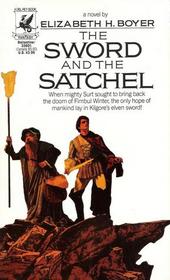 Elizabeth Boyer’s 1980 The Sword and the Satchel, a Scandinavian-mythology fantasy, is a story of a fighter with a magic sword and a wizard with a bag of holding. It has a couple more D&D moves worth pillaging:
The frost giants… shouldered their cudgels and passed swiftly, uprooting a few trees for practice. Their glancing eyes filled the air with snow and their breath was like the coldest night in deepest winter.
This is a beautiful detail: just as snow at night is often only visible under streetlights, there are flurries of snow in a frost giant’s cone of vision. It’s also a useful signal for PCs who are trying to sneak by a frost giant and want to know if they’re unseen. Except if it’s actually snowing. Then they’re screwed.
“A real lingorm!” Kilgore puffed. “Do they really get bigger with every bit of gold they have, or is that an old wives’ tale?” “Old wives aren’t so misinformed,” the wizard retorted.
In D&D, there is a correlation between dragon size/HD and treasure size. It would be interesting if there were causation as well. It would make dragons’ greed for treasure make more sense. It would also explain why Smaug freaked out when Bilbo stole that golden cup. That theft made Smaug diminish, just a little. (Maybe the missing cup caused the missing scale over Smaug’s heart?)
If it seems too extreme for all dragons to get this lore, you could give it just to metallic dragons: a silver dragon’s size is based on the amount of silver she has amassed, for instance. In this case, copper dragons would be totally safe. No one wants their hoard of a million copper pieces.
Three horsemen were riding up the side of the barrow toward a flickering blue light at the top. Kilgore strained his eye against the crack to see better, his heart suddenly thudding. From the ancient folklore of his people, he knew a blue light in a barrow mound meant there was treasure inside.
I don’t know enough about Scandinavian folklore – is this a thing? Whether it is or not, it seems cool.
I wouldn’t automatically put a visible blue light in every dungeon. I might turn this into a spell: someone using some sort of Detect Treasure spell might be able to see the blue glow that let them know this dungeon was worth exploring. It might even be a free-to-cast ritual known to all sorts of adventurous people.
The latest D&D articles from Wizards solved a problem for me. A giant problem.
This week, James Wyatt and Jon Schindehette are talking about 5e giants. The new giants cleave pretty close to D&D tradition, which reminds me that I’ve always had a bit of difficulty with traditional D&D giants in my campaign world.
When I’m making an adventure, I rarely think, “this would be a great place for (say) fire giants.” However, I often think, “This would be a great place for giants.” The elemental subtypes don’t help me tell my story: the giants in my campaign world are basically big, strong humans. They’re handsome in a cruel way. They’re smart, cultured, and they once ruled the world. Over the centuries, they’ve been pushed back by the little people, and they now rule only in the mountains.
Of the six D&D giants (hill, stone, frost, fire, cloud, and storm), none really matched my vision for giants. Therefore, when combat with giants came up in my 3e and 4e games, I usually made up a generic on-the-fly monster with high HP and damage, whose attacks sent people flying.
In my last giant-themed adventure, which I ran a month or so ago, I emphasized the high society of the giants: I mentioned that they wore silks, went hawking, and served noble feasts. Therefore, I was drawn to James Wyatt’s description of cloud giants: “Cloud giants are cultured and refined, collecting fine art and exquisite treasures in their mountaintop or cloud-built castles. They dress in rare silks and wear elaborate jewelry, and they enjoy gourmet food and sophisticated music.” It turns out that my giants are cloud giants!
That brings me to the other minor problem I have with the six D&D giants: cloud giants and storm giants are insufficiently distinct. They both live in the clouds and do cloud magic. According to Wyatt, cloud giants “mimic some of the magic inherent to the storm giants: controlling weather, bringing storms, and steering wind.”
Cloud giants don’t really have a big enough chunk of conceptual real estate to stand on. That’s probably why, in all my years of playing D&D, as a player or DM, I’ve never encountered a cloud giant. However, stripped of their unnecessarily duplicative cloud schtick, they can fill the vacant “generic giant” role.
So here’s how I’m going to arrange the giants in my own campaign:
There will be two common types of giants: hill giants (who fulfill an important purpose as the dumb, uncivilized, low-level giant) and cloud giants (the smart, civilized, high-level giant), who I’ll rename “mountain giants”. Those two races are the typical giants: the ones that commonly pose a threat to civilization. The other giants (fire, stone, frost, and storm) are exotic creatures who usually live far from civilization: in volcanoes, on inaccessible peaks, in the frozen north, and on clouds.
Looking through my old D&D notes, I found a few sentences I wrote in 2010 under the heading “Suggestions for Fifth Edition”. This was well before the D&D Next announcement: it was based on my reaction to Fourth Edition and how I’d like the developers to improve it in some hypothetical new edition.
How does the 5e playtest compare to my 2010 wishlist?
1) “Minor action” and “move action” are very descripive and easy to remember for new players. On the other hand, “Standard action” is almost meaningless. Change the name “standard action” to major action
2) “Combat Advantage” is clumsy. It’s a 5-syllable mouthful that you have to say a million times every session. It could be replaced with the term “on guard”. “Grants combat advantage” can be replaced with “off guard”.
My “Move/Minor/Major” suggestion was really just a gripe about the bizarre 3e name “Standard Action.” 5e uses the pared-down terms “Move” and “Action”, and ditches the minor action altogether. They extend the term “advantage” to a whole subsystem which goes way beyond my cute little nomenclature.
Either way, 5e is addressing my underlying problem here: it’s paring away some arbitrary and unnecessarily technical terms, and making things easier to explain to new players.
Did I get what I wanted? Yes!
3) Reduce analysis paralysis during combat and character creation. Feats and powers grouped in kits?
When I wrote this, I was imagining something like a “berserker” kit, which would be a bucket of feats and melee powers: Power Attack, for instance, might be a feat available only to berserker-themed characters. A single character might only have one or two kits. At character creation, rather than looking through, say, 200 feats, you’d instead have to look through 20 kits, and then 10 feats within your chosen kit (30 decisions instead of 200 decisions). Furthermore, this would reduce the number of bizarre corner-case combos that can lead to broken builds.
This is basically how the 5e “theme” or “specialty” system works, in essence and in detail. “Powers” are gone from 5e, but 5e feats are more like 4e powers anyway.
Did I get what I wanted? Yes!
4) Separation between combat and noncombat
I expanded this idea into a 2010 blog post. I didn’t like the fact that D&D throws combat feats, like Weapon Focus, into the same feat-choice slot as non-combat feats, like Improved Diplomacy. 4e made an attempt to separate direct-damage powers from “utility” powers, but it didn’t end up doing what I wanted, because most utility powers were combat powers anyway. I’d rather have more non-combat powers, siloed out from the combat powers. I’d like this division extended to feats as well.
5e is planning to address more attention to non-combat activities, “exploration and interaction,” but they’re not doing what I hoped, having the non-combat pieces of the game fed by different resources. My experience is that combat options are like kudzu that chokes out rival options, but I’m willing to be proven wrong.
Did I get what I wanted? No!
That’s all I wrote down in my notes, but I also have a few old blog posts with more pre-Next suggestions for 5e. Let’s see how they stack up:
I suggested that fighters lose the Marked ability; the Shift action be removed; and opportunity attacks go away. Furthermore, the fighter class should be given opportunity attacks as a class feature.
The first 5e playtest packet actually met these goals (except giving fighters extra stickiness). In the second playtest packet, things moved backwards a little bit: opportunity attacks returned. I guess my ideas didn’t pass the playtest test.
Did I get what I wanted? For a while!
In this 2010 blog post, I pre-invented “bounded accuracy”. I suggested that AC, attacks, and other bonuses shouldn’t get 1 point every 2 levels. The reason monsters and characters should get tougher is because they get more HP and do more damage. Furthermore, I suggested that skills could now have fixed DCs.
This change is being made in 5e, and it’s one of the changes I’m most excited about.
Did I get what I wanted? Yes!
My “suggestions about 5e” are, more or less, gripes about 4e. My 2010 vision of 5e was a new, improved version of 4e.
It seems that we’re getting something a little different. I’m not quite sure what it is yet, but it’s making more ambitious changes than the ones I suggested. My guess was that 5e was going to be an overhaul of the 4e chassis (more like the change between 1st and 2nd edition), and instead it looks like it’s going to be a new machine (more like the change between 2nd and 3rd).
On the whole, it looks like I’m seeing more Yes than No on my 5e suggestions. I’m getting what I wished for. Let’s hope I like it.
I’ve already plugged Spenser’s amazing 16th-century D&D poem The Faerie Queene.
It’s a pretty decent campaign setting. It already includes most of the D&D races: humans, of course; elves (the main character of book 1 is an elf knight); and dwarves (the dwarves are of the “let the dwarf mount the battlement and give signal on his trumpet!” variety, but you can fudge it). No halflings, sadly.
It also features the four big character classes: fighters and knights and paladins of all kind; a “guilefull great Enchaunter” with “magick bookes and artes”; “a stout and sturdy thiefe”; and clerics.
Here’s a description of Fidelia, the highest-level cleric in the setting:
And that her sacred Booke, with blood ywrit,
That none could read, except she did them teach,
She unto him disclosed every whit,
And heavenly documents thereout did preach,
That weaker wit of man could never reach,
Of God, of grace, of justice, of free will,
That wonder was to heare her goodly speach:
For she was able with her words to kill,
And raise againe to life the hart that she did thrill.And when she list poure out her larger spright,
She would commaund the hastie Sunne to stay,
Or backward turne his course from heavens hight;
Sometimes great hostes of men she could dismay;
Dry-shod to passe she parts the flouds in tway;
And eke huge mountaines from their native seat
She would commaund, themselves to beare away,
And throw in raging sea with roaring threat.
Almightie God her gave such powre, and puissaunce great.
So what do we have here?
First of all, clerics use spellbooks in this setting, and although Fidelia is Good, her spellbook is written in blood. Bad Ass.
“She was able with her words to kill / And raise againe to life”. She can case Raise Dead, and its reverse Finger of Death.
“Dry-shod to passe she parts the flouds in tway”: This spell is called Control Water, according to the third-edition d20srd.org.
“Sometimes great hostes of men she could dismay;” Fear? Cause Fear? Some sort of epic-level version, like Mass Cause Fear? Note the “sometimes”; clearly the spell has a saving throw.
“She would commaund the hastie Sunne to stay, Or backward turne his course from heavens hight;” Now we’re talking. Either she can stop and even reverse time, or she can command the sun itself. Either way, that sounds more powerful than the most powerful 9th-level spell (Time Stop only lasts 1d4+1 rounds, not long enough to notice an effect on the sun). We’ll call this a 10th level spell.
“And eke huge mountaines from their native seat She would commaund, themselves to beare away, And throw in raging sea with roaring threat.” This is a super-epic version of the 6th level spell Move Earth (which is much weaker: it has a maximum area of 750 feet on a side, and notes that “in no event can rock formations be collapsed or moved”). Since this spell can throw huge mountains around, it is clearly also a 10th-level spell.
There’s a slight possibility that Spenser meant this section as a religious allegory (“faith can move mountains”, etc) and not specifically as D&D spell list for an epic cleric. In my opinion, though, it’s both!