the cycle of repudiation and reclamation, and the 2nd coming of 2nd edition

September 18th, 2012

Here’s why 2nd edition is due to make a comeback.

For a long time, Original D&D was largely forgotten. Some people never stopped playing it, of course; that’s a given with any version of D&D. But it wasn’t a part of the public conversation about D&D. It was reclaimed in the 2000s by bloggers like Philotemy Jurament, whose analyses helped a lot of people realize how they had undervalued the OD&D game.

Nowadays on the Internet, the “Old School Renaissance” is a big thing. Most Old Schoolers revere the Original White Box game above all, although the early basic sets by Holmes and Moldvay come in for a lot of love. James Mal of Grognardia calls the White Box/Holmes/Moldvay period the Golden Age of D&D. The post-Gygax TSR period is generally ignored or dismissed: according to James Mal, the mid-to late-80’s is D&D’s Silver Age, and the 90s the Bronze Age. Of course, there are people still playing Second Edition, Dragonlance, Planescape, Spelljammer, and other products of the Silver and Bronze Age, but they don’t have the same control over the public conversation.

Reclamation occurs when someone rediscovers the value of something that’s usually ignored or sneered at. Right now, late-TSR D&D is the most undervalued property on the D&D Monopoly board. Today’s Edition Wars are fought primarily between the OSR, Pathfinder (3e) and 4e fans. The 2e supporter doesn’t have nearly as loud a voice.

I believe their day is coming. I predict that, within two years, some blogger will come along and express, with the persuasiveness of a Philotomy Juramont or James Mal, what was so special about the story-based, Elmister-infested, roleplaying-over-rollplaying Silver and Bronze Ages of D&D. We’ll learn why Spelljammer was actually awesome. THAC0 will stop being a punchline. People like Zeb Cook and Douglas Niles will finally get some praise for carrying the D&D banner for a while.

A hitherto silent piece of the D&D population will have a voice, and people who fondly remember the gaming 80s – and new converts – will flock to the 2e banner. They’ll have a movement.

I’m not the blogger who is going to bring that about. I wasn’t playing D&D during the 2e period, and I can’t even imagine the arguments that will make 2e sound like the Best Edition Ever. But the cycle of repudiation and reclamation is inevitable in literature, political science, high fashion, and in D&D too. I think there’s a mass of 80s and 90s D&D game material that’s waiting to be re-appreciated.

(By the way: I know that there are a lot of people currently playing 2e. I’m proposing that it’s currently undervalued, not that it’s unvalued.)

5 Metal Scenes From The Faerie Queene

September 14th, 2012

A while ago, my wife’s English PhD friends decided to run a D&D game based on Spencer’s The Faerie Queene, an Elizabethan epic poem that I’d never read.

I’m game for any D&D going, so I agreed to play. I didn’t want to be behind everyone else on understanding the setting, so I read the first book.

I’d heard that The Faerie Queene is long: it’s one of the longest poems ever. And it was written in the 1500s, AND Spenser was being deliberately archaic, so it’s sometimes hard to read.

Those are some of the reasons I never read it. Now here are some reasons you should read it: It’s super metal. You could use it to illustrate an entire 1980’s worth of heavy metal album covers. And it’s super D&D. It reads a little like Spenser was putting the adventures of his 1590’s D&D game into pentameter and dedicating it to Queen Elizabeth.

Here are 5 metal scenes you could steal for your D&D game. I’ve only pillaged Book 1.

The youthfull knight could not for ought be staide,
But forth unto the darksome hole he went,
And looked in: his glistring armor made
A litle glooming light, much like a shade,
By which he saw the ugly monster plaine,
Halfe like a serpent horribly displaide,
But th’other halfe did womans shape retaine,
Most lothsom, filthie, foule, and full of vile disdaine.
And as she lay upon the durtie ground,
Her huge long taile her den all overspred,
Yet was in knots and many boughtes upwound,
Pointed with mortall sting. Of her there bred
A thousand yong ones, which she dayly fed,
Sucking upon her poisnous dugs, each one
Of sundry shapes, yet all ill favored:
Soone as that uncouth light upon them shone,
Into her mouth they crept, and suddain all were gone.

This is maybe too metal for D&D! Not every group is ready for all the horrible little monsters drinking poison from the snake-woman’s breasts, and then the monsters scuttle into her mouth.

And next to him malicious Envie rode,
Upon a ravenous wolfe, and still did chaw
Betweene his cankred teeth a venemous tode,
That all the poison ran about his chaw;

All in a kirtle of discolourd say
He clothed was, ypainted full of eyes;
And in his bosome secretly there lay
An hatefull Snake, the which his taile uptyes
In many folds, and mortall sting implyes.
Still as he rode, he gnasht his teeth, to see
Those heapes of gold with griple Covetyse;
And grudged at the great felicitie
Of proud Lucifera, and his owne companie.

Each of the seven deadly sins are warlords in the army of Spencer’s Big Bad Evil Guy. My favorite is Envy. He rides a wolf, and chews a poison toad! Like most of the poem, it’s all transparent allegory, but if it’s read literally, it’s awesome.

The most metal detail? The BBEG that the seven evil warlords serve is named Lucifera.

Then tooke that Squire an horne of bugle small.
Which hong adowne his side in twisted gold
And tassels gay. Wyde wonders over all
Of that same hornes great vertues weren told,
Which had approved bene in uses manifold.
Was never wight that heard that shrilling sownd,
But trembling feare did feel in every vaine;
Three miles it might be easie heard around,
And Ecchoes three answerd it selfe againe:
No false enchauntment, nor deceiptfull traine,
Might once abide the terror of that blast,
But presently was voide and wholly vaine:
No gate so strong, no locke so firme and fast,
But with that percing noise flew open quite, or brast.

This is a pretty good magic item! When it’s blown, this horn has the following effects:
1) Cause Fear
2) Dispel Magic
3) Knock

Plus it has a range of three miles!

But ere he could his armour on him dight,
Or get his shield, his monstrous enimy
With sturdie steps came stalking in his sight,
An hideous Geant, horrible and hye,
That with his tallnesse seemd to threat the skye,
The ground eke groned under him for dreed;
His living like saw never living eye,
Ne durst behold: his stature did exceed
The hight of three the tallest sonnes of mortall seed.

…his stalking steps are stayde
Upon a snaggy Oke, which he had torne
Out of his mothers bowelles, and it made
His mortall mace, wherewith his foeman he dismayde.

…The Geaunt strooke so maynly mercilesse,
That could have overthrowne a stony towre,
And were not heavenly grace, that did him blesse,
He had beene pouldred all, as thin as flowre:
But he was wary of that deadly stowre,
And lightly lept from underneath the blow:
Yet so exceeding was the villeins powre,
That with the wind it did him overthrow,
And all his sences stound, that still he lay full low.

I love this fight against a giant. The giant is, like, 18 feet tall. That’s a serious giant: the same size as a cloud giant, according to the SRD. I like that he tore up an oak to be “his mortall mace”.

The giant strikes hard enough that, if he’d hit, he would have beat his opponent as thin as flour. That matches my group’s gory descriptions of critical overkills, which frequently turn goblins into thin red pastes or red mists, and makes me think that Spenser would fit in at my game table.

Finally: The giant’s attack knocks ther hero prone, and stuns him, ON A MISS? Killer DM!

There all within full rich arrayd he found,
With royall arras and resplendent gold.
And did with store of every thing abound,
That greatest Princes presence might behold.
But all the floore (too filthy to be told)
With bloud of guiltlesse babes, and innocents trew,
Which there were slaine, as sheepe out of the fold,
Defiled was, that dreadfull was to vew,
And sacred ashes over it was strowed new.

This is a great description of an evil castle. It’s a super civilized palace, all decorated with gold and art and beautiful tapestries, but the floors are just swimming with blood and gore, all the time. This is a really creepy location.

buy Paul’s Dungeon Master Notebook as PDF

September 13th, 2012

In case you missed the Random Dungeon kickstarter but would still like to play D&D like Paul does, I put a PDF version of Paul’s Dungeon Master Notebook up on RPGNow. 64 pages, $4.50. Edition agnostic, low to high level play, lavishly illustrated, yada yada.

Buy Jared’s dungeon paintings! And help out Jared!

September 10th, 2012

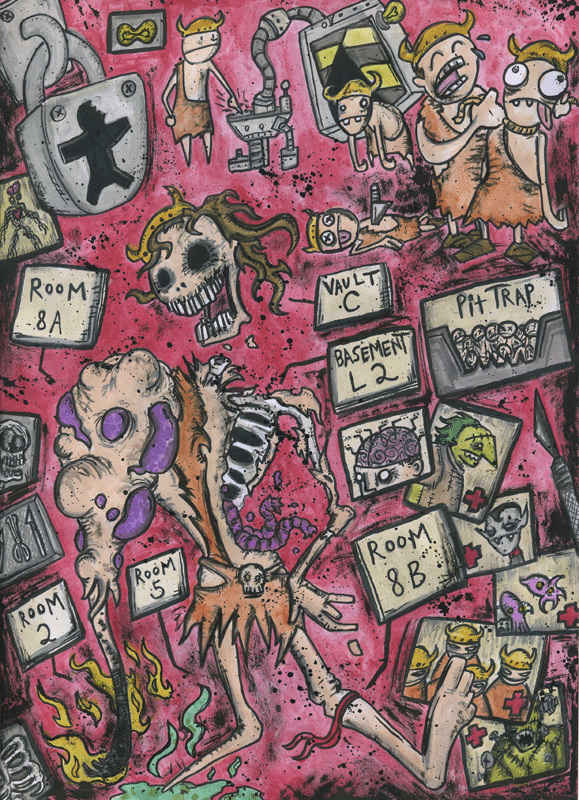
The inimitable Jared von Hindman produced some fabulous paintings for the Random Dungeon kickstarter: I asked him for a dungeon, and he produced five dungeon paintings, along with five dungeon keys (which are also paintings).

Here’s a sample: the Coroner’s Dungeon:

Coroner's Dungeon

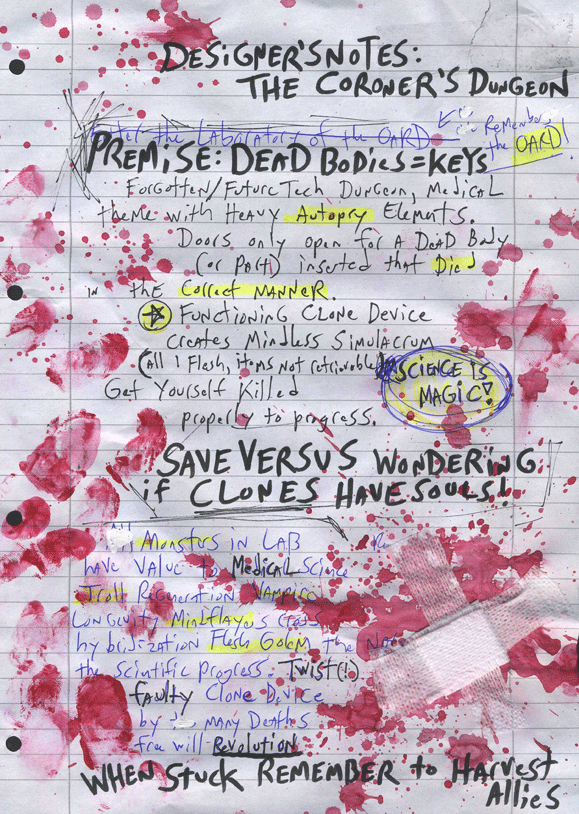
And the map key:

Coroner's Dungeon key

If you’re interested in buying prints, I’ve made a store for all ten paintings on zazzle.com. Each dungeon painting print sells for $29.50, and accompanying key sell for $19.50, so you can get a full dungeon and key, both on heavyweight archival paper, for $49. All of the profits from prints will go straight to Jared – I’m not keeping anything.

Which brings me to some sad news – Jared is going through a tough medical and financial time right now. He’s sick, and stuck in a hospital. He’s also having financial difficulties. Tracy of Sarah Darkmagic has set up an indiegogo campaign to help him out, Operation Jared Tech, to get him enough money for computer equipment so that he can continue working. There are 13 days left: make a donation! Or buy a dungeon painting print. Either way you’ll be helping out a cool artist, writer, and fellow D&D player.

Buy Paul’s DM Notebook. Here are some free pages!

September 7th, 2012

For my kickstarter, I put together a 64-page, edition-neutral book of adventures, rules, idea germs, settings, races, and high-level options from my home campaign. I’ve turned it into a lulu book, which you can buy for $9.95.

I’ve featured a couple of pages from this book before. Here’s a page from the book:
Rules for picaresque games

And here’s another excerpt I haven’t shown before:

THE FAIRY LAND’S DECAYING TREASURES

The feywild is a land of hyper-adventure, and you should be able to describe fairy-tale treasures, like trees that grow rubies as fruit, a beach covered with emeralds, or a coach carved from a single diamond. Problem is, for some crazy reason, DMs never want the PCs to get their hands on so much cash all at once.
Forget that impulse. You can’t be stingy in the realms of wonder. ALWAYS GIVE OUT TEN TIMES THE USUAL TREASURE IN THE FEYWILD.

Feywild gems and jewels are different from natural-world treasure. When you return home with your basket of fey riches, you may find that your pearls have turned to eggs, sapphires to cupfuls of water, diamonds to ice, rubies to rose petals, and emeralds to leaves. If you’re lucky, you may find a scattering of real gems in the bottom of your basket.

When any piece of Feywild riches is first exposed to the natural world’s sun, or touched to iron, roll a d10. On a 10, the treasure keeps its form. Otherwise, it turns to some natural, worthless object. Roll individually for each major object; for collections, assume 10% of the items survived. Once a fey treasure has survived once, it is forever a permanent, real treasure.

Magic items are immune to this effect. But you could consider giving fairie-made weapons and armor a higher enhancement bonus that’s only active in the Feywild. Once exposed to natural-world sunlight, +2 fey weapons become +1 sunrusted weapons.

In fairyland, there is no way to distinguish the “real” from the “false” treasure. The fey realm is made up of so much fantasy and glamor that the distinction is considered meaningless. Many fey treasures are enchanted by fairy craftsmen who think that flowers and leaves are as good origins for beautiful gems as dirty dwarven mines. Therefore, raw materials, like gold and gems, are more common and less valuable in the Feywild. Treasures are valued for the skill and beauty with which they are carved or engraved. Coins are rare: jewelry and luxury items are more often exchanged.

The nature of a precious item’s creator can often be determined by the ingredients used to make it: a good fey creature might create gold coins from dandelions, and an evil one might use living poisonous beetles.
Because the feywild is so rich, its rare money transactions are conducted at prices inflated by 10x. The most common forms of fairy currency, though, are favors and promises.

For Fourth Edition players, here’s a ritual that lets the PCs create fabulous fey treasures:

RITUAL: FEY CREATION
Level 5.
The caster makes an arcana check: a result of 15 means that the caster can create nonmagical gems, jewelry, or precious metal objects of up to 10 GP in value. For every 5 points by which the caster’s check exceeds the DC, multiply the maximum GP value by 10. Thus, an arcana check of 35 means that the
caster can create up to 100,000 GP in value.

The ingredients for the ritual include natural objects to represent each item to be created (a bushel of pebbles to become silver pieces, a giant fey buttercup to become a golden goblet).

Special materials, like mithral, cannot be created with this spell. Items created with this spell cannot be turned into magic items. The casting cost for the ritual is arcane ingredients worth 1/10 of the value of the items to be created. This ritual may only be cast in the feywild.

odnd encumbrance

September 4th, 2012

The rule for Encumbrance seems to be that you should always arbitrarily divide gear up into two tables. In 1e, weapon encumbrance was listed in the weapons table, while encumbrance for eveyrthing else was hidden in a table in the back of the book.

As a new-school D&D player, there’s a lot of D&D history I’ve missed. Editing Cheers Gary, gaming with Mike Mornard, and illustrating the AD&D Dungeon Generator have helped, but there’s a lot in D&D that I still don’t understand. I’m going back to the OD&D texts to see whether they can help my new-school game.

In OD&D, it’s a similar story. On page 15 of Men and Magic, there’s an “Encumberance” table, which mashes together entries for equipment items (“helmet”, 50 GP weight; “shield”, 150; “weight of a man”, 1750; “miscellaneous equipment” (rope, spikes, bags, etc)”, 80) with values for maximum load (“load in Gold Pieces equal to light foot movement (12″)”, 750).

Then there’s an example of encumbrance in action. A plate-armored guy on foot has equipment that makes him move at the speed of an Armored Footman. Makes sense.

Then, there’s another table, “Weights and Equivalents”, which mixes up carrying capacities (“one small sack holds” 50) with the weights of different pieces of equipment than the ones on Table 1 (“1 flagon or chalice”, 50). Well, fine. But how much does a ewer weigh?

There must be some sort of conceptual difference between the items on Table 1 and Table 2. The stuff on Table 1 is more likely to be the type of stuff you start out with, and the stuff on table two is more likely to be treasure that you pick up in the dungeon. But it’s a fuzzy line.

In my game, encumbrance is an unsolved problem. No one really wants to add up the weight of all their gear. Taking a tip from the OD&D “Encumbrance” and “Weights and Equivalents” table, I can imagine splitting up encumbrance into two areas on the character sheet:

1) Equipment. Anything, within reason, that players write in the Gear section is considered to be weightless. Only the armor type matters for movement rate.

2) Treasure. Everything you write in the “Coins, Gems, and other treasure” section has weight. If you’re running the kind of game where you can find 500 pounds of copper coins, you’ll need to figure out how to carry it. You can carry 10 pounds of treasure per Strength point without being encumbered.

It doesn’t matter what kind of armor you wear: if you have a strength of 10, 101 pounds of treasure slows you down a notch.

I’d consider using 5e’s Disadvantage here for encumbered characters: while you’re laboring under the weight of all those treasure sacks, you’re at disadvantage, meaning you’re worse at jumping over pits, noticing people sneaking up behind you, and fighting. When a monster pops out, you’d better drop the treasure.

dark shadows

August 30th, 2012

Netflix On Demand is carrying the 60’s horror show Dark Shadows. I’ve never seen it, but I have a vague memory of hearing that it was an influence on Gygax and Arnesen, so I decided to watch a little bit and see if I could detect any D&D flavor.

I watched one episode, and already the D&D influence is clear. It’s about a shady guy whose research leads him to believe there’s valuable jewelry buried in a tomb in a crypt. He gathers together some tools and enters the dungeon setting.

(spoilers ahead)

He finds himself in a room with some sealed stone coffins. He can’t open them with his crowbar, so he rigs up a rope and pulley, running the rope through a ring on a coffin lid and a ring set in the wall. When he pulls the rope, the coffin lid still doesn’t budge — but the tug on the ring on the wall opens up — wouldn’t you know it — a secret door to a hidden chamber.

Inside the chamber is another coffin. This one is wrapped with chains. The graverobber, who is suffering from a dangerous case of genre blindness, decides that the chains on the coffin somehow indicate that this coffin contains treasure. He pulls off the chains and opens the coffin. What’s in the coffin isn’t clear, but whatever it is, it strangles him.

This episode provides a perfectly usable D&D encounter. If the rings in the room are described, the PCs will probably pull the wall ring — either as part of a pulley system, as in the episode, or just under the general principle that anything described by the DM should be pushed, pulled, or hit.

The chains around the outside of the coffin add a spooky touch, and provide a hint that whatever’s in the coffin may be a tough encounter.

Rather than populating the coffin with a regular old strangling monster, as in the episode, I think I’d fill it with a puzzle/environment monster in the tradition of D&D puddings or yellow molds. I’d have a cloud of fog billow out, flowing across the floor and expanding in every direction 10 or 20 feet per turn. All the crypt’s dead would rise as skeletons as soon as they were touched by the fog. The PCs would either have to fight an ever-increasing army of skeletons or flee in front of the fog. Perhaps the original occupant of the coffin would be a ghost who had concealment while in the fog and could, as its move, teleport into any fog-covered area.

ecology of the kobold

August 28th, 2012

I mentioned that I have trouble playing kobolds and goblins differently. Two undifferentiated weak, trap-setting, underground cannon-fodder races is too many, so a while ago, I came up with some new quirks for goblins.

Here’s my take on kobolds.

Kobolds are scavengers

I decided that goblins were producers – they don’t need other races to survive.

Kobolds, on the other hand, don’t produce anything. They live on the edges of settlements and steal garbage, set up traps for travelers, and raid farms. Kobolds are the first thing you fight at level 1 because they’re right on the edge of town.

Therefore, kobold weapons are likely to be daggers, scythes, and shortbows created by other races. Their industry goes as far as weaving ropes into nets and turning leather into slings (but not making the rope or the leather).

When they’re unable to steal food, kobolds eat bugs and small animals, and set traps to catch large animals and humans.

Kobolds worship fear

I had a bit of a problem coming up with a kobold gimmick. Recent editions have them as dragon-worshippers, which is fine, I guess, but it’s limiting. For instance, you don’t want to design a system that has kobolds and dragons (a high and low level encounter) always sitting on top of each other. What level party will face them?

In the past, I’ve also experimented with kobolds as demonic minions suitable for level-1 parties to face. They’re scaly and have horns – all they need and pitchforks and the smell of brimstone to fill that role.

Kobolds’ defining characteristic is that they’re the weakest monster in the monster manual. Individually, they’re afraid of everything. I decided that was the key to their psychology. They worship fear. If a creature is strong enough to kill a lot of them, they will serve that creature. The more frightened they are of the creature, the more fanatically loyal they become.

Kobolds will fear any creature that kills a lot of them, but the creatures they worship most slavishly are those with cause fear effects: typically dragons and demons have such powers. Conveniently, that preserves the lore of the dragon-worshipping kobold.

Kobolds like to cause fear

Kobolds try to inspire fear in others. They’re too weak to do so with force of arms, so they do so by exploiting traps, darkness, and trickery. They prefer traps that don’t kill instantly. Fiery logs rolling towards their target; poison that weakens over time; pit traps that hurt but don’t kill; those are their favorite. They also have a weakness for Scooby Doo style trickery, terrifying villagers with phosphorescent scarecrows and devil masks.

When Mike Mornard ran us through a kobold maze, he had a handful of kobolds, striking from the darkness, terrifying a well-armed band of stronger first-level characters. That’s part of a tradition going back to Gary Gygax’s brutal level 1 kobolds. Kobolds are most effective when they’re scary.

Kobolds mutate

Like goblins, kobolds have their own brand of magic. Kobold magic lets them take on the characteristics of the thing they fear most. Thus, kobolds enslaved by a white dragon might gain icy dragon breath (for 1d4 damage). Kobolds enslaved by an evil necromancer might gain wimpy little Emperor Palpatine lightning. Kobolds used by drow might gain the ability to create shadows.

Kobolds will also gain obsessions related to those of their masters. A dragon’s kobolds will hoard treasure. A vampire’s kobolds will drink blood. An evil knight’s kobolds might actually learn to march in step.

Independent kobolds

Some kobolds can’t find any evil creature to act as their master/protector. These tribes tend to gravitate to the edge of human settlements, where they steal from, and to some degree imitate, adventurers and city guards.

downton and dragons 4: Titanic dungeon crawl

August 24th, 2012

In my last post, I described a big nine-PC D&D adventure set in 1912, on board the sunken Titanic. Like Telly Savalas, the PCs were after the contents of the Titanic’s safe.

During the adventure, the PCs managed to placate the Titanic’s ghosts by organizing one last ghostly waltz. Now that the ship had been drained of dangerous ghosts, the PCs had less to fear on their way to the safe. Still, I ran the exploration of the ship as a standard dungeon crawl. Here were the rules I used:

To get to the safe, the PCs must go down 2 staircases and through 6 sections of hallway. In each one, roll for a random encounter:

1-2: SEA ZOMBIES OF FIRST CLASS PASSENGERS: 2d4 zombies wearing furs, pearls, suits, top hats… there may be zombies of people the characters know. [Use zombie stats as appropriate for edition: I used the ones from the 5e playtest.] Every successive first class sea zombie encounter has 1d4 more zombies than last time. Treasure: do the treasure check as if you had rolled a 10-12.
3: SEA ZOMBIES OF THIRD CLASS PASSENGERS: 2d6 zombies. Mostly Irish. One of them is playing a fiddle faster and faster: zombies get +1 to hit every successive round (use an escalation die as if you were playing 13 Age). They all die if the fiddler is killed. Treat any further rolls of 3 as more first class zombies.
4: CARNIVOROUS SEA HORSES ridden by mermen. 3 units. Bite (+3, 1d8+5 and trident (+4, 1d6+5). After round 1, they will try to blow a conch to summon reinforcements: 50% chance of summoning more mermen.
5: PROBING TENTACLE (if the kraken was not defeated. If the kraken was killed, a roll of 5 results in no encounter.) A huge tentacle probes down the corridor. AC 14, 30 HP, +5 hit, 2d6+4 damage. If it hits someone, it automatically does 2d6 next turn unless they’ve escaped. After it grabs someone, it tries to draw them back out to be eaten three turns later.
6: LOCKED OR STUCK DOOR: strength check to open. Each round of failure: The PCs hear noises from behind them. Make a new random encounter roll.
7-9 No encounter.
10-12: Inanimate first class passenger corpses (wearing necklace, rings, furs, books, checkbooks, gold headed canes, cigarette box, gold pencils, etc). If the PCs loot their bodies, roll 5d6: every roll of 4-6 lets them find a valuable item worth 400, 500, or 600 GP.)

I ran this section pretty much straight, except that when mermen called for reinforcements, I decided that more identical mermen would be boring, and had them summon a merman riding a giant racing crab who made 2 pincer attacks per round.

the safe

The PCs got to the safe. In front of it, there lay three corpses: two older men in fancy clothes and one surprisingly handsome young man in working-class clothes.

At this point, several of the girl players made “aha” sounds. The guy players remained mystified.

The rogue opened the safe. “You find–” I said.

“–a nude picture of Kate Winslet,” said one of the girls.

“–A surprisingly inept pencil sketch of a nude woman,” I said. “Also, a priceless diamond. And the will of Patrick Crawley.”

The party high-tailed it up to the deck of the ship, where they met

UNDEAD LEONARDO DICAPRIO

A ghostly Leo teleports in front of each player in turn, spending a second or less in front of each, and says “Where is my diamond?” (If, for some reason, no one has taken the priceless diamond, he will leave them alone.)

Roll initiative! Not that it matters. In order to make a single creature a viable challenge for nine players, I had Leo act right after every character’s initiative, attacking that character (whether the character made an attack or not). Thus, Leo got 9 attacks per round. Leo was teleporting from character to character so fast that every character could make either a melee or ranged attack on Leo, their choice.

Oh, one more thing: While fighting Leo, use a laptop to play this heavy metal version of the Titanic song.

Leo attacks each character with a dagger:
AC: 16. +2 all saves, +4 on dex saves. 150 HP.
Attack on each initiative: +5, damage 1d4+10.
Quick Teleport: Leo attacks after each character’s initiative. Movement-restricting effects don’t work on him. Stun and similar turn-stealing effects only works for one player’s initiative.

When Leo is brought to 50 HP, he yells “I’M THE KING OF THE WORLD!” From this turn on, his attacks do an extra 5 damage a turn.

Here’s an ability I forgot to use in the game:
If Leo is ever alone, he uses one of his attacks to whistle and summon 1d4 sailor zombies. They attack random targets on Initiative 0.

When the PCs killed Leo, I described him getting old and puffy before his spirit dissipated.

Wrapping Up

Once the players had the will, they did some investigation: they found the new heir to Downton Abbey, a one-year-old baby. Next there was some player-directed roleplaying, wrapping up loose ends:

  • The rogue and sea captain conspired to ruin the quartermaster’s career and keep the submarine.
  • Two of the characters waylaid the evil wizard Matthew Crawley in an alley outside a tavern, and straight up murdered him.
  • One of the characters had a personal enemy, Lord Filth. The PCs smuggled Matthew’s corpse into Lord Fith’s bed, and then, in an act of pettiness, stole a bottle of perfume.
  • The halfling rogue and the daughter of the Earl got engaged!

    I had been thinking of having a final battle with Matthew Crawley, but it would have felt anticlimactic after the Leonardo fight. (I was going to play “Mr. Crowley” by Ozzy.) Anyway, Matthew’s anticlimactic ambush was funnier.

    All in all, the game was a pretty good prediction of what will happen in Season 3 of Downton Abbey.

    I’d never DMed a group this big. Given the challenges, I think that it didn’t go too badly. It’s tough to keep a nine-PC game moving swiftly through combats, and I bet there were times when it got annoying to wait several minutes to take your attack. Luckily, 5e combats do run a little quicker than 4e, and I had people roll their attacks simultaneously whenever possible.

    Outside of combat, everything worked very well. As it happened, everyone got to spend some time in the spotlight, and people were very entertained by each others’ antics. This was strictly a result of having a good collection of D&D players.

    As a 5e playtest? We hit a few jagged edges, which I’ll note in feedback. In general, though, I had a great time. That’s true of every D&D edition in which I play, which, maybe, makes me not a stellar playtester.

    The most important 5e question was answered: Does 5e works as a Downton Abbey simulator? It does!

  • downton and dragons 3: nautical nobles

    August 22nd, 2012

    Last time, I described the first part of a D&D 5e playtest set in 1912 England. Today I’ll continue the adventure. The second half of the adventure took place deep in the Atlantic ocean, on the sunken Titanic.
    When the PCs decided to explore the sea bottom, the character with the “Tycoon” background decided to consult his weather wizard. He just decided that that was something that a tycoon should have, and it sounded like a good idea to me. I had the weather wizard give everyone the ability to breathe and move freely under water.

    Rory, who had a Naval Officer background, asked if he had a ship. I decided that he had a sloop he could use to get to the coordinates of the Titanic wreck. Furthermore, I decided that he knew a dishonest quartermaster who would sell the characters the following naval equipment:

    An experimental submarine: the owner is asking 15k. (I intentionally priced this so high that the players couldn’t buy it with the money they had. I was curious if they’d be able to get their hands on it anyway.)
    Underwater diving suits: 700 GP each. Underwater, these act like +1 heavy armor, and above water, they are extremely cumbersome.
    Spidersilk swim trunks: For characters who wear cloth armor, these extremely modest Victorian bathing suits give a +1 AC bonus.

    The tycoon decided to buy upgraded armor for everyone, but he didn’t think we needed the submarine.
    Laura K, the swindler rogue, really wanted the submarine. She talked to the quartermaster privately. A few Charisma checks later, and he revealed that there was said to be a fabulous diamond on board the Titanic when it sank. If she would obtain the diamond for him, he’d give her the submarine. Showing a touching faith in her honor, he handed her the keys (or however you give someone possession of a submarine).

    under the sea

    I planned a cool fight for the PCs against a giant kraken. Because the PCs had a submarine, I didn’t use it as written. Here’s what I planned:

    The Titanic is lying on the sea bottom, broken into two pieces. A giant kraken is clinging to the broken cross-section of the front half, reaching inside and pulling out bodies, which it drops into its beak. When it sees you, it wriggles its fins and heads towards you.

    The kraken body has some huge number of HP, like 300, and the PCs are better off attacking the tentacles, which have 30 HP each and a reach of 20 or 30 feet.

    Every turn, the kraken can attack up to four PCs with up to four of its eight tentacles (doing 3d6+4 damage on a hit). On a hit, the subject is grabbed and needs to use his or her next turn to escape. On the kraken’s turn, all grabbed creatures take 2d6 damage. Tentacles currently holding PCs can’t make attacks; nor can tentacles that have taken 30 points of damage.

    If anyone decides to attack the kraken’s eyes, they may do so: each eye has 30 HP. Anyone who attacks an eye will be the subject of two tentacle attacks on the next turn.

    I had a roll of black crepe paper. I was planning to extend a piece of it to anyone grabbed by the kraken and ask them to tape it to their clothes.

    I don’t know how this fight would have gone, because the PCs had the submarine. They had negotiated with the port’s quartermaster for three torpedoes as well.
    I like big numbers, so i decided that each torpedo did 1d100 damage. Since firing the torpedo was a Dexterity attack, Rory, the sea captain, ceded control of the torpedoes to his cousin, Lady Glossop, a noted archer with a keen eye.

    3d100 damage later, the kraken was reeling. The characters swam out of the submarine to finish it off with a round of ranged attacks that dropped it to 2 HP.

    In the last round of combat, the kraken rolled very poorly for initiative. I announced that if any PC could do 2 points of damage this round, the kraken would be killed before it could attack.

    The wizard announced, “Magic missile! Autohit for 1d4+1 damage!” And the mighty beast died.

    That battle was a cakewalk for the PCs. I liked that it was a cakewalk because of the PCs’ actions. The rogue made a special effort to get the submarine, and the players were rewarded for it.

    In the Ballroom

    The PCs knew that they were looking for a safe on the C deck of the Titanic. When they left the submarine and stood on the ship’s deck, they saw stairs leading down. They also saw a deck-side ballroom, around which dozens of ghosts were gathering.

    There was really no reason to investigate the ballroom, but the players were curious, as I thought they might be. Here are my notes for the ballroom:

    The main ballroom is swarming with spirits. Normally, anyone who goes into the ballroom will see flitting white shapes and take 1d20 damage per round from their ghostly aura. Clerics, or those in a spiritual state of some kind, will instead see the ballroom the way it was the night of the accident.

    There is a full orchestra in evening dress, and a small choir. On the dance floor are many groups of people talking quietly to each other and asking strangers (like the PCs) for news. “We heard a crash! Did we hit anything?” There is a rumor going around that the ship is sinking.

    The band is worried that they may drown. If asked to play music, the bandleader will say that this is no time to dance. The PCs must convince the band. it should take 2+ of the following methods (or one really good one:)

    AFTER ONE SUCCESS: After one success, the bandleader will clearly be wavering. He lifts his baton and is about to strike up the band. Then, cold, black water starts flowing along the floor of the ballroom, getting peoples’ feet wet. People start screaming. The bandleader lowers his baton and looks to the PCs for advice. He will require a second success to make him play the song, preferably a success of a different type.

    SUCCESSES
    -Good reasoning (it will buck up the people and keep up morale! etc)
    -An inspiring speech (or a good charisma check)
    -PCs starting to play instruments or hum or dance
    -any form of magical compulsion
    -offer them blood to drink (they will lap up the blood but still not admit that they are ghosts)
    -any other interesting trick

    FAILURES
    FIGHTING: If the PCs offer violence or intimidation, four gentlemen in the crowd will yell “This is no time for violence!” and try to grab the most obnoxious PCs (they make attacks at +5; on a hit, they do no damage, but the PCs are Grabbed. Grabbed PCs must spend their actions making an escape attempt. If PCs attempt further violence, the ghosts will flip out.

    TELLING THE TRUTH: If the PCs tell the ghosts that they are ghosts, or that the Titanic has already sunk, the ghosts will flip out.

    GHOSTS FLIPPING OUT: If the PCs escalate the violence, the civilians will become more obviously spectral and start flying around the ballroom. Each PC will be attacked by two ghosts each (roll initiative).

    CONVINCING THE BAND
    If successful, the band will strike up “Autumn” by Louis Von Esch. Go here and press Play:
    http://www.loc.gov/jukebox/recordings/detail/id/2700/

    After a few moments, all the people in the room will start waltzing. Spectral ghosts will flow into the ballroom from all directions. As soon as they enter the ballroom, they will turn into richly dressed couples and start dancing.

    The way it worked out was even better. One of the clerics convinced the bandleader to play, and then convinced panicked passengers to dance. “It might be your last chance,” he said, truly.

    Meanwhile, the tycoon, who had the ability to interact with the spirit world because of a 5e class feature, asked if he saw the dead heirs or anyone he knew. I said that he saw the ghost of his old friend, the millionaire John Astor. John Astor said something like, “There’s a lot of noise about this ice collision, but the Titanic is unsinkable. Everyone is overreacting. Will you play a game of cards with me?”

    The tycoon agreed to a game of cards – agreeing to take several rounds of damage from the ghosts’ auras. He wanted to make a Bluff check to let his friend John Astor win one last game of cards.
    A Bluff check was made. There was a pause. “You always were a terrible bluffer, old friend,” Astor said. (The players sighed in disappointment.) “I could tell right away you had terrible cards. I have a full house!” (The players cheered!) John Astor, happy in his last victory, faded away!

    This scene was actually a tiny bit touching. The mournful musical cue, which I played from a laptop and which was actually the last song played on the Titanic, really helped set the mood.

    Next time: The players wrap up the Titanic dungeon crawl!