the ships that sail the desert

November 2nd, 2011

The desert is nearly impassable. Obviously it’s plagued by some giant sandworm-like creatures, as well as its environmental hazards. Surely someone crosses it, though! You have desert caravans in your D&D world, right?

Whoever the caravan masters are – humans? halflings? dragonborn in 4e? – they need some way to fight off the sandworms, blue dragons, and other high-level desert creatures. With food and water so scarce, there’s no way that hundreds of defenseless creatures – walking meals – are going to make it alive across the wastes, even if they do make a practice of hiring PCs as guards.

Since D&D is a post-apocalyptic game, the caravanners may well have cobbled together a Jawa sandcrawler-type vehicle from the magical vehicles of previous ages. It’s all Mad Max scrap metal, giant tank treads and armor, but seamed with golden light and bolted with runes. The desert crawler must be armed with a weapon powerful enough to keep the giant monsters at bay. Solar power is the traditional technology of all-knowing progenitor cultures, so let’s give it a mirror cannon that focuses beams of radiant energy.

No magic engine has survived from the ancient empires, so the desert crawler is powered by slaves in treadmills. The slaves are mostly the orcs and elves who live on the desert’s border. The caravan is always looking to buy strong slaves, so if the PCs are defeated in the desert by any intelligent opponent, they may wake up in a treadmill themselves.

How do the PCs escape from the caravan? Straying from the caravan’s oasis-dotted route invites death from thirst and sandstorm. Falling behind will put the escapees in the midst of the swarm of landsharks who pick off stragglers. Traveling ahead? Possible, but only the caravan leader has a map of the route.

The best option is the classic swashbuckling approach: free the galley slaves, throw the slavers to the sharks, and become a privateer on the desert sea.
how to make a werewolf creepy

October 31st, 2011


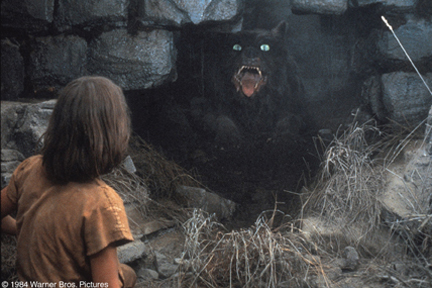
“The meat!” came a panted whisper. … He picked up the piece of meat and tossed it outside. It vanished immediately, and he heard the sounds of chewing. “That is all?” came the voice, after a time. “Half of my own ration, as I promised,” he whispered.

“I am very hungry. I fear I must eat you also. I am sorry.”

“I know that. And I, too, am sorry, but what I have left must feed me until I reach the Tower of Ice. Also, I must destroy you if you attempt to take me.”

“The Tower of Ice? You will die there and the food be wasted, your own body-meat be wasted.” …

The white beast panted for a time. Then: “I am so hungry,” it said again. “Soon I must try to take you. Some things are worse than death.”

–Roger Zelazny, Dilvish the Damned

I think that similar creatures in other books – often wolves, perhaps – apologize for their desire to eat the protagonist. Am I thinking of the Neverending Story? Something in Narnia?

Anyway, it’s not a bad trick for making a random encounter feel very creepy and personal, and a little sad as well. Play up the creature’s struggle as much as you want – maybe make it indebted to the PCs, to increase its guilt and anguish.

Ultimately, as much as a PC may feel sorry for such a creature, they’ll have to kill it, now or later; and it will be a mercy killing.

Like so many things in fantasy (and horror), including vampires, this creature’s relationship to the PCs seems like a symbol for some other, more disturbing human relationship. Fantasy handles these layers well. This is one of the reasons I’m not particularly interested in dealing with real-life disturbing issues in-game. Fantasy seems to me like a genre where these monsters are best transformed before they are fought.

there is no night without day! for serious

October 28th, 2011

Billboards depicting smart, well-dressed Indians enjoying soft drinks or cigarettes, or wearing the latest fashion creations, sheltered masses of naked homeless who lay wrapped in rags beneath their cheerful slogans. Roving throngs of orphaned children ran after the buses and wagons and rickshaws, chanting for coins or food or castoff objects. The stench of all this–the cooking, rotting, festering, putrefying–hung over the city like a malodorous cloud, reeking in the hot sun. To Spence it smelled like death. “The City of Dreadful Night,” said Adjani. “Look around you, my friend. You will never forget it.”
Dream Thief by Stephen Lawhead

Your wretched D&D slum isn’t complete without a conspicuous-consumption foil to set it off. It might be a foppish noble and his retinue, scented handkerchiefs held to their nose, as they pick their way over the starving beggars; immense gates festooned with bronze cornucopias and grain sheafs; or cheerful torchlight and the sounds of music and laughter from the palace over the river as the poor townspeople die of plague or frostbite.

Also “The City of Dreadful Night” is not a bad name for your horrific D&D city. It’s the title of a pretty depressing poem about London as well as a pretty depressing Kipling story about an Indian city.

1001 Nights vs King Arthur’s knights

October 26th, 2011

I have heard, O auspicious king, that when Ghanim brought the chest to his house, he opened it and brought the girl out. On looking around, she saw that she was in a handsome house, spread with carpets and adorned in attractive hangings and so forth. On seeing bundles and bales of materials and other such things, she realized that here was a merchant of substance, a man of great wealth. She uncovered her face, looked at him and, discovering him to be a handsome young man, she fell in love with him at first sight.
-1001 Nights

Coming from a childhood spent reading about King Arthur, I find the world of 1001 Nights notable for its dearth of knights and lords. In Europe, the male heroes are the nobles – the hereditary warrior class. In 1001 Nights, successful warriors are almost absent. The storybook heroes are merchants.

In 1001 Nights, access to the upper class is gained through business. People with swords are usually among the lowest classes: city guards, bandits, and armed slaves. In that way, it’s closer culturally to us than is Arthurian legend. In the modern USA, rich businessmen are the closest thing we have to a ruling class, and people who live by physical violence – criminals, soldiers, cops – aren’t in positions of power.

Interestingly, while our modern culture is built on a 1001 Nights model, our entertainment is built on a Knights of the Round Table model. Adventure movie heroes are frequently violent strongmen, while non-physical businessmen are more likely to be villains than heroes.

Old D&D editions, with their emphasis on treasure hunting, enable both modes. Like 1001 Nights heroes, and the players, the PCs are after money. They live in a world where once you collect enough gold, you level up and become a Lord. There may be hereditary lords and nobles as window dressing, but the real powers in the world are the nouveau riche, and wealth is primarily in the form of coins (as in 1001 Nights) not land (as in Camelot).

On the other hand, D&D money is collected through force of arms. In OD&D, the XP value of a treasure haul is related to the strength of its defender. If you’re 8th level, and you defeat a lowly 5th-level creature to win a treasure hoard, you get 5/8 of the XP value of the treasure. So in D&D, you’re a violent thug AND you’re greedy. Best of both worlds.

search for traps as an encounter power

October 24th, 2011

If PCs treat an old-school dungeon with any rational amount of caution, they will search every ten feet of floor for traps, listen at every door, and search every wall for secret doors. In other words, they’ll spam their at-will search abilities.

It’s a problem that Gary Gygax railed against in 1e:

Continual listening becomes a great bother to the
DM. While ear seekers will tend to discourage some, most players will
insist on having their characters listen at doors at every pretense.

4e has a general solution for spammed actions: make them encounter powers.

You could just make searching a regular encounter power, so it can only be done every five minutes, but I think it would be more interesting to make searches into a daily resource to be managed, like Fate points from Spirit of the Century-type games. During the day, you can search carefully for traps. Every time you search, and find nothing, you expend one of your searches. If you search and find something, you don’t expend a search. Furthermore, every time you blunder into a trap, you gain a use of your search power.

It makes sense narratively. If you’ve searched 100 consecutive doors for traps and found nothing, no matter how hard you try, you’re going to relax your vigilance. On the other hand, if you’ve been finding tons of traps, or if you see something about this door that makes you suspicious, you’re going to be far more alert.

We’ll leave all the search rules the way they are: we’ll just add to them. At the beginning of every day, every character gets a number of Search tokens equal to their Perception bonus. Rogues get, say, three extra tokens.

Whenever a PC wants, they can risk a Search token to get a +5 bonus to a Perception check. If the check doesn’t turn up anything interesting, they lose the token. If they find a trap, treasure, a secret door, or anything else hidden, they get to keep their token. Every time a PC falls victim to a trap, they get a Search token BACK. This represents their suddenly-increased attention level.

This system would reward players for searching judiciously, based on clues and intuition, not as part of a mindless sweep.

To compensate the PCs for their extra search power, every Perception DC in the game is 5 points harder.

I think this would encourage people to play the way that Gary wanted them to play: to search for traps and listen for monsters judiciously, when they have a reason to be suspicious – and to blunder blindly into the occasional ambush for the DM’s amusement.

fire has a lineage

October 21st, 2011

The symbolic passing of the old god would be enacted, and every fire would be extinguished except for a single firepot guarded by the queen and her family at the temple. (Stalking Darkness, Lynn Flewelling)

This isn’t really explored in the novel, but if every fire is relit from the Queen’s fire, in some sort of cascading olympic torch relay, everyone ends up with a royal fire: a descendant of the fire lit by the Queen herself.

There might be some magic power in it too. Perhaps fires lit by certain kings and priests – and all their children fires – have magical powers. Fire has a lineage. In that case, an ordinary torch might become a magic treasure.

The Lineage of Fire actually strikes me as a decent idea for an entire campaign. There are many families of fire in the world, passed from generation to generation through candles and torches. The different fires may have different powers (the blue necrotic fire of the deeps, the golden radiant fire lit aeons ago by the Sun God, etc). The different lineages of fire war for dominance. The PCs may work for a fire instead of a noble house; and PCs’ torches might be among their most valuable weapons.

All of the fires of the world are united against some evils. This world is a circle of firelight, and hungry things prowl, outside, in the Dark, waiting for the flames to fail.

My simple XP rules: 1 XP per encounter

October 19th, 2011

I know I’ll never fully embrace OD&D because I hate using charts. I prefer simple, easily internalized rules, like 3e’s Base Attack Bonus, rather than 1e’s Attack Matrix charts. 4e’s XP system still has a big ol’ level-advancement chart at the center of it, along with XP entries for every creature in the Monster Manual (which I often don’t use).

The 4e XP system has been formalized and math-checked, which means one of D&D’s central problems is more obvious than it has ever been: it suffers from “inflating-numbers-that-don’t-do-a-goddamn-thing-itis.” At level 1, you fight 10 battles in order to collect 1,000 XP. At level 10, you fight 10 battles to collect 20,500 XP. The specific amount of XP per battle changes, but the number of battles doesn’t.

There’s a historical reason for that. In old D&D, your XP was tied to your income. Since high-level characters won richer and richer treasures, XP totals per level had to rise. Now that characters don’t get 1 XP per GP earned, however, there’s no reason that XP needs to stick to that inflationary model.

Besides, calculating XP is kind of a pain: it involves flipping around in various books to add XP from monsters and traps, and dividing by the number of PCs.

I can’t be bothered to calculate XP, but I’m not ready to totally dump the idea of leveling up. Having the DM bestow levels arbitrarily takes away some of the treadmill charm of D&D. So here’s the super-simple XP system I use nowadays.

Every level costs 10 XP.

Most battles provide 1 XP. Boss battles provide 2 XP.

Same with quests and skill challenges: 1 XP, or 2 XP for major quests/challenges.

There are some minor variations here from the standard XP system:

  • XP differences between hard and easy battles are not so granular. Personally, I think this is fine, especially since the difficulty of a battle often has as much to do with circumstances and terrain as with the XP budget.
  • Quest XP is vastly higher in my system. In standard 4e, a minor quest gives about 1/5 the XP of one encounter, and a major quest as much XP as one encounter. This is probably a tiny fraction of the XP gathered from battles along the course of the quest. Video game RPGs, on the other hand, often give huge quest XP bonuses. This is great, because it’s weird when saving the world grants much less of a reward than fighting a random encounter.
  • It’s impossible to forget. You can give XP on the fly without consulting any charts. In fact, the players can track the 1 XP for each battle: all you have to do is grant the extra XP for quests and boss battles.
  • that 5% or 10% XP bonus is pretty irrelevant

    October 17th, 2011

    Old editions give you a 5% or 10% XP bonus for having a high Primary Attribute. You can argue that it’s realistic – naturally talented people progress faster. You can also argue that it’s overkill – most editions already give you gameplay bonuses for having high primary abilities. In fact, though, it doesn’t make much of a difference.

    In the versions of the game with XP bonuses, the XP per level generally doubled or almost doubled, at least until high levels (8 or 9). That meant that the 10% bonus was irrelevant most of the time. 9 out of 10 game sessions, the guy with the 10% bonus was the same level as the clod with 10 in his primary attribute.

    Is it worth the math busywork of multiplying every single XP bonus by 1.05% or 1.1% in order to level up a session early every 3 months? Maybe. Levelling is pretty awesome.

    In my houserules XP system (every level requires 10 XP, every encounter provides 1 XP) the effects of the 10% XP bonus can be duplicated very easily: characters with 16+ in their primary attribute (or whatever) start the game with 1 XP. Everyone else starts with 0 XP. That 1 bonus XP at character creation will have exactly the same effects as the 10% Primary Attribute bonus – the character is always 10% of a level ahead. Except no multiplication.

    conan has been consulting the random harlot table

    October 14th, 2011

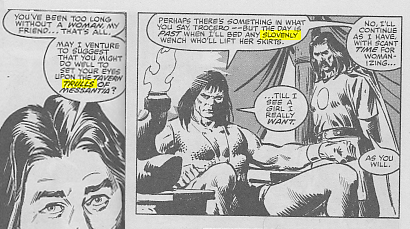
    Trocero: You’ve been too long without a woman, my friend… that’s all. May I venture to suggest that you might do well to set your eyes upon the tavern trulls of Messantia?
    Conan: Perhaps there’s something in what you say, Trocero–but the day is past when I’ll bed any slovenly wench who’ll lift her skirts.

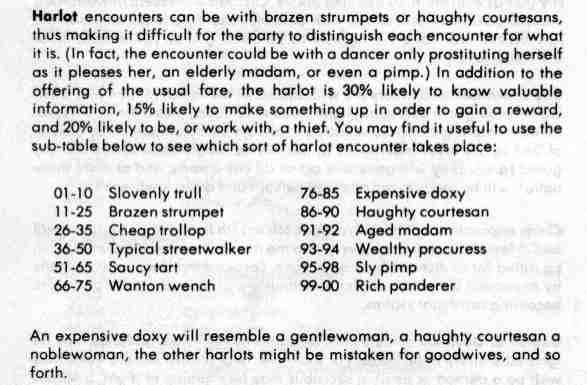
    Conan loves to roll on the random harlot table, but he hates to roll a 01-10!

    don’t make me refuse the ice cream

    October 12th, 2011

    When you’re asking me what I want for dinner, don’t offer me a choice between, say, carrots and ice cream. And when I’m choosing a feat, don’t make me choose between, say, improved Diplomacy and +1 to hit in combat. Combat is ice cream, and I’ll choose ice cream every time. And I’ll make myself sick.

    Separate the combat and noncombat abilities into two different courses. Give me a main course, where my dwarf fighter can choose between, say, the ability to detect new construction or slanted passages. Then for dessert I can choose between +1 to hit or +2 to damage with my trusty axe.

    I know a lot of people will say that overindulging on combat abilities is a player problem, not a rules problem. Sure, if you’re disciplined, and you have a strong character concept, you might turn down the cool sword in order to pour money into your barony. And there are always a few people who genuinely prefer the carrots of character flavor to the sundae of combat optimization. But a lot of people are like me: given the choice, we’ll choose the ice cream and then feel disappointed that dinner didn’t feel nourishing at all. The perfect system would save me from my gluttony and force me to eat a balanced diet.

    Given “Don’t Make Me Refuse the Ice Cream” as a design principle, here are some requests for 5th edition D&D.

    You shouldn’t be able to buy combat-boosting magic items. Rory’s excellent magic items article makes a lot of good points, this among them. If it’s possible to buy a sword with a bigger plus, then that’s the ice cream, sitting there ruining the rest of the menu. Versatility items, like wolfsbane, rituals, and flying carpets, and fun story items, like castles and battleships, shouldn’t have to compete with +5 swords.
    Read the rest of this entry »