I recently ran a 5e one-shot adventure for a big group of 9 PCs. Like any good playtester, I wanted to push the system in a way the designers didn’t expect. Our game answered a question I bet Mearls has never asked himself: “How well can 5e handle a game set in Downton Abbey?”
Last week I shared the custom backgrounds I made for the adventure. Today, I’ll share the adventure. I’ll go light on game details, as per the rules for discussing 5e mechanics.
I look for any excuse to play girly D&D. In this session, we had five girls, which was a good enough excuse for me to run the game as a combination D&D game/tea party.

Laura K, who is doing a PHD in costume design, brought some spare funny hats.
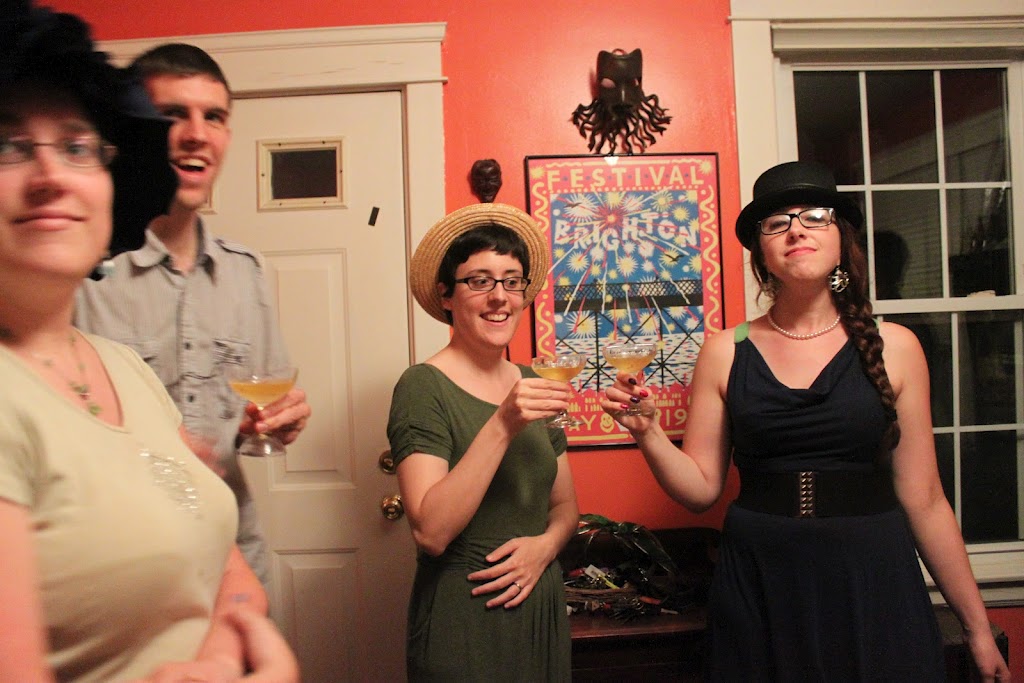
I began the adventure by having Laura H, one of the “loyal servants”, bring in a telegram telling us that the heirs of Downton Abbey had been lost on the Atlantic. Then I gave this speech:
“This is a DND game about Downton Abbey. Don’t worry if you haven’t seen it. I don’t really watch it, and all the information you need to know happens during the credits of the first episode. The Earl of Grantham lives in Downton Abbey. His heirs die on the Titanic. You can make up any characters you want, just so they’re currently staying at Downton Abbey. They could be relations, acquaintances, or servants. You just can’t be an heir of the Earl.
“Pick out a character you want to play and a background that describes your role in society.”
After everyone generated characters, I had the ladies retire to the drawing room to play cards while the gentlemen sat around and drank brandy-and-soda and smoked cigars. This was what happened after dinner in 1912. Also, it allowed me to temporarily break the huge group into two more manageable game tables. Caolan assisted me by acting as my co-DM, running the girls’ table.
Once we were segregated by gender, both groups were attacked!
The Gentlemen

Once the gentlemen were alone, I told them,
A black wind blows through the house, darkening the torches. Suddenly the evil wizard Mr Matthew Crawley appears before the earl! “So, Robert, I am now your heir! Now that James and Patrick have so unfortunately drowned, I shall inherit the estate! Your ancestral home shall be the new academy of the red arts of pain, and the shrieks of the damned shall crack the sky!”
The evil wizard had brough help with him: peasants upon which he performed magical experiments. He had two owl-headed men (owlbears) and four puppy-headed men (gnolls).
Matthew, the evil wizard/cleric, used standard D&D attack spells: Command, to make people grovel; magic missile; and cure light wounds in case he got in trouble.
One of our PCs was a scheming servant, and tried to sneak up to the wizard and change teams during the battle. Apart from that, the gentlemen did very well.
The PC cleric Lord Featherbottom, after being Commanded to grovel, cast his own Command spell on Matthew. While Matthew was rolling around and licking Lord Featherbottom’s boots, the other characters jumped on him and tied him up with the curtain ropes.
They discussed killing Matthew out of hand, but decided that they couldn’t murder a cousin of the family. If every noble who performed vile operations on peasants were killed, who would be safe?
The Ladies

Here’s the battle that I gave to Caolan for her to run:
Caolan in her character as Lady Cora should suggest they all play cards (i don’t have a period-appropriate name for the card game, make one up if necessary). Deal 2 cards to every player. “Put these face up in front of you.”
Then, a whistling wind blows through the room, causing all the candles to gutter. There is an icy cyclone in the center of the floor, and an old hag appears.
“My son is the new heir to Downton! All of you foolish women will be my slaves!”
She points at the cards and they come alive, as in Alice and Wonderland. Roll initiative! The old crone, Isobel Crawley, gets one initiative roll and the cards are on a different initiative. Have someone else keep track of what number initiative everyone is on.
In front of each woman are two cards (the two cards that were dealt).
Card stats: AC=13. HP=the number on the card (or 10 for face cards or 11 for ace.) Hit bonus=+5. Damage= the number on the card (or 10 for face cards or 11 for ace.)
Each card attacks the person who it was dealt to.
Every turn, as her action, Isobel will deal a new card and give it to someone who has the fewest cards attacking her.
If Isobel is personally attacked, she will fight back instead of dealing a card that turn: she casts a magic missile that looks like an icicle. It automatically hits and does 1d4+1 damage.
ISOBEL: AC 12, HP 40.If Isobel is brought to 20 HP (bloodied), or all her cards are defeated: She says “How dare you! You cannot stand before my brilliant son! All the other heirs are dead, we saw to that with our ice magic!” and she will disappear. Her cards will turn into regular playing cards. If Isobel is somehow killed in one round, she dies.
If the gentlemen’s battle is still going on, the ladies will hear noises of battle from the dining room. The women can run in and help (bringing their character sheets).
If anyone makes a pun about “cutting the cards”, a magic sword mounted on the wall flies to her hands. It is a +1 sword (1d8 damage) and she can use it no matter what her class is. The handle of the sword has a carving of a joker on it, and it has an inscription: “To Geoffrey, the second Earl of Grantham, for his bravery in the Great Card Rebellion.”
The ladies were able to deal with this threat, and they rejoined the gentlemen just as Matthew was being captured. Isobel had escaped.
Investigation
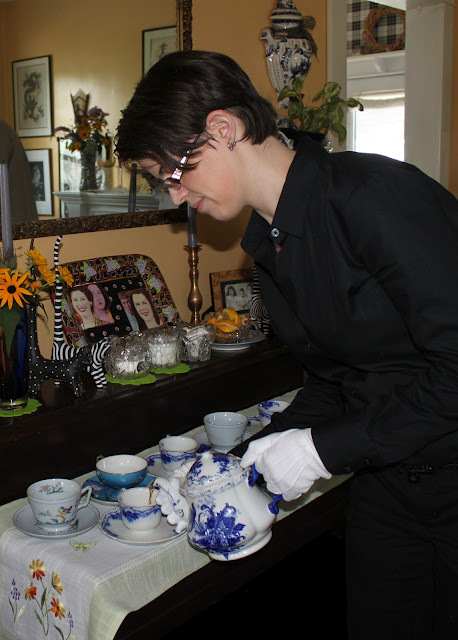 The players began discussing what should be done with Matthew. One of the daughters of the house, who needed to find a husband as soon as possible, offered to marry him, despite the fact that he was a raving monster. He was still rich!
Other characters speculated about the possibility of finding another heir. Rory, who was playing a naval captain, got a natural 20 on a society gossip skill check. I ruled that Rory not only knew that one of the drowned heirs had a secret family, but knew the location of the lawyer who had altered the will.
Everyone visited the lawyer. The lawyer revealed that the dead Patrick did indeed have a son. The son’s identity was revealed only in Patrick’s will, which was locked in a safe inside the Titanic!
“To the Titanic!” everyone cried.