cantrips for every class

June 27th, 2012

4th edition classes have been accused of feeling a little “samey” in combat, but there’s more to classes than combat. Or there should be.

Take the 4e wizard. This is an example of a well-designed out-of-combat class. In noncombat scenes, they generally feel like wizards. A huge part of the credit goes to cantrips. When you’re using Prestidigitation to make something disappear and Mage Hand to drop it into your pocket, all without making a single die roll, you feel like an all-powerful wizard. The class design complements the flavor nicely.

Compare that to the Ardent class from PHB 3. I tried an Ardent; I was reasonably interested by the premise of an emotionally explosive brain-warper who clouds men’s minds. The class flavor promised that, but outside of combat, the mechanics didn’t deliver. The only relevant class feature I got was a +2 to allies’ social skill checks. Now, I played that up as much as I could: instead of saying, “Remember that I give you +2 to Diplomacy” I said, “Richard Ink waves his hands and feelings of wellbeing fill the room. You get a +2 to diplomacy.” That can only go so far: that’s me working to support the flavor, not the mechanics of the class working to support the flavor as they do with the wizard. The Ardent badly needs a cantrip-like ability or two to give it an emotional niche besides “cleric who uses the Psionic power source”.

Really, every class could benefit from archetype-defining non-combat abilities. They’re a little hard to imagine for melee classes, but every magic-using class (arcane and divine definitely, and possibly primal) should get the noncombat fun that the wizard gets from cantrips.

You know what else is cool about wizard cantrips? There is no die rolling. They always work. The wizard doesn’t have to depend on the DM: the DM doesn’t get to set DCs or say whether something worked or not. Cantrips are small ways that the wizard has mastery over the DM’s game world.

So here’s what I want to do. Every class will get at least one little cantrip-like trick. Wizards are among the most magical classes, and have three cantrips. Most classes will probably have two. Martial classes might only get one. The cantrips will have the following characteristics:

  • They will have primarily out-of-combat effects. Their effects should be, on the whole, minor; but characters may be able to use them cleverly to good effect.
  • They will not require a d20 roll. A character should be able to predictably succeed when using a cantrip.
  • Using a cantrip should support the reason that people play the class.

CLERIC
Most people play the cleric because the group needs a healer. Putting that aside, though, people who actually enjoy playing the cleric tend to like giving out buffs and talking about their deity. A cleric’s cantrips should enable these behaviors.
-SYMBOL As a minor action, the cleric may make their god’s symbol glow from their palm or holy symbol. It disappears at the end of the cleric’s next turn. Sustain minor. Only a true cleric of a god can make the god’s symbol perfectly. It can be faked by illusion, but such fakery can be automatically discovered by anyone trained in Religion.
-BLESS The cleric touches an object or or a willing ally with their Symbol cantrip. The mark of the god will appear on the object or creature. If an intelligent creature sees the mark and knowingly kills the creature or destroys the object, they take 5 radiant damage (10 at cleric level 11 and 15 at level 21).

A cleric may maintain one simultaneous Blessing per level. The cleric can end any Blessing at any time. All of a cleric’s Blessings end when he or she falls unconscious or takes an extended rest.

PALADIN
People who play the Paladin usually want to be virtuous – sometimes obnoxiously so. A paladin will be happy if his cantrips support the paladin’s code while causing potential inconvenience to his party.
-VOW The paladin makes a promise. The hearer has total confidence that the the paladin is bound to his word. If the paladin willingly or unwillingly breaks his word, he suffers Shaken Faith, which gives the effects of resurrection sickness, until he has reached 2 milestones. While in Shaken Faith, the paladin may not make Vows and is generally broody.
-TAME As a standard action, a paladin may tame any adjacent creature with the Mount keyword of the paladin’s level or lower. The creature cannot be currently ridden by another rider. Such a creature instantly becomes a rideable ally of the paladin. As a minor action, the paladin may command it telepathically while it is within one mile. The paladin may only Tame one creature at a time. If a new creature is Tamed, a previously Tamed creature is released from the effect.

WARLOCK
People play the warlock because they want to act creepy and slightly evil. A warlock’s cantrips should make everyone nervous.
-SUMMON As a standard action, the warlock may summon a Tiny lesser creature belonging to their patron, as appropriate for pact – devil, fairie, alien. Sustain minor. The creature can make no attacks and has defenses equal to the caster’s. If the creature is hit, the caster loses a surge and the creature disappears. The creature has a fly speed of 5, and skills equal to the summoner. The creature may travel up to 10 squares away from the caster. The creature can communicate telepathically with the caster.
-BURN As a minor action, the warlock may ignite any unattended flammable object within 5 squares. Nonflammable objects become uncomfortably hot.
-EVIL EYE As a standard action, a warlock may fix a malignant stare upon any creature within 20 squares within line of sight. That creature will be under the Evil Eye until the end of the caster’s next turn or until the creature gets out of line of sight of the warlock. A creature under the Evil Eye feels physically uncomfortable and takes a -2 penalty to all skill checks. On a natural 1 on any check, a creature under the Evil Eye fails spectacularly: the DM should make up a critical failure penalty. Minor persists. At eleventh level, a warlock may have two subjects under this effect – one with each eye. This creeps everyone out.

FIGHTER
People play the fighter because a) they want to be a skilled, canny, defensive warrior or b) they want to do a lot of damage and don’t know about the barbarian class. Slayers are a little different, but it doesn’t hurt to give them the same abilities.
-SIZE UP: A fighter can tell what level enemies are, and whether they are minions, elite, or solo. In combat, it takes a standard action. If opponents are specifically trying to hide their true abilities, they must make a Bluff check. Fighters get a +5 on their Insight vs. this bluff.

RANGER
The deal with rangers is that they can track. Although the Ranger class description mentions their tracking abilities, they have no tracking class features to back it up. Furthermore, the Nature skill doesn’t even mention tracking. Perhaps WOTC was intentionally divorcing the ranger class from its “Aragorn” history: but what wotc has put asunder, let us join together.
-TRACK: The Ranger can determine the number and kind of creatures who have passed in the last day, and follow their trail. If the targets are hiding their trail, they make an opposed Nature check: otherwise, the ranger automatically succeeds, regardless of weather and conditions. At level 11, the ranger can track trails up to a week old; at level 21, a month old.

WARLORD
The Warlord desperately needs some abilities that let them lead an army.
-DRILLING: By putting allies through a course of martial lessons, a Warlord can permanently increase their combat abilities. Able-bodied creatures capable of bearing arms, of less than the Warlord’s level, may be drilled. Untrained but able-bodied civilians become level 1 monsters. Other creatures gain a level, up to the Warlord’s level. Once a creature has been given a level by a warlord once, it cannot gain a second in this way.

Unless otherwise specified, gaining a level grants extra HP (typically 8, but dependent on role), and +1 to defenses, attack, and damage.

The Warlord can train five beings a week at level 1, 50 a week at level 11, and 500 a week at level 21.

ROGUE
The player of a rogue wants his character to be a movie star.
-IMPLAUSIBLE ESCAPE: Whenever a rogue dies off-screen (not witnessed by any intelligent creature), he is not really dead. He can rejoin the party at a suitably dramatic moment, at half his hit points, as soon as he comes up with an unlikely explanation for how he survived.

One of the effects of this is that rogues who scout far enough ahead can’t be killed (permanently) by traps. They are, however, still vulnerable to most monsters. Furthermore, a rogue who’s close to death is best served by jumping into a dark pit.
art by gygax and arneson

June 25th, 2012

(Today I’m talking about the art of OD&D, so this post is NSFW inasmuch as you think the OD&D art is NSFW.)

During a D&D game with Mike Mornard, we got to talking about the art in the original Little Brown Books and the Greyhawk supplement.

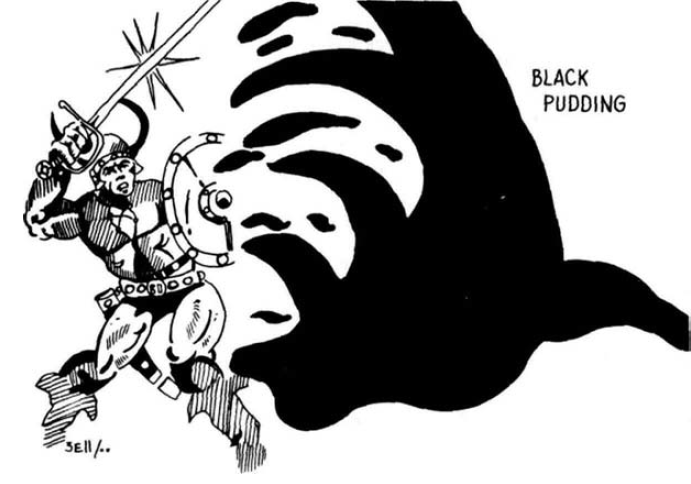
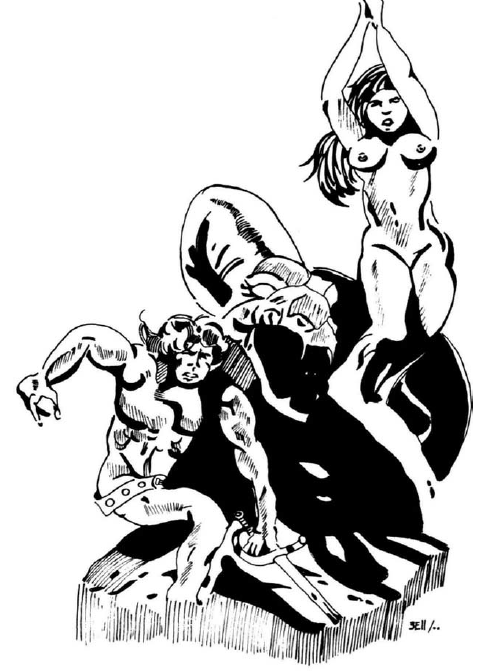
Greg Bell is listed as one of the illustrators in the original books. You can recognize Greg Bell pics by the blocky outlines.

It seems that Greg copied the compositions of a lot of his pieces from comics of the time: for instance, I bet this picture started its life as a Conan the Barbarian splash page.

But hey – Greg was a teenager drawing pictures for a friend’s semi-amateur zine. I don’t think we need to hold him to super high standards here.

Mike Mornard says that, at the time, he hated Greg Bell’s pictures and asked Gary why he was using so many of the illustrations. “Because Greg works for $2 a picture,” said Gary.

Mike disliked the Bell artwork so much that he went off and recruited an artist who, he believed, could do better: David Sutherland. Mike met David at a Society for Creative Anachronism meeting, saw his drawings, and told him to get in touch with Gary Gygax.

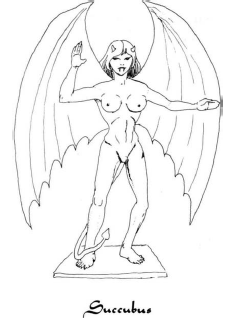
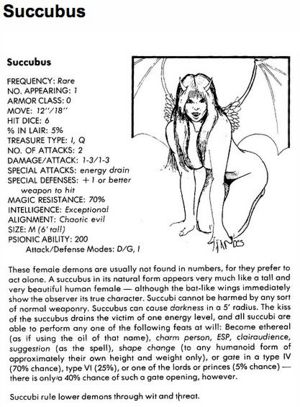
Sutherland’s art, of course, became a staple of early TSR work. He drew the adventurers that inspired my dungeon map poster. He also drew a lot of naked ladies. Here are two David Sutherland succubi.

Mornard told us that the body of one of these original succubi was copied from a Playboy centerfold. If I were truly dedicated to D&D history, I would no doubt look through early 70s centerfolds to find the original. I will leave that research project up for grabs.

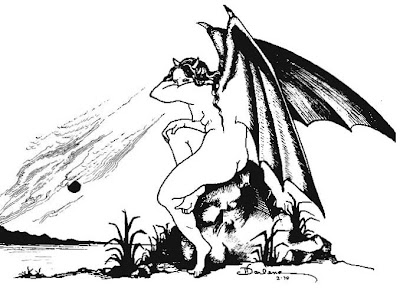
Speaking of nudity, there were a lot of naked-lady monsters in Oe and 1e. They’re often recalled fondly (and only barely creepily) by guys I know who played D&D as kids. A lot of these pieces are by Darlene. Here’s Darlene’s succubus, this time in a sort of Baroque odalisque pose instead of a Playboy pose:

Mike Mornard mentioned that another of the naked-lady pieces from the original book was by a female artist, and that it arrived unsolicited in the mail:

It’s interesting that more than half of the nude women of OD&D are by female artists. I have no conclusions I can draw from this, except that it seems that the indie geek scene of the 70s is different from the one I’m familiar with.

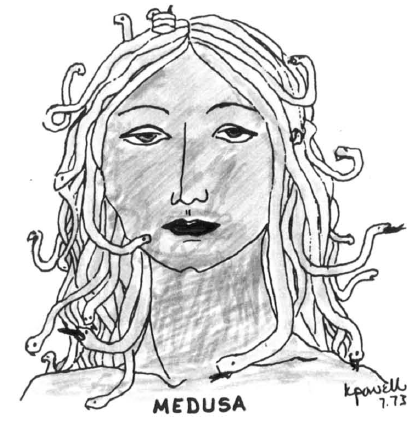
Another artist whose OD&D work has always fascinated me is Keenan Powell:

Keenan Powell’s amateur, almost outsider-art pictures set the tone, for me, for the OD&D aesthetic. The whole book gives the feeling of being illustrated by gamers who draw pictures, not by artists who play games.

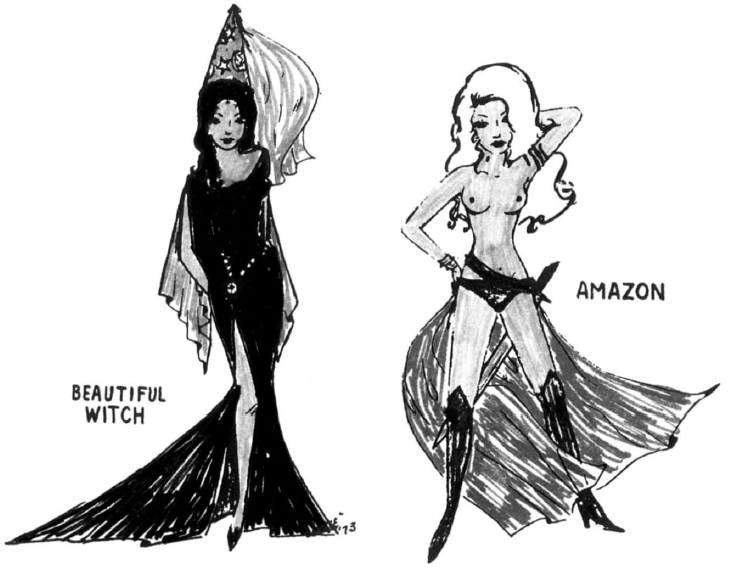
Is Keenan Powell (who’s also a female artist, apparently) the same person who drew the Beautiful Witch and Amazon? I can’t read the signature on the witch illustration.

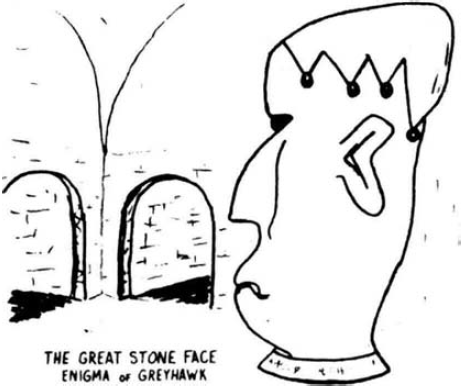
While we were on the subject of OD&D art, I asked Mike something which had puzzled me for a long time. “Who drew that stone head in the Greyhawk book? And what was that about?”

“I think that was by Gary,” said Mike. And he didn’t know what it was about: it wasn’t one of the things he encountered on his trips through the Greyhawk dungeon. As far as Mike knew, the Enigmatic Stone Head might have been something that Rob Kuntz discovered on one of his solo dungeon escavations.

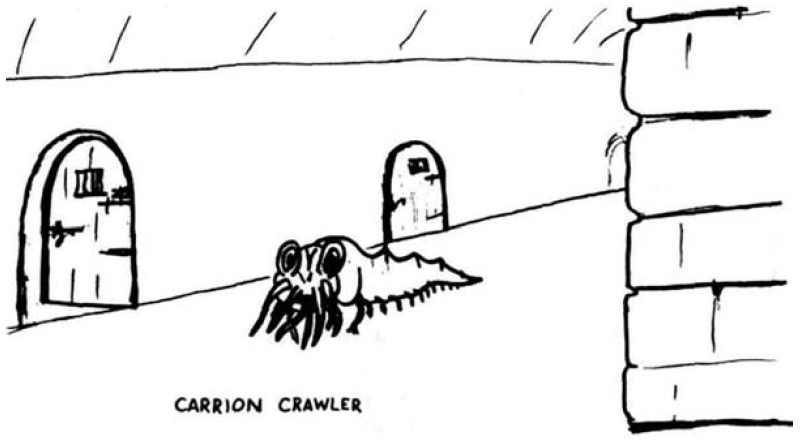
Furthermore, Mike told us, the Carrion Crawler picture from Greyhawk was by Dave Arneson.

Without hearing it from Mike, I would never have known that these pictures, by the inventors of the game, weren’t by the same hand. I might have attributed them to Keenan Powell. I find it somehow touching that these guys, out of their exubrance and their love of the game (and maybe in an effort to save $2) were inspired to draw and share these pictures.

I’m not a professional artist. When I draw a picture and put it up on the Internet, I sometimes feel like it’s an act of hubris. Maybe it is, but it’s also an act of faith that the world will cut me a break and accept what I can offer. I think that all of these OD&D artists need to be approached on those terms.

peasants with magic weapons

June 22nd, 2012

A spritely little old fellow sat comfortably on a tree root not fifteen paces off. He was clad in a single garment made from the hide of some unidentifiable and long-dead animal. It covered him from neck to knees and was cinched around the middle with a wide belt with a brass buckle. From it hung several pouches, a double-edged knife, an old silver horn, and a crude but serviceable battle-axe, well-rusted and probably taken from a barrow.
Elizabeth Boyer – The Sword And The Satchel

The obscure corners of the D&D world are brimming with dungeons, barrows, and other ancient treasure caches. Occasionally, a peasant or woodsman will stumble upon a cave and emerge with an ancient, runed +1 sword or axe.

What will a peasant do with such a find? Some will sell it at the next county fair. Others live too far from commerce to find a willing buyer. And, jewels and runes or no, an axe +1 is better at chopping down trees than a regular axe.

This means that occasionally, PCs should find remote peasant families using ancient treasures in their labor. This might be an opportunity for the PCs to buy an item for less than market value, and it may tip the PCs off that there’s a source of ancient treasure nearby.

Here are some other possibilities (roll d20):
1- One of the ancient items is haunted! The peasant will give the PCs the treasure if they will take care of the evil, horse-sized cat in the barn.
2- The peasant is not what he seems! He is a barrow ghost in disguise, and only his magic weapon is undisguised.
3- The peasant is a mighty fighter who wrested the item from ferocious monsters. There are more treasures in the barrow, and more ferocious monsters. The PCs might be outclassed unless they bring the peasant along.
4- The peasant family acquires their treasures by murdering passing adventurers. They suggest that the PCs stay the night, and explore the barrow tomorrow. There is no barrow: the peasants will try to slit the PCs’ throats as they sleep. In the basement are graves.
5- The peasant asks for an exorbitant sum for either the treasure or the location of the ancient barrow.
6- The peasant is willing to sell and will adjust the price according to how big a deal the PCs make about the item.
7- The items are “cursed”: they love their peasant owners. While a PC has one of the items, all paths will bend so as to lead back to the peasants’ farm. Strange coincidences will occur so that the PCs keep meeting the peasants.
8- The item allows you to Turn werewolves using Turn Undead mechanics, and the peasant is afraid to sell it unless the local werewolves are destroyed.
9- The peasant is holding the weapon because it’s one of those ones that will not leave your hand until you kill a foe. The peasant can’t sell it until someone helps him kill a foe: apparently farm animals don’t count.
10- The peasant is waiting to hand off the item to a Chosen One, in accordance to an ancient prophecy about a Red Woman who will arrive from the east. The PCs are not the Chosen Ones, but the peasant is sick of his custodial duties. He keeps hinting to a female PC that she should go have a picnic in the East Pasture, and here, wear this red hat.
11-15: Just an ancient treasure the peasant found in a barrow. There is no more treasure to be found there.
16-20: Just an ancient treasure the peasant found in a barrow. There is more treasure in the barrow, and a guardian monster.

dungeons and wyverns

June 20th, 2012

If you’re in Asheville, NC, and you’re not quite sure how to randomly generate a dungeon, you should go by The Wyvern’s Tale, a FLGS that just opened this weekend. I mention it because the owner sent me some pictures from the opening day celebrations, including one of my posters.

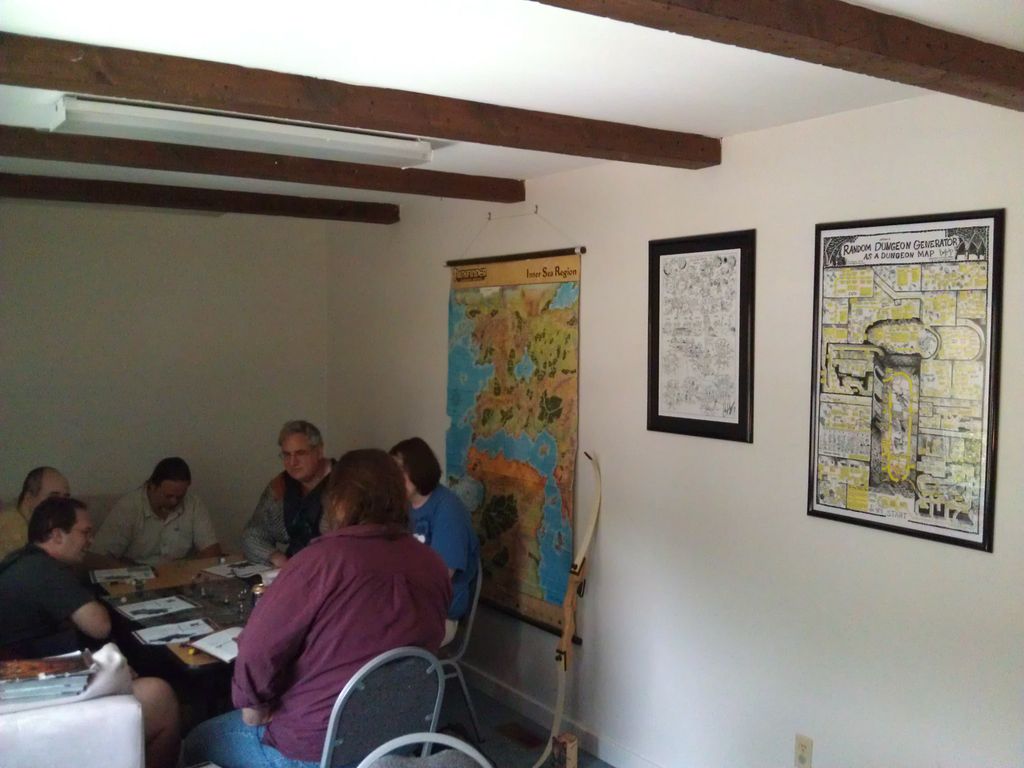
Here is what my posters looks like in front of a Pathfinder Society:

And here are some other pictures from the opening day. Looks nice! I’d totally go by if it weren’t a 12 hour drive.

Anyone else have pictures of the Random Dungeon or Monster posters in the wild?

new 5e info from mike mearls’ q&a

June 18th, 2012

Mike Mearls answered D&D questions on Reddit last week. He answered over 100 questions. In this post, I’m not providing a full transcript: we already know that Next is going to be modular, that they want our feedback, and that Mike has a charming personality. Here, I’m just including the Qs and As that reveal new game rules information about D&D Next.

GokaiCant: I loved the advantage mechanic at first glance, looked like a really elegant way of handling attack bonuses and penalties. Until I had to make 36 rolls a turn for some mice. What approach, if any, will D&D 5e take to make Advantage/Disadvantage bearable with large encounters?

mikemearls: Ah yes, the rats. Sometimes, playtests reveal subtle issues. Other times, they hit you over the head.

This is a pretty big issue, because the monster design is aiming to keep hordes of orcs/goblins/etc a viable threat at high levels. So, at level 1 it might be 18 rats, but at level 10 it might be 18 orcs.
I’d like to incorporate a core “swarm” rule into the game, an easy way for DMs to group up monsters into single attacks. For instance, something that lets you combine X attacks into one die roll, with some small amount of damage even on a miss to make that an appealing option.

Hopefully, that solves the rat issue and also the humanoid horde issue at higher levels.

themanwhowas: Are you actually going to include modules for 4E fans who want flexible, intelligent, veteran fighters? With maneuvers, combinations and techniques like real swordsmen? Powers that are designed by game designers to be balanced as well as fun? That give consistency across tables, sessions and DMs? Or are we going to be forced to settle for dumb-as-brick fighters because that’s what the old guard want for nostalgia’s sake?

Question 2: On a similar note, encounter powers can make a lot of sense in-game. Tricks you can only pull once before enemies become prepared for it, like sand in the eye, trips, taunts, unexpected maneuvers and so on. Is there going to be a module that includes these, not just for fighters but for other classes as well? And don’t say I can improvise them already, I want mechanics that I can rely on.

mikemearls: Fighters – We have a maneuver system in design that we’re playtesting here in the office. In my Monday game, Chris Perkins’ fighter could choose between an inaccurate but high damage attack, a defensive attack that force an enemy to pay attention to him, and a second defensive option that boosted his AC. That’s just the surface of what we have going on in there.

I’d also like to extend the maneuver idea to other areas of the game – social maneuvers, rogue tricks, things like that. Our goal is to make a wide variety of characters possible, rather than stick each class into a limited box. Just as we’re moving roles out of class, we’re also moving complexity limits out of class as much as we can.

Encounter Powers – We’re looking at a mechanic that draws on the idea of pushing yourself beyond your limits between rests, basically a stamina-based mechanic. This is precisely the kind of more complex option that we place in the game for players who want to take on that sort of approach.

SleepyFingers
How does D&DNext plan to balance magical and non-magical classes and avoid caster-supremacy?
Also, on another note, I’ve heard that skills are almost non-existant as of the current builds and might just be a module that comes out. I know that skills is the hardest point to do because it lacks any consistency across editions, but the taking away of skills seems to put a huge focus on combat, which can be a bad thing. Though you probably don’t want to speak too concretely, I’d like to know what the current plan for skills actually is.

mikemearls: For caster supremacy, the key lies in attacking it from both ends. We can do a lot by reining in the most abusive spells and making it harder for casters to chain things together in abusive combos. The other end is making sure that we make an honest comparison of the casters to the non-casters.

For instance, if a wizard can turn invisible we have to be cool with rogues having an almost entirely assured chance of success to hide or sneak up on people. It’s unbalanced if the guy who is supposed to be stealthy has a real chance of failure, while the wizard’s magic has 100% chance of success of turning someone invisible.

For skills, we definitely will have them in some form to give people pointers to the non-combat stuff they are good at. Right now, classes give skills as appropriate but most of your skills come form your background. Backgrounds are not linked to class, so a fighter can choose the criminal background to become stealthy or good at picking locks.

The key discussion we’re having right now with skills boils down to this – does a skill make you better than you otherwise would be at something, or does it make you strictly good at it?

Making you better would be a +3 bonus, which is then stacked on top of an ability modifier. So, a Wis 9 rogue (ahem) would be better at finding traps, but still only at +2.

The second path removes abilities from the equation. The rogue would just have +5 to find traps. You’d use either an ability mod or your skill, rather than stacking them.

We’ve been arguing back and forth on which path works better. Neither has emerged as a clear front runner.

beckermt: With the return of Vancian casting are you planning on giving non-magical characters some sort of “pull out the stops” type of abilties?

I know the fighter has twice per day do 2 actions, but that’s not… you know, exciting, per se. The magic stuff allows casters to perform new and different abilities, even at a limited level.

Second Question: Is there any intention to add a Attacks of Opportunity system or somesuch to give players a more effective way to control the battlefield?

mikemearls: Yes, we’re looking at a set of maneuvers that characters can dip into to gain more concrete options in fights, along with options that you can use to push yourself beyond your limits for an action or two per encounter.

We’re strongly considering adding a free attack if someone breaks away from a melee. The playtest feedback has been a little soured on letting people move around without consequence. However, the rule would be much simpler than attacks of opportunity – likely it’ll be that if you start your turn in someone’s reach, they get an attack on you if you try to leave their reach using an action to withdraw.

Keep in mind that our goal for adding a mechanic like this would be to keep it very, very simple. We are 100% NOT going to give you a long list of things that provoke. It would be moving away from an enemy and nothing else.

SergioSF: Can you give us just a tid bit about bards?

mikemearls: The first pass on bards is going back to their Celtic roots while also looking at making a jack of all trades mechanic that doesn’t make the bard second best at everything. It’s still early, and the final design might be much different, but I really want to give the bard something unique that really speaks to their roots.

HighTechnocrat: With the limited numerical advantages gained by advancing in level, how will high level characters still feel the difference in power when they face foes which were a challenge at previous levels?

mikemearls: We’re working on higher level play in concert with our monster design, but you can expect that each class will have some built-in abilities that help them deal with greater numbers of foes and single, more powerful enemies.

For instance, fighters might have a mechanic that lets them hit several weak enemies at once at the cost of reduced damage. That doesn’t work so well against giants, but it lets a higher level fighter take down numerous, lower-level foes.

OTOH, a rogue might just get better at backstabbing or dueling one guy. It depends on the class’s identity and how we see it interacting with hordes of weaker enemies.

Armored-Saint: A common complaint on the discussion boards is that heavy armor isn’t effective enough when compared to light armor + Dexterity modifier. What plans, if any, are in the works to address this concern?

mikemearls: We’re completely re-working armor. We’re bulking up heavy armor, giving medium armor a better definition, and slightly pulling back on light armor.
Heavy armor allows no Dex bonus but has a high base value. Heavy armor always gives disad on attempts to be stealthy.

Medium armor has +2 Dex max or no Dex allowed. It sits below heavy armor. Classes like the ranger and barbarian are proficient with it. Some medium armors give disad on checks to hide or move silently. Basically, if you play a ranger or barbarian, you can either junk Dex and take a “heavier” medium armor or take a lighter one that lets you be stealthy.

Light armor allows full Dex and has no stealth drawbacks.

Rajion: 1) How much will coins weigh in the next edition? Or will the weight of coins be ignored, like sheets of paper?
2) If they will have weight, will the different varieties of coins have different weights, or will they have the same weight?
3) Will Platinum coins go back to a worth of 10 gold coins like in 3.5, or will they remain equal to 100 gold coins like in 4.0?

mikemearls: 1. Coin weight will likely be X coins/pound.
2. Likely they will all be the same.
3. I believe they are at 10 gold per platinum right now. You can expect a flatter wealth level for characters in 5e.

liblarva 1. Is there any other way to handle humans than the apparent +1 to all stats? It seems rather OP considering the new focus on abilities.
2. Will martial maneuvers be open to all, or limited to fighters? I ask because making subsystems for one or a handful of classes seems like a waste when the fighter can be given a simple bonus to these maneuvers rather than a unique subsystem. Similar to how classes shared spells in prior editions.

mikemearls: 1. Classes also give ability bonuses, so the ideas is that a human is more balanced than other races and that the other races are a little more focused vs. the generalist human.
2. Anyone can take maneuvers.

CastleCrasher Hey, I played the playtest with a couple friends of mine last weekend and we had a blast! My one question regards healing. I liked most of the mechanics, but I felt like the human cleric couldn’t quite heal enough. I was wondering what your thought process behind the healing kit was, and why you decided to make it an item instead of a class ability.

mikemearls: The idea behind making it an item was to make it something anyone could take. One direction we’re thinking of taking is making a cleric’s healing a separate ability from spells, so that we can give more healing without also having to give more spells in total.

cr0m: Hi Mike,
I’m one of the founders of Red Box Vancouver and a big fan of Basic D&D, so I’m loving the playtest rules–especially the choice of adventure!
Are there any plans for adding monster reaction tables or morale? They’re one of my favorite parts of the old school games. The first one really helps with sandbox play/improv and the second really speeds up combat.

mikemearls: Yup, you can expect both in rules modules. I wrote a set of morale rules for tactical play, and I expect we’ll include reaction tables for our interaction mechanics.

clue_bat: If most of a class’s cool abilities are in the first 3 levels (Rule of Three), might we see a return of 3.5’s level dipping? I’m sure we all remember characters that looked like this:
Fighter 4 / Ranger 2 / PsyWar 3 / Monk 2 / PrcA 2 / PrcB 3

mikemearls: We want to go back to 3e multiclassing, but I think we learned some very valuable things from the hybrid system in 4e.

deathdonut: 1. How do you plan to balance magic item stacking?
2. Will it be possible to permanently increase a stat?
3. Will magic users have items that directly increase their abilities in a way that corresponds to magic weapons for melee?
4. Is there thought given to the “budget” that different class styles will need to spend on equipment to keep up with the balance curve?

mikemearls: 1. We’re hoping to avoid +X items outside of armor, weapons, and shields.
2. Yes.
3. We’re looking to keep implements as items that increase spell accuracy/save DCs.
4. We’re actually looking at making buying equipment optional. Instead, you are given a starting package based on background and class.

shimmertook: How many levels is the current playtest model giving for a character’s entire career?

mikemearls: We’re looking at capping at level 20, but giving a set of options for uncapped advancement beyond that.

PrinceAuryn: How are magic items handled in DnDNext? Will we see a return to awesome extra damage, or will they say “super balanced” and +1 to hit.

mikemearls: We want magic items to feel awesome. I want the +1 or +2 to be something that you might even gloss over, and part of me wants to try designing the game without them.
I’d much rather have a hurricane flail that generates buffeting winds, knocks arrows out of the sky, and summons an air elemental than a +1 weapon. Key is – how many people agree with that? Are +X weapons/armor/etc iconic to D&D?

That said, I think we can have both. We’ll likely limit the maximum plus you can get, and we can then simply start with interesting/cool items and add pluses to those.

MindWandererB: 1. Any comments on Perception and the blind rogue/radar cleric issue? The wisdom=perception still has some bizarre side effects, like the fact that the characters who used to have Listen At Doors as a class feature are now among the deafest characters in the game, and that it’s considered a good choice to spec a cleric, not traditionally known as scouts, for high Perception. (And of course there’s the OotS joke that your hearing and eyesight get better with age, but that’s rarely relevant at the table.)
2) Any second thoughts on Intoxication and the fact that it’s a viable decision at low levels?
3) Any ideas yet about how to balance rogue damage?
4) Please comment on random HP and the decreased, irregular value of a Con bonus on HP.

mikemearls: 1) We’re looking at skills right now and trying to determine if skills make you better than you are (a flat bonus that adds to your ability check) or strictly make you good (a flat bonus that takes the place of your ability modiifer). So, the 8 Wis rogue with perception training might just be at, say, +5, rather than at +3 added to a -1 Wis check.
2) We definitely want to avoid making it abusive, but I think it’s kind of funny that getting drunk and charging into a dungeon might be a good idea.
3) Definitely taking a long look at this one. I’d like to give a rogue a nice but not overpowering bonus that he can get every round, and a BIG bonus (like AD&D backstab) for those once an adventure ambushes or set ups.
4) Random HP will be an option alongside fixed HP. The key to Con is that adding the bonus at each level can overwhelm class contribution to total HP. We need to find a middle ground.


The rest of Mike’s answers are worth reading too: check them out.

currency exchange between gold pieces, dirhams, francs, and dollars

June 15th, 2012

I found this amusing passage in a Kane novel:

“Have you, say, twenty-five mesitsi gold [about two hundred dollars]?” Arbas asked casually. The stranger faked a hesitant pause–no merit in giving the assassin reason to think to ask for more. “I can raise it.”
-Karl Edward Wagner – Darkness Weaves

I don’t know why, but I find the exchange-rate note charming. It also matches with my intuition that buying a 10-GP sword is approximately the same scale of professional expense as, say, buying an $80 electric drill. (Of course, 200 dollars in 1978, when the novel was written, is probably more like $600 in 2012.)

Oddly, I’ve been noticing a lot of specific expenses in books lately, which I can use to construct a tenuous web of currency equality.

This man used to work in the baths for a daily wage of five dirhams. For Dau’ al-Makan he would spend every day one dirham on sugar, rosewater, violet sherbet and willow-flower water, while for another dirham he would buy chickens.
-Tales of 1,001 Nights

According to D20SRD, “the typical daily wage for laborers, porters, cooks, maids, and other menial workers” is 3 SP, which is not too far from the bath man’s 5 dirhams. Let’s say that a dirham is equal to an SP, and the furnace man’s high pay is because Cairo happens to have a strong economy. After all, says 1001 Nights, Cairo’s “soil is gold; its river is a wonder; its women are houris; its houses are palaces; its climate is mild; and its scent surpasses that of frankincense, which it puts to shame.”

D20SRD is silent on the price of willow-flower water, but a chicken is 2 CP. That means that the bath worker and his wife eat five chickens a day! That seems high to me, but the story goes on to say that, when a guest stays with them, they feed him two chickens a day. So five chickens is plausible!

As a fun bonus, if we take the SRD, Kane, and 1001 Nights as equally valid, we can determine that 10 dirhams = 1 GP = $8 in 1978 = $24 in 2012, and we can infer the important fact that, in 1001 Nights Cairo, a chicken cost 50 cents.

All of this is, of course, nonsense, for many reasons. One of the main reasons is that the US economy is totally incompatible with any historical economy: things used to cost different amounts relative to each other.

Check out this late 19th century letter from Emile Zola to Cezanne:

I’ll reckon out for you what you should spend. A room at 20 francs a month; lunch at 18 sous and dinner at 22, which makes two francs a day, or 60 francs a month.…Then you have the studio to pay for: the Atelier Suisse, one of the least expensive, charges, I think, 10 francs. Add 10 francs for canvas, brushes, colors; that makes 100. So you’ll have 25 francs left for laundry, light, the thousand little needs that turn up.
-Emile Zola via Malcolm Gladwell’s What the Dog Saw

Look at the amounts budgeted for necessities. A starving artist who eats only two meals a day spends three times more on food than on rent. Half of his money is spent on food. That’s almost exactly the reverse of a US budget, where the food budget is typically 1/3 of rent.

That’s why we can’t really convert 25 GP to $200 USD. The modern world is too different from the past. Emile Zola, writing in the 19th century, inhabited a world that was, economically, closer to D&D and 1001 Nights than we are now.

dungeons and dowels

June 13th, 2012

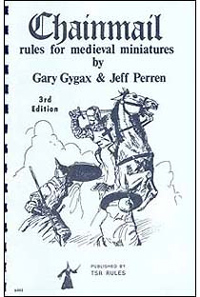
I guess Gary Gygax must have had a bunch of spare dowels in his house, because there are some great dowel-based rules in the Chainmail booklet.

The first rule is for determining the efficacy of cannon fire.

The length of a firing dowel will correspond to the maximum range of the cannon which it represents. Each is colored alternately white and black to represent the flight and bounces of a cannon ball. BEFORE PLACING THE DOWEL THE PLAYER FIRING MUST STATE WHETHER HE IS FIRING SHORT (white) OR LONG (black) AT THE TARGET. All figures that are touched by the named color on the dowell are eliminated.

This is a beautiful, elegant rule. I love the way it simulates the random bouncing of high- and low-ranged cannonballs, both on the same dowel, each using the other’s negative space. It’s like the yin and yang of shooting pretend people.

I Photoshopped this dowel image based on the measurements in the book for a cannon with a range of 36″.

Dowel Rule 2 is in the Fantasy Supplement:

If any number of figures are airborne at one time, it becomes difficult to maintain a side record of their height and course. It is recommended that a number of 36″ dowels be set firmly into 2″ x 4″ bases, and flying figures be secured at the proper height in the dowel by use of a rubber band.

Recording flying creatures’ positions is a bit of a problem in D&D. We’ve used stacks of dice, notes on scraps of paper, and, most frequently, ignoring positioning altogether. I’m not going to rush out and buy dowels, but I recognize that perhaps I SHOULD.

dragons in 5e

June 11th, 2012

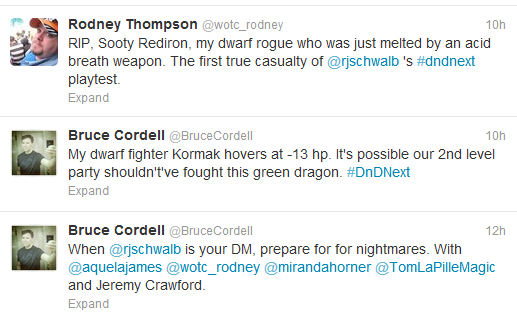
2 consecutive tweets from my twitter feed:


Rodney Thompson (@wotc_rodney) 10h
RIP, Sooty Rediron, my dwarf rogue who was just melted by an acid breath weapon. The first true casualty of @rjschwalb’s #dndnext playtest.
Bruce Cordell (@BruceCordell) 10h
My dwarf fighter Kormak hovers at -13 hp. It’s possible our 2nd level party shouldn’t’ve fought this green dragon. #DnDNext

The green dragon is breathing acid instead of poison! 5e speculation: Every dragon has swapped breath weapons with another. The Red Dragon’s breath weapon is now a line of blinding light (once belonging to the crystal dragon), and the black dragon has taken over the yellow dragon’s breath weapon: salt water.

(Oh man, there are so many B-list breath weapons: hot sand. inebriation gas. shrink ray. apathy gas.)

The speculation is a joke, but the tweets are real. Also for real, I have actually fought dragons in 5e.

I rode Rory’s coattails into the Friends and Family 5e playtest program that preceded the open playtest. There were more monsters in that F+F bestiary, including white and blue dragons. (Don’t be too jealous: the D&D version I played in that early ruleset was much worse than the one we’ve seen in the open playtest. Which means that playtesting is working.)

Like Rodney Thompson and Bruce Cordell, our group was destroyed by the dragon we fought. In that old snapshot of 5e, at least, dragons were TOUGH.

When the white dragon was spotted in the sky, my fifth-level witch wizard, Nelf, crouched on top of a tower, far from the rest of the party. I’d be able to get a fireball off, and, I reasoned, the dragon would rather swoop down and blast the other four party members at once than waste a turn killing one paltry wizard. I was wrong.

My fireball did a lot of damage and got the dragon’s attention. White dragons don’t like fireballs. It changed course and landed next to me on the tower. I’d buffed myself with Resist Energy (Cold), but it didn’t matter, because the dragon launched into a claw/claw/bite routine. I went from full hit points to dead in less than six seconds, and I didn’t even get the dignity of death by breath weapon.

Chewing meditatively on my head, the dragon swooped down on the rest of the party. It unleashed its cone of icy breath. The party died.

The fact that my wizard’s quick death wasn’t a comic freak – that even the party fighters could be flash-frozen in a single round – was, I have to admit, oddly comforting.

But it was a cold comfort.

i really WANT to look at the medusa

June 8th, 2012

The medusa is the figurehead monster for the Good Ship Argument About Save-or-Die Effects. Some people don’t want their character killed by a single failed saving throw, and others argue that if a medusa doesn’t turn onlookers into stone, it’s not a medusa.

The 5e playtest includes a medusa in its bestiary. In this version, gazing upon a medusa is a save-or-die effect, but an optional one; you can always choose to avert your eyes as you fight.

I found this quote in Greg Keyes’ The Charnel Prince: it’s about the gaze of another monster, a basilisk, but it’s worded in such a way that it’s practically game rules.

“They have two blind men with them,” he said. “They serve as its handlers. The rest walk behind. The cage is like an aenan lamp, closed on all sides but one. It makes a light, this thing, and once you have seen it, you can resist only through the greatest contest of will.”

A contest of will? Like a will save? That’s actually a kind of unique mechanic for a turn-you-to-stone monster, which usually attacks fortitude. Say on, Dungeon Master Greg Keyes: how does a basilisk’s gaze force a Will save?

And he saw a light suffusing the landing. It was beautiful, golden, the most perfect light he had ever seen. A promise of absolute peace filled him, and he knew that he could not live without seeing the source of that light.

This is a fun variation on the basilisk/medusa: you see something out of the corner of your eye that’s you know you shouldn’t look at, but you want to. It’s a good excuse to give people two saving throws: a will(/wisdom) save to let them tear away their gaze, followed by a fortitude(/petrification/constitution) save to resist petrification. Personally, I don’t like save-or-die effects, but I don’t actually mind save-or-save-or-die effects.

This effect not only makes the old-school save-or-die medusa less deadly, it could be used to make the 5e medusa more deadly. While you’re fighting that medusa with your eyes averted, you can’t help seeing little glimpses of something – a beautiful light, perhaps, or an angelic face. For some characters, maybe medusa cleavage is all it takes. Every round that you fight with your eyes averted, you need to make an easy will/wisdom save. If you fail, you gaze upon the medusa.

Greg Keyes’ quote also contains another cool idea: an army of blind men who carry a basilisk’s eye (or medusa’s head, or ark of the covenant) before them as a totem. A mercenary company of blind warriors with such a weapon would be quite powerful, although they wouldn’t work very well with allied troops.

Have I seen this idea somewhere else – maybe an Elric book or something? No matter, it’s worth stealing anyway.

a new schooler reads Chainmail

June 6th, 2012

As a new-school D&D player, there’s a lot of D&D history I’ve missed. Editing Cheers Gary, gaming with Mike Mornard, and illustrating the AD&D Dungeon Generator have helped, but there’s a lot in D&D that I still don’t understand. I’m going back to the OD&D texts to see whether they can help my new-school game.

I decided to start with the original fantasy roleplaying game: Chainmail!

I’m not a war-gamer, so I expected to get bogged down in pages of elliptical rules that only made sense to other wargamers. I have to say, it was much more readable than I thought!

For the most part, Chain Mail uses a simple system, and most of the rules seem like rulings – fairly logical rulings – on corner cases, mostly involving how awesome awesome Swiss and Landsknechte pikemen are.

Double all penalties for poorly trained troops, and half for Swiss/Landsknechte and horse.

Only Swiss and Landsknechte pikemen can form a hedgehog. If ten or more of these troops are in a square-type formation, pikes or pole arms facing outwards in all four directions, a “hedgehog” has been constituted.

Swiss/Landsknechte Pike Charge: Because of the reputation and ferocity of these troops, an enemy charged by Swiss or Landsknechte pikemen (other than like troops) must roll two dice and consult the Loss Table, just as if they had suffered excess casualties.

Swiss and Landsknechte armed with pikes or pole arms facing the enemy automatically stand any charges.

Swiss/Landsknechte attacking in close formation ( 5 x 2 figures minimum) fight as Armored Foot, with extra die for weapons. For every two men so attacking as additional “mass shock” die is added.

At the Battle of Marignano, Swiss pikemen actually fought Landsknecht mercenaries. Because it was impossible for either side to lose, THE BATTLE IS STILL GOING ON.

There are a handful of charts in the back, but the basic melee mechanic seems to be to to convert your soldiers into a d6 dice pool, roll all the dice, and score kills for every success. 6 is always a success, and for better troop types, 5’s and 4’s can be a success as well. It’s all very… White Wolf.

The 45-page book manages to find room for rules for sieges, and … jousting! Not to mention the 13-page Fantasy Supplement that kicked off this whole D&D thing.

There are a few rules that make me scared to play. For instance:

FATIGUE
Continued activity brings on weariness:
1. Moving 5 consecutive turns.
2. Moving 2 consecutive turns, charging, then meleeing.
3. Moving 1 turn, charging, then meleeing 2 rounds.
4. Meleeing three rounds.

(Except of course that Swiss/Landsknechte can go twice as long in every category before getting fatigued. OF COURSE they can.)

When I read these fatigue rules, I realized how much recordkeeping is involved in this game. Every turn, you have to write down every unit’s move – even if you’re not using the optional “written orders” rule variation. Not only that, you have to look back through your notes to see if each of your units have rested in the past 5 turns, etc. I’d think this would slow the pace way down. How are you going to get through Waterloo in one day at this rate?

There’s also a bunch of stuff you have to reevaluate at the half-move (after the unit has moved half its movement rate). Melee and archery can take place at the half-move and at the end of the move. I wondered why every unit’s movement rate wasn’t just cut in half and one turn cut into two. I’m sure there’s a reason, though.

I’m kind of surprised to say this, but I would… play… Chainmail. I’m just throwing that out there, guys. Any beardos in New York with a sand table?