mr. meeson’s will

May 11th, 2012

Mister Meeson’s Will, by H Rider Haggard, tells the story of a veddy propah Englishwoman who is shipwrecked on a desert island and must have a dying tycoon’s will tattooed upon her back. It’s part of the 19th century tradition of novels exploring outlandish corner cases of the law, like Wilkie Collins’ Man and Wife.

The informational tattoo idea has been explored in fantasy. The tattoo treasure map has been done before: I remember seeing it first in some Ultima game. In D&D, tattoos of spells have been mentioned as alternatives to spellbooks.

Worst case D&D scenario: someone is tattooed with an expendable spell. They’re essentially a living scroll. Scrolls self-destruct when used.

This might lead to a rough situation for a poor sailor. He passes out at the tattoo parlor, and wakes up a living – and disposable – piece of ordnance. If the ship is attacked by pirates, the ship’s wizard might decide that there’s nothing to be done but read the scroll and expend the sailor.

Either that or someone is tattooed with Explosive Runes.

Any other weird D&D consequences of an ill-considered tattoo?

The magic quantity: How to scale everything important in the D&D world

May 9th, 2012

D&D is a game where you spend half your times killing monsters and half your time interacting with the world (adjust proportions to taste). In every edition, the killing-monsters part is very well-defined, mathematically speaking. The interacting-with-the-world part has a few data points here and there: how much do things cost in shops? How many men-at-arms does a level 9 fighter get? for how much can you sell a subdued dragon? At first it all seems like little islands of subsystem in a sea of dm-use-your-judgment, but what would you say if I told you it can all be distilled into a formula THAT ONLY I HAVE DISCOVERED?

You’d rightly tell me that I was going math crazy, like the guy in Pi. So I won’t say that. I’ll instead offer a rule of thumb that can be surprisingly useful, and offers surprisingly coherent results, that you can use when you don’t know how the size of something, how many there are, how much it costs, or any other game-world number.

The Magic Quantity: How Many at What Level?

Every level has a Magic Quantity (and vice versa). It’s meant to answer this question: “If I have one of something at level 1, how may will I have at level x?” The magic quantity for level 1 is 1. The magic quantity for level 30 is 1000.

TRANSLATING LEVEL TO QUANTITY:
Level 1 to 10: quantity = level
Level 11+: quantity = 10 per level above 10
Level 21+: quantity = 100 per level above 20

TRANSLATING QUANTITY TO LEVEL:
10 items or less: level = quantity
11+ items: level = 10 + 1 level per 10 items (round down)
101+ items: level = 20 + 1 level per 100 items (round down)

What do you do with a magic quantity?
You multiply it by things. Gold coins, soldiers, miles of land.
x1000 GP: That’s how much PCs can earn per level.
x1000 GP: That’s the price of a really awesome thing that’s appropriate for a given level (pet monster, castle, airship)
x1 mile: That’s the diameter of the domain PCs can control.
x1 soldier: That’s how many soldiers PCs can defeat singlehanded.
x10 soldiers: That’s how many soldiers PCs can command.

Level Quantity
1 1
2 2
3 3
4 4
5 5
6 6
7 7
8 8
9 9
10 10
11 10
12 20
13 30
14 40
15 50
16 60
17 70
18 80
19 90
20 100
21 100
22 200
23 300
24 400
25 500
26 600
27 700
28 800
29 900
30 1000

Disadvantages of this system:

  • it’s spiky (it’s linear for 10 levels and then changes by an order of magnitude). Linearity means that, between level 1 and 2, a number is multiplied by x2, while between 8 and 9 it is multiplied by x1.125. Still, this is not new to D&D: this is also how hit points work.
  • There is a weird repeated value at level 10 and 11, and again at 20 and 21.

    Advantages of this system:

  • It’s spiky. It changes the focus of play at what 4e calls heroic, paragon, and epic tiers. Suddenly, around level 12, new possibilities open up.
  • it is easy to learn: It replaces several different charts with a learnable rule. It also generates some convenient short cuts: 10x the number of something is always 10 levels higher.
  • It generates results not out of the realm of plausibility, which I will demonstrate below.

    I think this rule of thumb is strong enough to be the backbone of several D&D subsystems. Below, I’ll try a couple, and compare my work against existing D&D rules.

    TREASURE PER LEVEL

    If you multiply the Magic Quantity by 1000 GP to generate treasure by level, a character might get 1000 GP at level 1, 2000 GP at level 2, 20k GP at level 12, 100k at level 20, and 1 million GP at level 30. (Or less. This might be the total treasure the DM puts into the adventures, but no party clears out the whole dungeon.)

    This not too terribly far off from the 3e expected Wealth By Level. A WBL character would earn 900 GP as opposed to 1000 at level 1. By level 20, a character using the magic quantity system would have accumulated about 600,000 GP; a 20th level WBL character is expected to have wealth of 760,000.

    (For first edition, where GP=XP, wealth by level is irrelevant. You level up as soon as you collect the right amount of money.)

    AWESOME THINGS

    I recently posted a giant list of things for high-level characters to buy. I used the Magic Quantity rule to price the items.

    The awesome-things economy is based on the same multiplier as the treasure-by-level economy – x1000 GP – so you can always spend your level’s worth of treasure for one level-appropriate cool thing. This might be a magic item, in campaigns where you can buy magic items; a new spell; or cool stuff like hippogriff eggs, castles, and flying pirate ships. To determine a cool thing’s price, just figure out the level at which you’d expect it to show up in the campaign. For a pet monster or henchman, this is the level of the monster. For instance, if a hippogriff is a level 3, encounter level 3, or 3 HD monster, you could price a hippogriff at 3,000 gp.

    How well does this stack against canonical rules? OD&D specifies that a party can sell a subdued ancient red dragon for about 50k GP, so I presume they can buy it for 100k GP. That means that, if a red dragon were for sale, a level 20 character could afford to buy it. Badass! Similarly, in AD&D, hippogriffs are 3 HD monsters whose eggs and fledglings sell for 1000, 2000, or 3000 GP, depending on age.

    From the 1e DMG, it’s hard to tell how much it costs to build a typical castle – the construction menu is complicated – but I priced a four-tower castle of a couple thousand square feet at around 20,000 GP, which would make it suitable for level 12. Sure.

    LAND CONTROLLED

    Let’s say we use the magic quantity for the diameter, in miles, of a PC’s area of control: 1 mile at level 1, up to 1000 at level 30. That means that a level 1 character will find enemy monsters 20 minutes from his house, while a level 30 character can control an area about the size of Europe.

    How well does this stack against canonical rules? We’ll sanity-check this against the only D&D data we have for determining characters’ areas of control: the rules for PCs building strongholds at name level. At level 10, when an OD&D fighter is clearing five-mile hexes for his stronghold, a Magic Quantity character can control a ten-mile-diameter area (about four hexes). OD&D specifies that a character can control land up to 20 miles distant from a single stronghold: that’s a diameter of 40 miles, and, according to the magic quantity rule, would require a level-14 character. This is plausible for the level of a character who has maxed out his stronghold. For it to grow any further, a character will need to become a monarch or other ruler of vassals.

    If you want to be a serious big-time king, you need to conquer an area the size of England. It’s about 300 miles from the north of England to the south, making England a level-23 realm. (France is level 27.)

    SOLDIERS DEFEATED

    How many soldiers (or, more strictly, level 1 creatures) can a character expect to beat? Using the magic quantity for this might, or might not, match with actual combats run in different D&D editions. It’s hard to say for sure, because D&D doesn’t handle battles against 100 opponents very well. It’s also inexact because it varies a lot by class and situation: a flying wizard can lay waste to legions while the rogue is better away from the battlefield. The numbers are reasonably plausible, though: A level 1 character can beat one soldier (sure, PCs are better than NPCS). A fifth-level fighter can defeat 5 soldiers, a 15th-level fighter 50, and a 25th-level fighter 500.

    How well does this stack against canonical rules? I think it works reasonably well up to level 10, especially if you use the fighter as your yardstick. High-level PCs don’t engage in melee with dozens of orcs, so let’s turn away from D&D, towards literature, and see if we’re capturing the right feel for battlefield might.

    For an example of a paragon-level fighter – over level 10 – I usually think of Inigo Montoya, one of the best duelists in the world, who helpfully comments that, even at his best, he could not defeat 60 men. If he could defeat 50, that would put him at a very plausible level 15. For over-the-top epic heroes, one of the best is mythical Irish warrior CĂș Chulainn. When he’s singlehandedly defending Ulster from the army of Connacht, he flips out and kills “one hundred, then two hundred, then three hundred, then four hundred, then five hundred, where he stopped” – making him a level 25 barbarian. Archbishop Turpin, one of Gygax’s inspirations for the cleric class, supposedly killed 400 Saracens in a battle, which means he’s a level 24 cleric.

    Now that that’s set in stone, we can settle an old debate! What level are the Lord of the Rings characters? At the Battle of the Hornburg, Gimli kills 42 enemies to Legolas’s 41, so both characters are level 14. That’s settled!!

    SOLDIERS COMMANDED

    Let’s say that a PC war leader usually has access to a number of level-one troops equal to 10 x the Magic Quantity. Thus, a fighter might command 10 troops at level 1 (as a sergeant), 100 troops at level 10 (as a lord), 1000 troops at level 20 (as a king), and 10,000 troops at level 30 (as an emperor). 100 at level 10 is in line with the followers granted to 10th-level fighters in the 1e DMG, and 10,000 is a realistic historical size for a medieval army from a powerful (non-points-of-light) country like France. (The largest late-medieval armies are larger than the ones generated by these rules, but human populations are probably smaller in a fantasy world shared with a hundred hostile species.)

    How well does this stack against canonical rules? A level 9 AD&D fighter collects between 60 and 120 troops – 90 average. In OD&D, every group of 30 bandits has a 4th level leader, 50 bandits have a 5th or 6th level leader, and 100 bandits have an 8th or 9th level leader.

    I’ll go more into this later: for instance, I think you could put the troop guidelines together to make a decent mass combat system.

  • kickstarter posters shipping this week! In the meantime, run a barony!

    May 7th, 2012

    GameSalute has been busy. They’re doing shipping and fulfillment for my project as well as the Dwimmermount, Sunrise City and Empires of the Void kickstarters, as well as some others. Still, Dan at GameSalute says he’ll begin shipping the posters this week. Thank you all for your patience!

    Around the time that posters are shipped, everyone will get a URL where you can download PDFs of the posters and, eventually, the other rewards as they become available. Most of the other PDFs (all-star adventure book, board game, etc) aren’t ready yet, but one reward that WILL be ready for $22+ backers (and $15 backers) is a PDF version of Paul’s DM Notebook!

    I’ve been working on the DM notebook for a lot of hours over the past month, and it’s just about done: I just need to do one or two more illustrations. It weighs in at 64 pages. This will be a beta version of the book. I’d love it if you guys each tested something from the notebook in your next game and sent me some feedback. Next month or so, I’ll update the notebook and make the final version available as a PDF and on lulu.

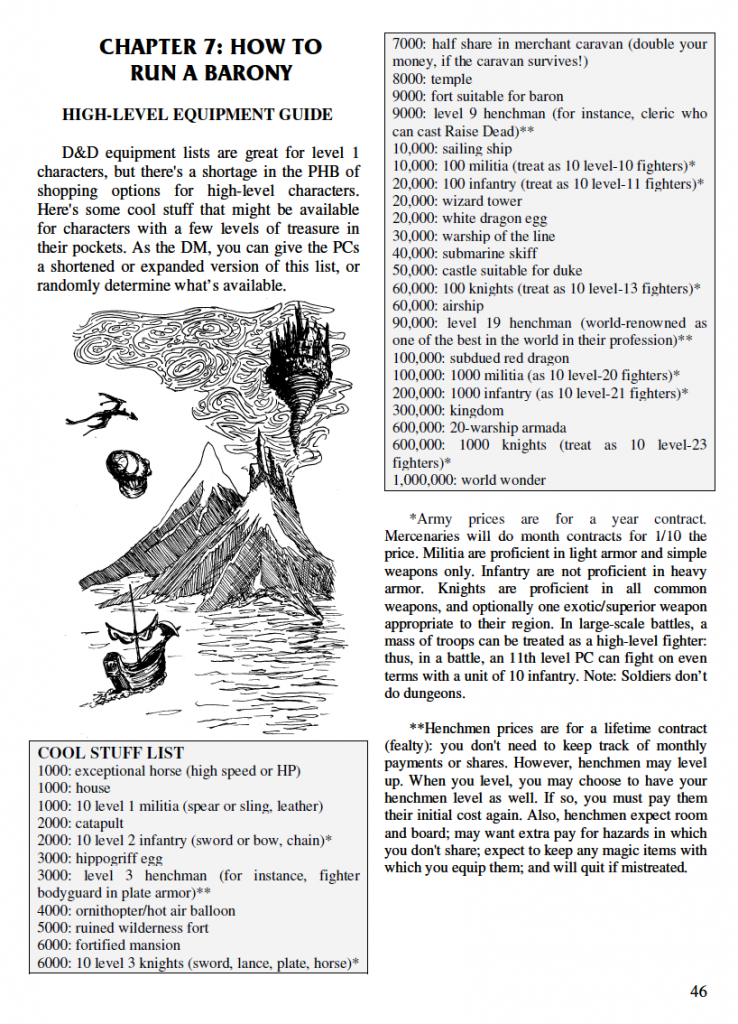
    In the meantime, here’s a big chunk of Chapter 7, which includes prices for big-ticket items like castles and armies, and gives rules for running a barony of your own.

    (Download chapter)

    Also, here’s a picture I drew yesterday, for the Epic Adventures section of the book.

    in search of the unknown

    May 4th, 2012

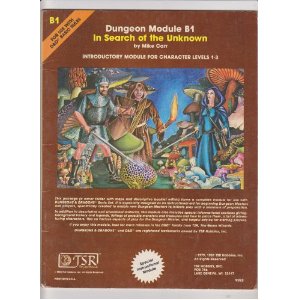
    I’ve heard a lot of references to the 1981 module “In Search of the Unknown:” it came with the first edition of Basic D&D, and a lot of people have fond memories of it. I’ve never read it. When I got a heavy box of D&D books in the mail, it was the first module I grabbed.

    I’ve been on a search of my own lately, exploring the D&D I missed before I entered the hobby. As a kid, I played in bizarre junior high versions of Red Box Basic and AD&D, and as an adult I’ve mostly played third and fourth edition. It’s been fun playing OD&D: I’m slowly getting a handle on a different style of D&D than one I’ve ever played.

    I was delighted to find Mike Carr’s lengthy “how to play D&D” essay at the beginning of the module. It’s pretty similar to advice in the OD&D and Dungeon Master’s Guide books, but since I’ve never read it before, it’s fresh. I have two other fresh experiences with which to compare the advice: my OD&D games with Mike Mornard and my extremely close study of Gary Gygax’s Random Dungeon Generation tables from the Dungeon Master’s Guide. There are a lot of parallels to draw here.

    mapping

    Here’s what Mike Carr says about the dungeon in In Search of the Unknown:

    The dungeon is designed to be instructive for new players. Most of it should be relatively easy to map, although there are difficult sections – especially on the lower level where irregular rock caverns and passageways will provide a real challenge.

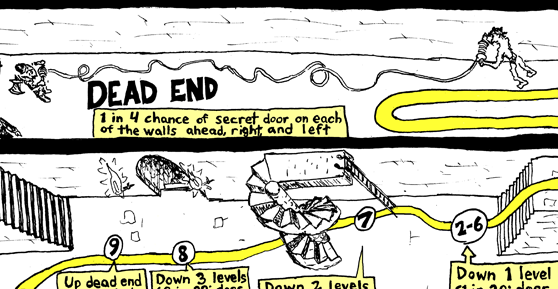
    I didn’t realize until Mike Mornard spelled it out for us that mapping was intended to be one of the big challenges of D&D. The labyrinth is as dangerous as the minotaur. In Search of the Unknown is explicitly teaching mapping skills. The assumption is that more advanced modules will be bigger mapping challenges.

    It is quite possible that adventurers (especially if wounded or reduced in number) may want to pull out of the stronghold and prepare for a return visit when refreshed or reinforced. If this is done, they must work their way to an exit.

    When we play in Mike Mornard’s D&D game, he makes us use our maps. We can’t say “We leave the dungeon.” Every time, we have to specify our twists and turns back to the entrance. This still feels foreign to me. I think I’ve quoted Baf of The Stack before: a game is about what you spend your time doing. OD&D is a game about mapping. Exploration takes more game time than combat. Coming from 3e and 4e, I feel like I’ve been playing a different game.
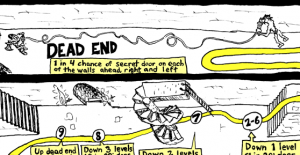
    I love the 1e Player’s Handbook illustration of the troll re-winding the twine trailed by the fighter. (I referenced it in my poster.) Mornard related this story: Once in Dave Arneson’s Blackmoor game, some guys decided to leave string behind them instead of mapping. Eventually, the rope jerked out of their hands and started unrolling, and then they heard a slurping, like someone eating spaghetti. Mapping is a necessary skill: don’t try cheat your way out of it.

    caution

    One player in the group should be designated as the leader, or “caller” for the party… once the caller (or any player) speaks and indicates an action is being taken, it is begun – even if the player quickly changes his or her mind (especially if the player realizes he or she has made a mistake or error in judgment).

    Before playing in Mike Mornard’s game, my eye would have skipped over this classic bit of old-school advice as irrelevant to me. Now I’ve seen it in action:

    DM: There are passages north and west.
    US: We go south.
    DM: Bump… bump… you bump into the wall.

    More ridiculously, I recently had my thief start down the magic staircase into the chamber of Necross the Mad, even though I knew that the stairway hadn’t been summoned yet. A merciful DM would have reminded me of that fact – what adventurer would step off a ledge? – but Mike Mornard took me at my word, and I fell. Mike only gave me one point of damage, where perhaps Gary Gygax or Dave Arneson would have assigned more.

    Mike says that his game is pretty close to the Gary and Dave game in rules and in content, but where their influences ran more to swords and sorcery, Mike brings more Warner Brothers to the table. There is a lot of laughing in Mike’s game, where Gary and Dave’s were grimmer. But in all three games – and in Mike Carr’s game as well – you need to listen to the DM, and visualize what you hear – and think. As Mike Carr’s introduction says elsewhere, “Careless adventurers will pay the penalty for a lack of caution – only one of the many lessons to be learned within the dungeon!”

    time

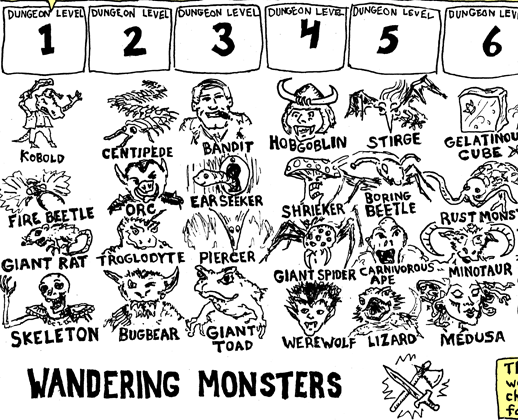
    Every third turn of adventuring, the DM should take a die roll for the possible appearance of wandering monsters at the indicated chances (which are normally 1 in 6)… Some occurrences (such as noise and commotion caused by adventurers) may necessitate additional checks… Wasted time is also a factor which should be noted, as players may waste time arguing or needlessly discussing unimportant matters or by simply blundering around aimlessly. … You set the tempo of the game and are responsible for keeping it moving. If players are unusually slow… allow additional chances for wandering monsters to appear.
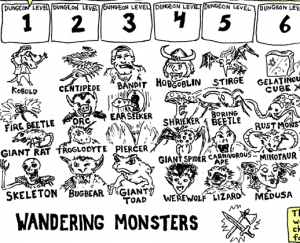
    This passage will feel very familiar to the players in Mike Mornard’s game. We’ve all grown to fear the d6, which comes rolling out at us whenever we’re “needlessly discussing unimportant matters or simply blundering around aimlessly” – which is often. Wandering monsters disappeared from 4e (and from many 3e games) because they slowed down the game pointlessly. What Mike Carr is suggesting here, and what we’ve learned from Mike Mornard, is that wandering monster checks are actually a way to preserve pacing. Once you’re in the dungeon, you can’t afford to get bogged down in bickering over minutiae. How I wish that work meetings came with wandering monster checks.

    mysterious containers

    The dungeon includes a good assortment of typical features which players can learn to expect, including… mysterious containers with a variety of contents for examination.

    The typical D&D treasure announcement isn’t “You find 1000 GP in a chest:” it’s “You find an old wooden chest. What do you do?” Containers are important. The Appendix A random generator has three separate tables for rolling up characteristics of treasure containers. Here are a couple of the ones I’ve encountered in OD&D:
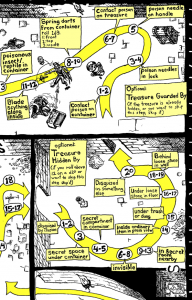
    Contact poison on trap: One of the cardinal OD&D rules is “check the chest for traps.” As the party thief, I make sure to incant this formula. I think that the Greyhawk supplement has rules for finding traps, and I imagine that my odds of success are quite low, but in the last game, Mike told me, without requiring a roll, that the lock was covered with a brownish paste. Good enough warning for me to wear gloves. This transforms a 50/50 chance at arbitrary death into a game element that rewards a methodical, cautious play-style: quite in keeping with the mysterious OD&D “player skill.”

    We considered taking the chest with us so we could brush it against opponents, but Mike’s beatific expression – that of a DM who’s thought of flaws in PCs’ plans – warned us to leave it where it was.

    Invisible chests: Invisible chests are are oddly common in dungeons made with the Appendix A random generator – and hard to illustrate. They always seemed to me oddly pointless. Why include a treasure you can’t possibly find?

    In our case, we passed the invisible chest on the way into a room, but tripped over it on the way out. I can imagine it working like OD&D’s 3 in 6 chance to fall in a pit: there are rewards, as well as dangers, you might never know you passed.

    Our invisible chest contained 1000 or so gold, but we were all struck by the advantages of owning our own invisible chest. My character in particular, who frequently leaves his bandit hirelings unsupervised at home, has every need of a way to hide his treasure.

    There’s probably a lot more of interest in In Search of the Unknown, but I’ll leave the rest unread – just in case I can get someone to run it for me. After all (says Mike Carr,) “this element of the unknown and the resultant exploration in search of the unknown treasures (with hostile monsters and unexpected dangers to outwit and overcome) is precisely what a DUNGEONS & DRAGONS adventure is all about.”

    Portable hole, leveled

    May 2nd, 2012

    Portable hidey hole: This is just like a Portable Hole, but a creature may enter the portable hole and seal it up behind them. Every day, the creature must make a Stealth check with a +10 bonus which is used against all Perception checks. A creature in the hole may make Perception checks at a -10 penalty to hear what’s going on outside.

    My old houserules for leveling magic items mean that every piece of magical treasure has the potential to gain power in ways that the players can’t predict. Furthermore, WOTC recently invented the concept of the “rare magic item,” but we don’t yet have lots of examples.

    While some items may get mechanically better (for instance, a +1 sword becomes a +2 sword), it’s more challenging to improve items that don’t have numeric bonuses. I thought I’d go through the Wondrous Items in the 4e Player’s Handbook and give examples of how each could gain powers that reflect their history.

    Inside the hole it is cramped and dark, with enough air for one Small or Medium creature with no fire. It is possible to eat and perform other quiet activities inside the hole. Loud activities will grant perception checks to nearby creatures.

    Portable hobbit halfling hole: This portable hole is not a nasty, dirty, wet hole, filled with the ends of worms and an oozy smell, nor yet a dry, bare, sandy hole with nothing in it to sit down on or to eat: it is a halfling hole, and that means comfort.

    Notch’s Portable Mine Shaft: At the bottom of this Portable Hole is an unusually soft stone surface that, with proper mining tools, can be tunneled through quickly but loudly, in any direction, at a rate of 1 foot/hour. Tunnels and shafts can be excavated up to a maximum distance of 15 feet from the portable hole. If a tunnel breaks through into an area of open air in the real world, the digger can step through into that space. When the portable hole is removed from the surface, all tunnels are removed and the original surface is unharmed.

    Scans of some kid’s D&D notebook from 1989

    April 30th, 2012

    As I mentioned, I recently came into a windfall: 45 pounds of D&D stuff that comprise some kid’s D&D collection from the 80s. From the Dragon magazines, it looks like he subscribed from about ’83 to ’89, and he stopped playing around the time Second Edition came out.

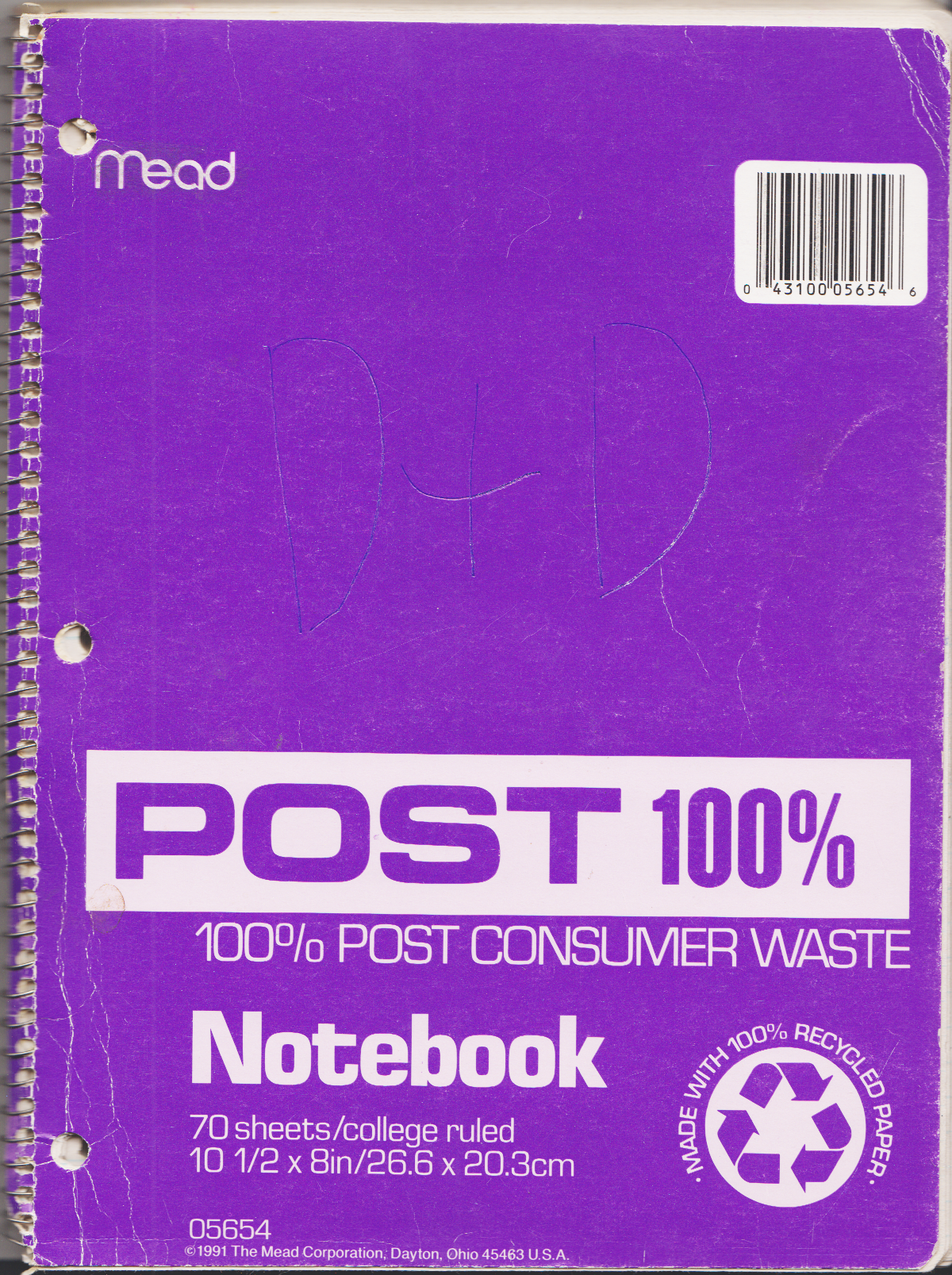
    I was excited to get the books and magazines, but the first thing I opened was the spiral notebook, on the cover of which were scratched the letters “D+D”.

    It’s a peculiar, and brief, notebook. I might need a little help prizing out its secrets.

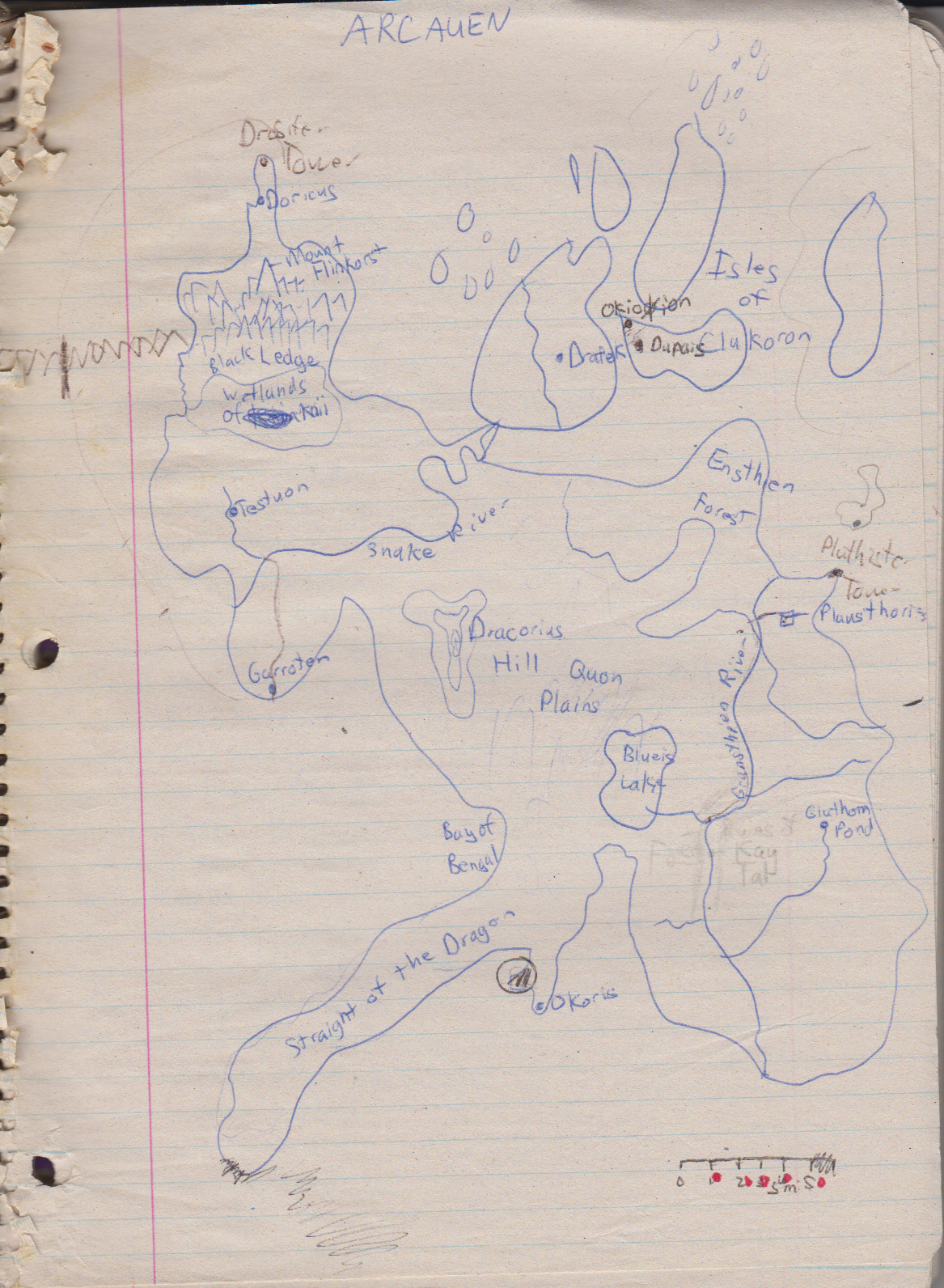
    It starts very strong, with an awesome map of a land called ARCAUEN:

    There are so many kickass names here, including, but not limited to, Drosifer Tower… Doricus… Isles of Clakoron… Drafek…Okioxion… Mount Flinkorst… Garroten… Dracorius Hill… Blueis Lake… Bay of Bengal… Straight of the Dragon. It’s like an episode of He-Man, in the best possible way. My favorites have to be Bay of Bengal – yeah, it is an awesome name for a bay, even if it is real! and Straight of the Dragon. Straight of the Dragon isn’t even a strait – it’s a peninsula. Spotmarkedx suggested that the world of Arcauen is two dimensions, which you can traverse with the right spell: an island, in which the Straight is a peninsula, and a landlocked sea, in which the Straight is – well, still not a strait, actually. Maybe some sort of bay. Anyway, a good idea.

    Other locations of note: Black Ledge, which protects Drosifer Tower, the home of (I suspect) the greatest evildoer of the campaign, and Plathister Tower, where good wizards weave great magics using the poetry of Sylvia Plath. That’s just a guess.

    The other interesting thing about this map is the scale: it’s not a continent, as I first thought, but a pretty small island. It’s maybe 30 miles across – approximately the same size as Mauritius. There are a lot of great locations packed together pretty tightly here.

    On the next page, we have an Encounter Table!
    Read the rest of this entry »

    literary source of the brooch of shielding?

    April 27th, 2012

    The Brooch of Shielding (which absorbs 101 HP of Magic Missile attacks) was useful in early D&D editions, when evil wizards filled so many slots in the wandering monster tables and when there were so few low-level attack spells. By third edition, with the proliferation of monsters and spells, it was significantly less so. I bet that during the run of third edition, nobody’s Brooch of Shielding ever took 101 points of Magic Missile damage.

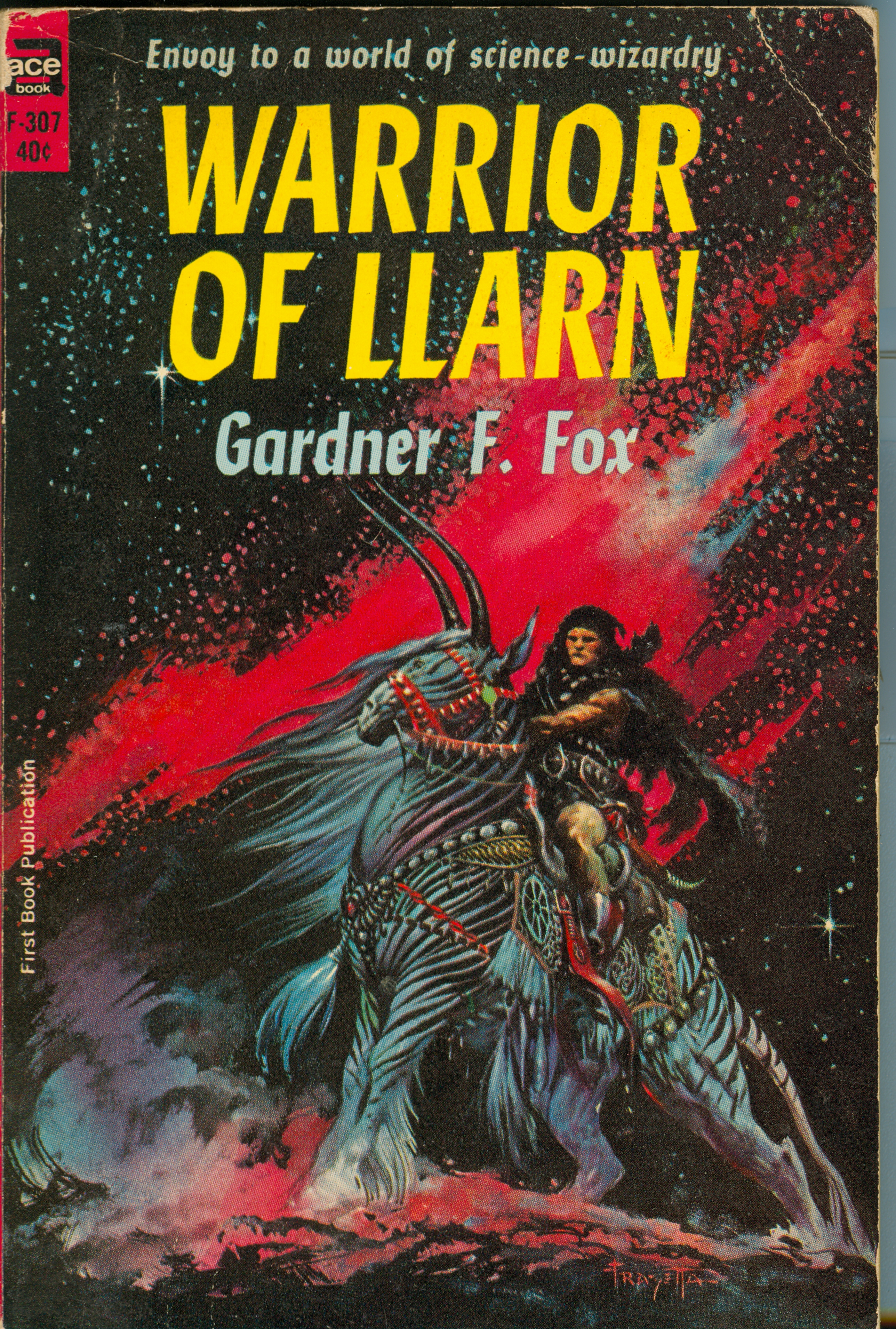
    It’s not necessary to posit a specific literary model for the Brooch of Shielding: it’s not too hard to come up with an item that protects against missile attacks. Still, here’s a plausible literary source: a passage from Gardner F. Fox’s 1964 Warrior of Llarn, written by an author Gary Gygax admired (and who is part of the Appendix N pantheon) at a time when Gygax was reading practically all the sci-fi and fantasy that came out.

    The Llarnians carry ornaments on them – the medallion on a chain was such an ornament – that counteract the deadly efficiency of the red needle beams. These roundels perform somewhat the same service to their wearers as do lightning rods on earth. Their peculiar metal absorbs the awesome power of the red rays as soon as they come within a foot of anyone wearing them.

    I take the Brooch of Shielding’s 101-HP maximum to be a game balance thing; and I’m not sure what to make of the strange specificity of its description: “The Brooch of Shielding appears to be a piece of silver or gold jewelry, usually (90%) without gems inset.” I guess sometimes you just like to roll a d100.

    look what i got in the mail

    April 25th, 2012

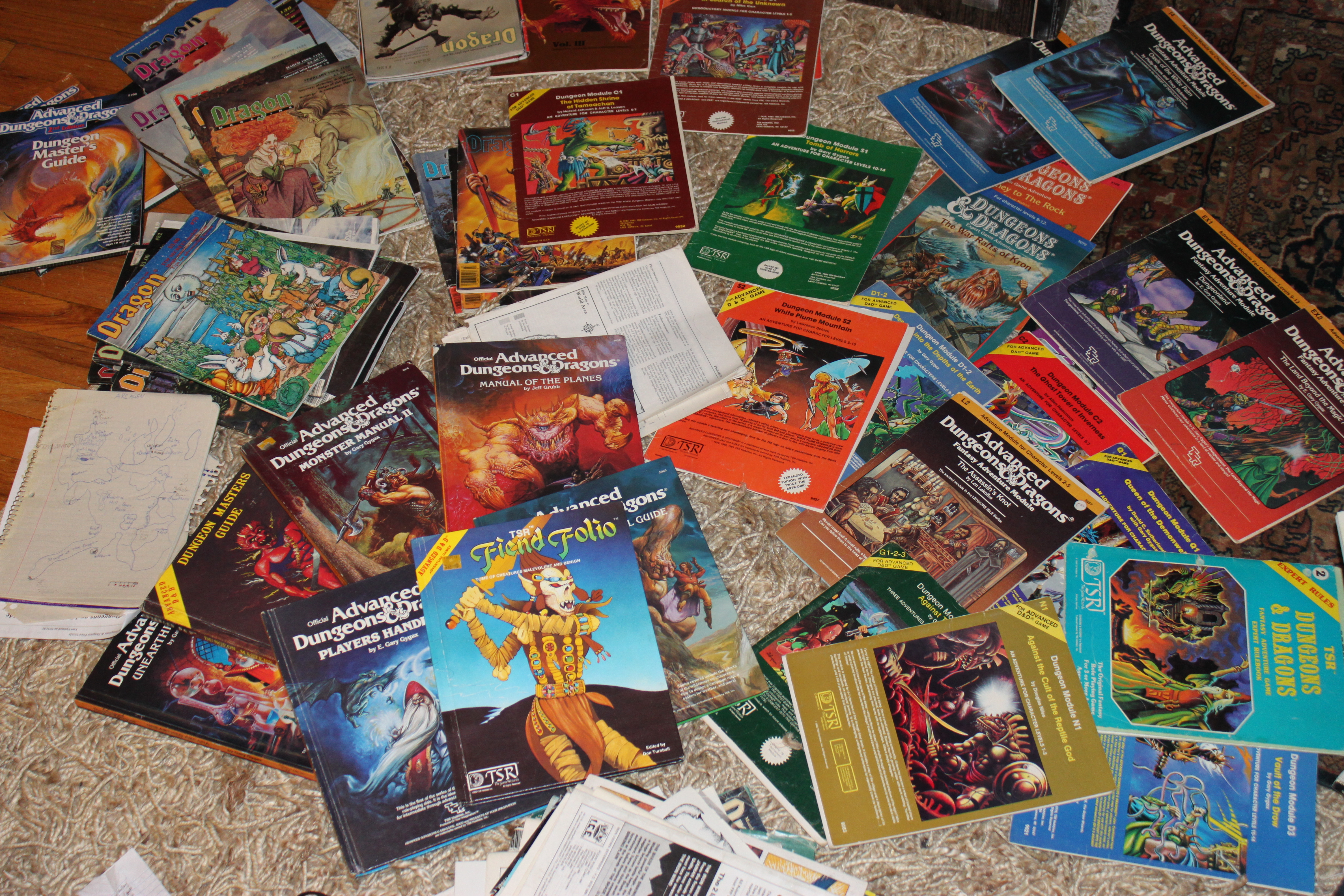
    A friend of my wife’s said, “My dad has a giant box of D&D stuff in the basement. A friend of his gave it to me but I never played it. Do you want it?” Casually flicking some invisible cigarette ash off my perfectly-creased lapel, I murmured, “sure, if it will help him clear out his basement.”

    I got the box in the mail today – a banker’s box filled with 45 pounds of Dragon magazines, books, and modules. Here’s the haul.

    The previous owner of this stuff seems to have been playing D&D right before I got into it. His Dragon Magazine collection goes from #87 to around #140, overlapping with mine for a few issues. He has the same hardcovers I had as a kid – I never re-acquired most of them, and I’m glad to see them back.

    What’s really new to me is the modules. As a D&D-playing kid in the 80s and early 90s, I never had a single module. For years, I’ve heard people talk with bated breath about their experiences playing Against the Giants, In Search of the Unknown, Vault of the Drown, Descent into the Depths of the Earth, Isle of Dread, Ghost Tower of Inverness, and the rest. I’m excited to read them.

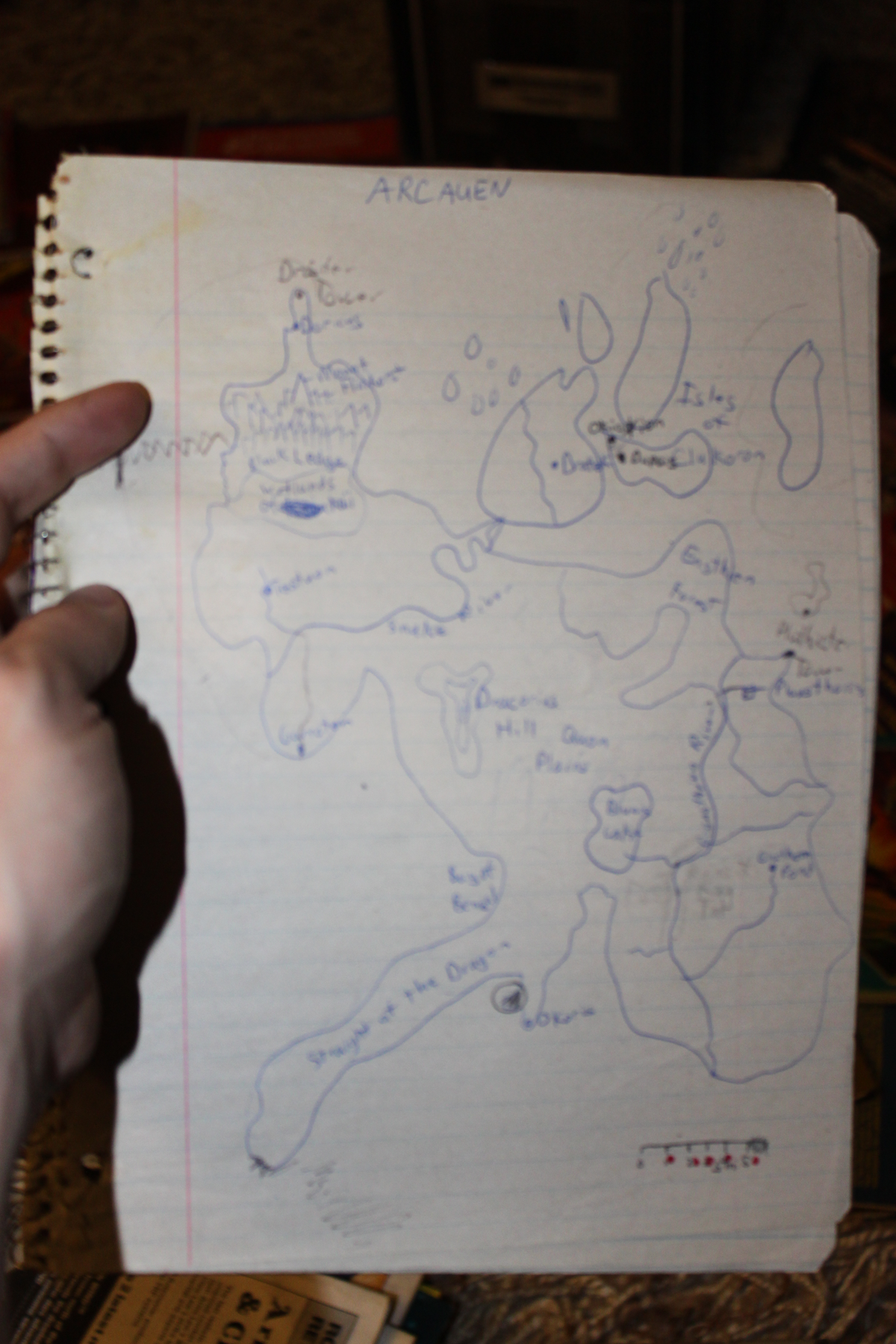
    Finally, the original owner’s D&D notebook and a few characters are in the box. Check out this sweet world map:

    It would be totally great to share this random 80’s kid’s campaign world. Next stop: Arcauen!

    Besides Arcauen (obviously), what should I read first?

    try an easy rpg: d4 basic

    April 23rd, 2012

    I’m a big fan of easy D&D, which means, for me, two things: “easy for the dm to prep” and “easy to explain to a first-time player”.

    For me, the ideal prep for a game involves brainstorming a few characters and gimmicks. My DM notes generally look like this: “whenever the PCs search a house, they have a 1 in 3 chance of finding the black-handled knife. Whoever owns the house is the witch.” and I never get around to looking up the Night Hag stat block.

    I’ve also played a lot of D&D with first-time players, and the more rules they need to learn before they start playing, the more ashamed I feel for wasting their time. I think the ideal situation for a new player is to choose between a few pregens of recognizable archetypes, each of which has a couple of cool, simple attacks.

    Experienced players should have lots of customization options, but experienced players can look after their damn selves.

    I’ve been trying a playtest version of Jason Hurst’s d4 Basic game. It’s sort of a D&D-style RPG/board game which takes the “easiest” elements from each. From the RPG corner, it keeps the idea of the game master who makes judgment calls and referees actions outside the rules. From the Descent-style board game corner, it uses pregen characters and scenarios, clockwise play, and win conditions. The result is a rpg manual that’s about 7 pages long: and actually, when you subtract art, table of contents, and the usual “what is an RPG and “what are dice” sections, it’s probably 3 or 4 pages of rules. There’s more text in the scenarios, treasure cards, and so on, but it’s still probably 1/4 of the length of the Descent rules and a tiny fraction of the length of any D&D edition. You could play it with zero prep, and you could probably have a RPG n00b run the thing.

    D4 Basic is in open beta right now.

    playing D&D with mike mornard: better to be lucky than good. third best: be amusingly incompetent

    April 20th, 2012

    Last time I played D&D in Mike Mornard’s campaign was over a month ago, and I never got around to describing the game. I’ll see what I can remember now. I should have detailed it at the time, but my kickstarter’s taken up all of my time for the past month or so.

    I took a look at my last “D&D With Mike” blog post to refresh my memory, and found this interesting passage:

    When TSR printed 1000 copies of D&D, Mike said, people thought they were crazy to print so many. Today I feel an especially strong kinship with the guys at TSR, because my D&D poster kickstarter is driven by very much the same sort of loving pastiche, [although] I’d be crazy to expect to sell 1000 of my posters.

    Since I wrote that, I sold 1000 posters! I am officially as good as TSR! Right??

    OK, maybe not. I think my kickstarter’s success was one of those freaks of fate. But hey – it’s better to be lucky than good. And, best of all, my good luck means labor for Mike Mornard, since I convinced him to provide a dungeon as a kickstarter stretch goal.

    On that note, here’s what happened in that month-ago D&D game in Mike’s dungeon:

    I’ve mentioned before that in Mornard’s game, some of the dungeon’s denizens are significantly more powerful than we are. A few sessions ago, when we crept into a dungeon room and saw an unarmed old man scribbling away at a desk, I was terrified. I was convinced that this was one of those guys you don’t want to mess with.

    Last session, the group convinced me that we should at least go TALK to the guy. Somehow my 11 Charisma makes me the party negotiator, so I walked down the long, straight corridor to his study (thinking all the while about my chances to evade a lightning bolt in such a place). I cleared my throat nervously, and started babbling about how one rarely gets a chance to find such civilized company in the dungeon, and were there any errands we could run for him in town?

    Our host introduced himself as Necross the (ha ha ha!) Mad. (As well as a dweller in the dungeon, he seems to be a character from the late 70s Cerebus comic.) Necross did have a quest for us: he wanted us to pick up some pipe tobacco in town next time we were in the area. OK, as quests go, that one sounded like it was within the capabilities of second- to third-level characters.

    He also offered us a unique moneymaking opportunity. He had access, he said, to a private entrance to a rich part of the dungeon. He’d show us the entrance for a nominal fee of only 100 gold pieces.

    This sounded a lot like the beginning of a confidence scam, but we decided to take the risk. It was only 100 gold pieces, after all.

    Necross summoned a djinn and gave him a command. The genie summoned a set of wooden stairs that climbed to a doorway high on the wall of Necross’s chamber.

    We weren’t sure what to make of this. Everyone knows that lower dungeon levels were more dangerous: what do you make of a dungeon level that’s higher than level 1? One thing we all agreed on: we were glad we had talked to Necross, and not gone in swords a-blazing. Any wizard powerful enough to command djinn was probably a match for a ragtag group of low-level PCs, bandits, and muleteers.

    We climbed the stairs and ventured into the new section of the dungeon. Somewhat to my surprise, we found that Necross had played straight with us about the richness of the treasure. We lost a character to monsters, but found a bunch of treasure, including a piece of jewelry worth 1000 or so gold.

    With our loot and our fallen companion burdening our mule, we returned to Necross’s chamber. And that’s where we hit the “if I was smarter, I would have seen this coming” moment that I’ve experienced a few times in Mike’s game. No doubt you know exactly what’s coming, but hey, I’m not as smart as you.

    Read the rest of this entry »